

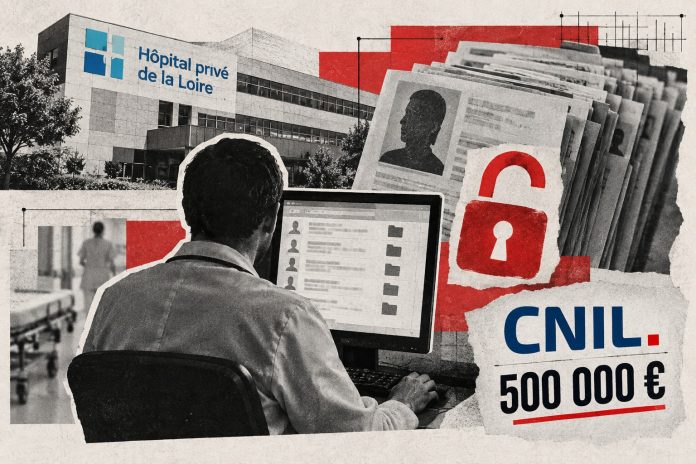
Healthcare institutions account for 19% of data breaches reported to the CNIL, making them the second most affected sector after public administration. Electronic health records are particularly vulnerable as they consolidate all known information about patients into a single database. In the summer of 2025, a cyber intruder accessed the private hospital of Loire, compromising the data of 524,867 individuals without triggering any alerts. As a result, the CNIL imposed a fine of 500,000 euros on the institution.
Following a security incident, the outcome of a CNIL sanction hinges on two key factors: the preventative measures the organization had in place prior to the attack, and the steps taken after the breach was discovered. The latter aspect often receives less scrutiny, despite its critical role in determining how affected individuals can manage the information owed to them. The CNIL’s restricted formation convened on July 21, 2026, with the decision publicly announced on September 3, targeting the healthcare facility under Articles 32 and 34 of the General Data Protection Regulation (GDPR).
In 2025, the CNIL issued a staggering 486 million euros in fines—nearly nine times the total penalties imposed the previous year. The agency’s restricted formation now routinely publishes its decisions with the names of the entities involved. Healthcare remains one of the most exposed sectors, with attacks primarily aimed at software providers and large sector-specific databases, rather than individual workstations. An electronic health record system centralizes patient admission, stays, reports, and prescriptions, serving as a common reference for all teams within a facility. This centralized nature increases the potential damage in the event of unauthorized access.
A single account opened access to all records
The facility allowed external access without either a Virtual Private Network (VPN) or multi-factor authentication—meaning a stolen password could suffice for unauthorized entry. An attacker only needed a single phished or brute-forced credential to enter the system, requiring no advanced skills to breach security.
Furthermore, access rights were not adequately compartmentalized. The CNIL pointed out that there were no restrictions based on healthcare teams, allowing a single account to access the entire database. Consequently, both a night intern and an administrative manager had access to the same patient records, enabling the attacker to exploit this breadth of access along with the compromised credential. Implementing service-based access restrictions does not require expensive technology; rather, it necessitates an administrative effort that many institutions deem cumbersome due to their centralized structures.
Additionally, there was no oversight of how these rights were being utilized. The CNIL noted the absence of any mechanisms capable of detecting “suspicious activity in real-time or shortly thereafter,” a statement underscoring the need for both immediate alerts and swift reviews. An account belonging to a healthcare worker accessing hundreds of records in one night would leave an easily identifiable trail, assuming someone or something is monitoring those logs.
Trusted third parties received no notifications
The breached database included not only patients but also the contact details of 202,246 trusted third parties—individuals designated by patients to be informed or consulted when they can no longer make decisions. These individuals are not patients of the facility and often have no prior relationship with it beyond their names and numbers being entered on admission forms.
The hospital did notify its patients about the breach but failed to directly inform the trusted third parties. This lack of communication is what Article 34 penalizes. The CNIL determined that these individuals were deprived of the understanding necessary to grasp the implications of the breach, and consequently, to protect themselves from potential misuse of their contact details.
This oversight warrants attention from management teams responsible for databases containing indirect contacts, a concern that extends beyond the healthcare sector. Insurance beneficiaries, emergency contacts for workplace accidents, guarantors for leases, and emergency contacts do appear in business applications without ever being clients. The obligation to inform does not follow the commercial relationship; it follows the data.
Compliance upgrade spans over a year
The restricted formation attached timeframes ranging from three to fifteen months for the implementation of security enhancements. The difference between these two timeframes offers insight into the nature of the tasks involved—three months corresponding to measures that can be easily applied to existing infrastructure, while fifteen months implies a comprehensive overhaul of a central application’s access rights model.
The timeline of the decision is also noteworthy. Six weeks elapsed between the deliberation on July 21 and its publication on September 3, during which the institution worked on measures that the CNIL considered when determining the fine. Consequently, an IT department discovering a public sanction would find itself reading an evaluation that is already outdated, to the advantage of the penalized organization rather than at its expense.
Finally, the ruling leaves an open question for other institutions. The value of electronic health records lies in their consolidation, a principle not challenged by the fine, which targeted the methods of access rather than the concept of centralization itself. Thus, the CNIL sanctioned the lack of checks and balances, not the framework that necessitates them.



