

MuleSoft Enhances AI Oversight with F5’s Guardrails Integration
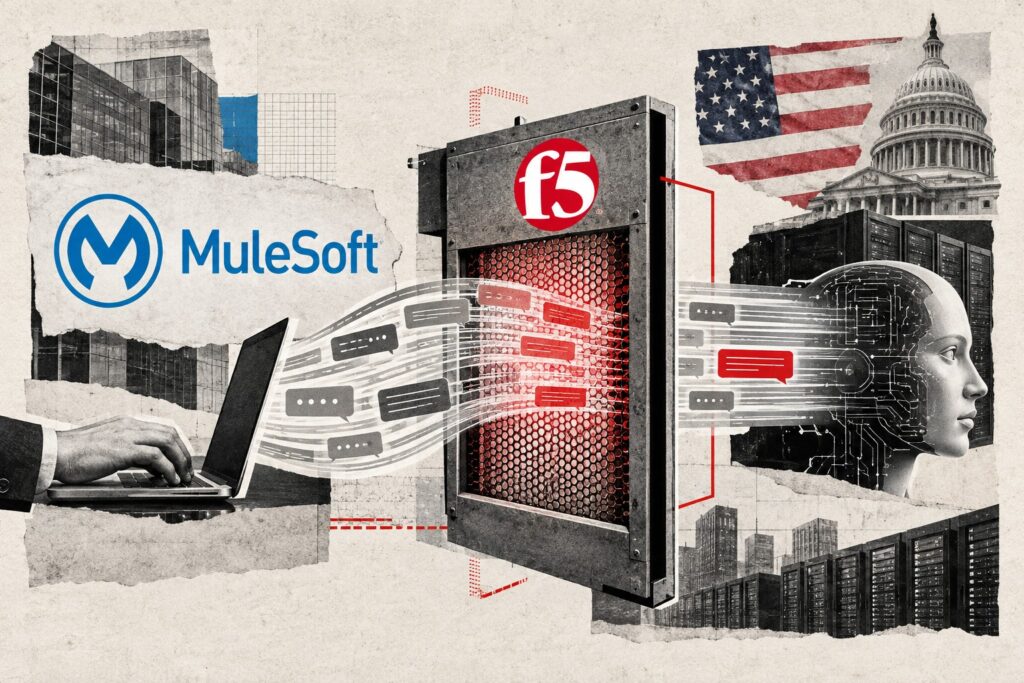
MuleSoft has expanded its Agent Fabric, a layer for orchestrating agents, to incorporate F5’s AI Guardrails for prompt and response inspection. This new functionality processes requests within the Omni Gateway, eliminating the need for businesses to deploy an additional proxy or depend solely on native controls. Both companies operate under U.S. jurisdiction, and hosting data on client premises does not alter this legal framework.
As organizations increasingly deploy AI agents at scale, there is a growing concern that model traffic may circumvent security measures intended for applications. When security teams lack visibility into this traffic, they become unable to detect prompt injections or prevent sensitive data leaks in outgoing requests. On September 7, MuleSoft announced enhancements to its model interfaces and AI services within Agent Fabric, enabling integration with F5’s inspection component, AI Guardrails.
Salesforce first introduced Agent Fabric in September 2025 as a coordination layer for its agents and those from other vendors. It features an agent registry, task broker, governance module, and interaction visualizer. IT Social previously discussed this launch from the perspective of multi-agent orchestration, highlighting the ongoing competition for control among various stakeholders. The integration primarily modifies the functionality of the Omni Gateway, which directs calls to models.
Inspection on the Call Path
The Omni Gateway now directs model calls to F5’s analysis interface, which scrutinizes incoming prompts prior to engaging the model and evaluates outgoing responses before reaching the requester. This real-time analysis distinguishes it from traditional monitoring, which only detects anomalies post-factum.
The inspection encompasses potential prompt injections, attempts to bypass model instructions, toxic content, unauthorized subjects, and exposure of personal data. F5 claims to enhance its database with over 10,000 attack patterns monthly, though it does not specify how this metric is calculated. Furthermore, the announcement comes without data on detection rates or false positives, raising concerns about legitimate requests being erroneously blocked by an overzealous real-time control.
Security teams can configure this control via the F5 console, managing analyzers, blocklists, and sensitivity thresholds without requiring code modifications on the MuleSoft side. Each action generates a trace and a shared analysis ID across both consoles, providing security operation centers with the information necessary to correlate specific blocks with their pertinent calls.
Eliminating the Double Proxy
Previously, organizations using Agent Fabric that wished to integrate F5’s guardrails had to choose between two costly configurations. The first option involved routing traffic through a separate F5 inspection layer, adding a network hop and fragmenting telemetry across two systems. The second option relied solely on native gateway controls, neglecting to implement F5’s policies within MuleSoft-managed flows.
The Omni Gateway consolidates these two setups into a single control plan, which is the primary value proposition of this announcement. The telemetry is no longer fragmented, allowing for more streamlined incident investigations. Agents built on Agentforce, chains managed by Agent Fabric, and AI applications developed by clients will all follow the same security policies.
Kunal Anand, F5’s product director, emphasized the importance of bridging the gap between agent deployment and governance adaptation. Andrew Comstock, vice president and general manager of MuleSoft, linked the initiative to their platform, noting that teams have enhanced existing model interfaces and AI services within Agent Fabric to support F5 as a tier-one guardrails provider. He described Agent Fabric as a neutral layer, open to agents from various vendors and models. This claimed neutrality will be tested based on the number of security providers receiving equal treatment.
Client Hosting Maintains Jurisdiction
F5 highlights a dual deployment topology, including a self-hosted Kubernetes deployment within the client’s virtual private cloud, ensuring that prompt and response content remains within their control. This response addresses valid concerns since an inspection mechanism inherently accesses all submissions to models.
As a publicly traded American company and a subsidiary of Salesforce, F5 operates under U.S. law which poses jurisdictional questions, irrespective of data hosting locations. While deploying solutions within the client infrastructure can reduce exposure, it does not exempt either the publisher or its software components from U.S. laws.
F5 provides policy frameworks aligned with GDPR, HIPAA, EU AI regulations, and card payment standards. These frameworks offer technical controls and actionable audit trails to support compliance efforts but do not establish compliance guarantees. Legal teams preparing documentation under EU regulations may find useful auditing materials, but not certification.
The timeline for the availability of these mechanisms and associated costs remains unspecified by either F5 or MuleSoft. Security leaders evaluating this integration will need answers to three critical questions: When will the features be available? What will the billing structure be for online analysis? And how will the system respond if the analysis interface is unresponsive since all model calls will now route through it?



