

iPhone 18 Pro: The A20 Pro in 2 nm Promises a Significant Leap in Efficiency, But the Numbers Remain to be Confirmed
Apple is set to debut TSMC’s 2 nm process with the A20 Pro in the upcoming iPhone 18 Pro and iPhone Ultra. A recent leak suggests up to an 18% increase in performance and a 30% reduction in power consumption compared to the A19 Pro.
These figures seem credible in scale, but they still mix TSMC’s official data with unverified projections on Apple’s chip.
The A20 Pro could represent a major leap in chip fabrication
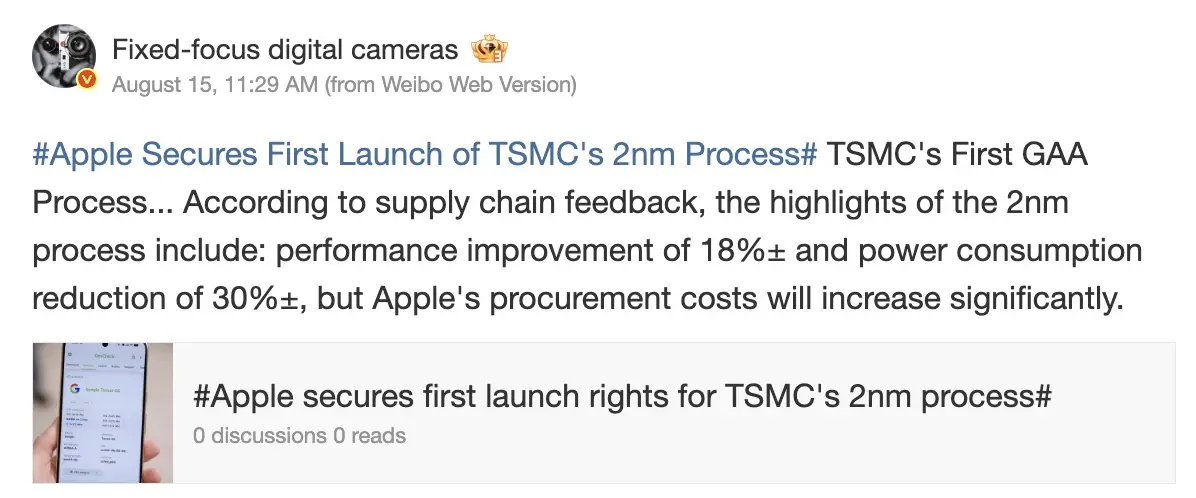
The next high-end processor from Apple might signal a more significant transition than recent changes. According to leaker Fixed Focus Digital, the A20 Pro for the upcoming iPhone 18 Pro and iPhone Ultra is set to be manufactured using TSMC’s N2 process, marking the first 2 nm generation from the Taiwanese foundry.
The leak mentions two particularly ambitious figures: an increase of up to 18% in performance and around 30% in energy efficiency compared to the A19 Pro. At this point, Apple has not confirmed the A20 Pro, its specifications, or even the precise models that will utilize it.
However, the move to N2 aligns perfectly with TSMC’s public roadmap.
TSMC officially promises a 10 to 15% increase in performance
It is essential to differentiate what is confirmed from what is based on leaks. For its N2 process, TSMC officially announces a 10 to 15% increase in performance at the same power consumption compared to its N3E.
Conversely, the company mentions a reduction of 25 to 30% in power consumption at identical performance levels. The logical density also improves, enabling more transistors to be integrated into a comparable area. These figures do not imply that the A20 Pro will automatically be 15% faster while consuming 30% less.
A chip designer must decide how to utilize the gains provided by the new process: higher frequency, more transistors, lower consumption, or a balance between these parameters.
Thus, Apple has a significant degree of flexibility.
The 18% figure for the A20 Pro remains a leak
The 18% figure cited by Fixed Focus Digital slightly exceeds the official speed gains communicated by TSMC for the process change alone. While this is not inconsistent, Apple could also enhance the CPU architecture, caches, GPU, or various specialized blocks between the A19 Pro and A20 Pro. The final performance gain of a chip never relies solely on its fabrication process.
However, it is still impossible to state that the A20 Pro will indeed be 18% faster. Currently, we lack reliable benchmarks, definitive frequencies, or official data from Apple. Therefore, this number must be treated as an estimate from a leak rather than a manufacturer promise.
The 2 nm technology primarily introduces GAA transistors at TSMC
The most significant architectural change of N2 occurs at the transistor level. For the first time in its advanced process, TSMC is abandoning the FinFET structure in favor of GAA nanosheet transistors, meaning Gate-All-Around. In a FinFET transistor, the gate controls the electrical channel from multiple sides of a vertical structure. With GAA, the gate surrounds the nanosheets comprising the channel more completely.
This geometry allows for more precise electrostatic control.
Practically, it helps reduce electrical leakage while facilitating performance increases at very small fabrication scales. For smartphones, where every watt quickly turns into heat, this change is particularly significant.
Energy efficiency could be the key selling point for the iPhone 18 Pro
Therefore, the most intriguing figure may not be +18%. It might be -30% in consumption at equivalent performance levels, which aligns precisely with the maximum announced by TSMC for N2 against N3E. A smartphone has a very limited thermal envelope. Unlike a laptop, it cannot freely increase its power consumption to maintain high speeds.
Every improvement in efficiency allows either for increased autonomy, sustained performance for longer, or more leeway for other components.
Apple may very well allocate some of the N2 gains to avoid temperature spikes rather than chasing the highest benchmark.
Real progress might be more noticeable after twenty minutes than after twenty seconds
This is a point often overlooked in mobile processor comparisons. Achieving peak performance is relatively straightforward. Maintaining it is much more challenging. A SoC can deliver excellent results during a short benchmark, then throttle its frequencies when temperatures rise. This phenomenon is called thermal throttling. If the N2 technology enables the A20 Pro to be more efficient under identical loads, Apple could sustain higher power levels longer without exceeding the iPhone’s thermal limits.
In gaming, video editing, intensive AI computations, or demanding photography, this behavior might be more significant than a small increase in peak performance.
The WMCM packaging could be equally strategic
The manufacturing process may not be the only innovation. Several leaks also discuss the adoption of WMCM packaging, or Wafer-Level Multi-Chip Module. This design aims to bring the logic chip and memory closer together in the same assembly. This type of architecture could shorten electrical distances, enhance memory access, and allow for greater thermal placement freedom for components.
Recent information even suggests that the production of the A20 Pro could be more dependent on the availability of DRAM due to this new packaging.
Although Apple has yet to confirm anything officially, multiple sources are converging toward this assembly change.
Integrating more RAM could improve sustained performance
The placement of memory has a significant impact. Modern mobile processors constantly move large amounts of data between the CPU, GPU, NPU, and system memory. Reducing latency or increasing bandwidth can enhance performance even without significantly raising CPU frequency.
This is especially true in AI-related tasks, where models handle vast parameters. Therefore, Apple may aim with WMCM not only to save space but to create a more efficient memory system for future local AI functions.
The LPDDR6 with a 96-bit bus remains highly speculative
Some leaks go even further, discussing a transition to LPDDR6 with a 96-bit memory interface, compared to 64-bit previously. On paper, the potential bandwidth gain would be considerable. However, caution is advisable here. Apple sometimes adopts new memory generations with some delay relative to their theoretical availability.
Moreover, there is currently no official documentation confirming this configuration for the A20 Pro. The hypothesis is technically plausible, but it is not solid enough to be regarded as an assured feature of the iPhone 18 Pro.
A higher bandwidth would directly benefit local AI
If Apple does choose to implement a wider memory bus, the purpose might extend beyond merely benefiting the GPU. Locally executed AI models are highly sensitive to memory bandwidth. A more powerful Neural Engine offers little value if the data cannot be fed to it quickly enough. A 96-bit interface could thus accompany an increase in the size of models run on the device.
This aligns with a broader industry trend: the smartphone is progressively becoming a small autonomous inference platform. The SoC, RAM, and packaging must then be designed as a unified system.
The A20 Pro could focus more on efficiency than on record-breaking performance
The early figures are promising, but still too incomplete to declare a winner. TSMC already guarantees a significant leap on paper with N2: up to 15% more performance or 30% less consumption, depending on the operating point.
The leak surrounding the A20 Pro adds an even more ambitious scenario with +18% performance, the WMCM could enhance memory integration, and the LPDDR6 could significantly boost bandwidth. However, several pieces of this puzzle remain unconfirmed. Ultimately, the real value of the iPhone 18 Pro could be less about spectacular benchmark scores and far more about practical utility.
After years where mobile chips primarily pursued speed, moving to 2 nm may enable Apple to achieve something more challenging: maintaining that power without converting more energy into heat.



