


Snapdragon 8 Elite Gen 6 Pro: a preliminary AnTuTu benchmark nears 4.84 million points
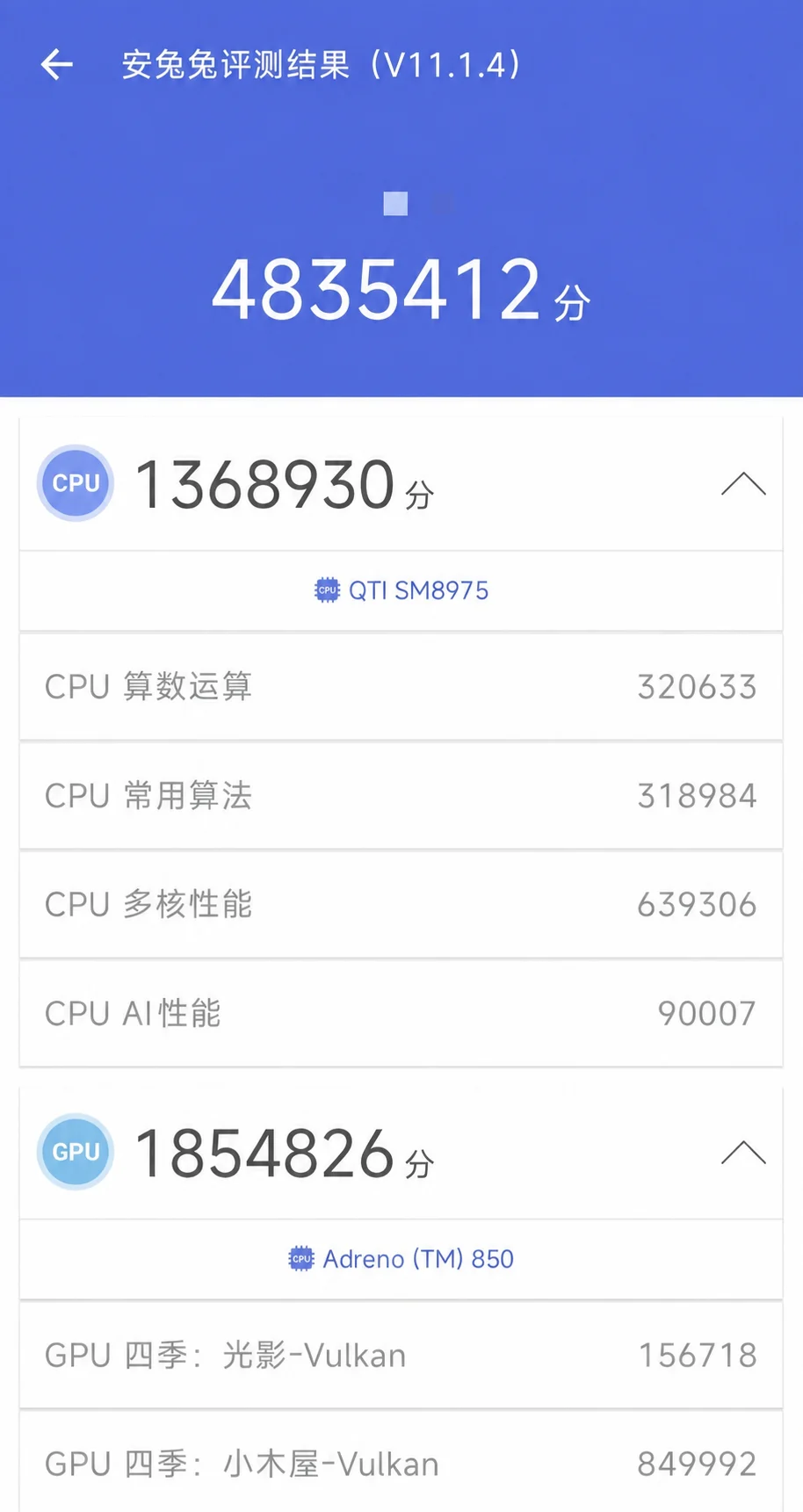
Qualcomm has yet to officially announce its next high-end mobile platform, but the Snapdragon 8 Elite Gen 6 Pro is already making waves with its power. A screenshot attributed to AnTuTu shows it scoring nearly 4.84 million points with a chip identified as SM8975, featuring an Adreno 850 GPU. This is an impressive figure, but its authenticity remains to be validated.
Snapdragon 8 Elite Gen 6 Pro Appears on AnTuTu
The upcoming battle for Android performance may have already begun. A screenshot shared by leaker Digital Chat Station displays what is believed to be the first run of the Snapdragon 8 Elite Gen 6 Pro on AnTuTu V11.1.4.
The chip, identified as SM8975, reportedly scores 4,835,412 points.
The benchmark details are equally impressive:
- CPU: 1,368,930 points
- GPU: 1,854,826 points
The graphics component is identified as an Adreno 850, suggesting a next-generation GPU from Qualcomm aimed at premium Android smartphones for 2026 and 2027. On paper, this could be one of the fastest mobile chips ever tested on this version of AnTuTu. However, there is a caveat.
AnTuTu Cannot Retrieve the Result from Its System
This screenshot should be taken with caution. AnTuTu has reportedly stated that the corresponding score could not be retrieved from its backend. This detail considerably weakens the credibility of the leak. A score truly recorded by the application would normally leave traces that allow verification of the configuration, software version, and other details related to the device.
Its absence does not automatically mean the screenshot is fabricated. An internal prototype could indeed operate under specific conditions, using development software or systems that prevent certain data from being recorded.
However, until an independent validation occurs, 4,835,412 points should remain an indicative figure rather than a confirmed performance for the Snapdragon 8 Elite Gen 6 Pro.
About 6% Better Than Current Top Snapdragon Models
If the result is genuine, the improvement would be relatively modest compared to the fastest smartphones using the Snapdragon 8 Elite Gen 5. Some current models already exceed 4.5 million points on AnTuTu V11. Thus, the score attributed to the new chip would represent roughly a 6% to 7% lead in the overall benchmark. This is much less spectacular than one might expect from simply crossing the 4.8 million threshold.
That said, this comparison also requires caution.
AnTuTu scores aggregate several components: CPU, GPU, memory, and user experience. A relatively modest overall score increase may mask much larger gains in specific areas.
Here, the GPU score of 1.85 million is particularly noteworthy.
The Adreno 850 Could Be the True Engine of This Generation
Qualcomm has made the GPU a cornerstone of its high-end Snapdragon platforms. The currently marketed Snapdragon 8 Elite Gen 5 already relies on a particularly robust graphics architecture, especially for gaming, ray tracing, and heavy graphical loads. If its name is confirmed, the new Adreno 850 could continue this strategy.
With nearly 1.86 million points in the graphics section of AnTuTu, it would represent a significant portion of the overall score.
This could enable future smartphones to better utilize high refresh rate displays, handle more demanding Android games, and leverage Qualcomm’s image generation and upscaling technologies. However, in the mobile realm, maximum power only constitutes half of the equation.
The other half is consumption.
The Move to 2nm May Be More Significant Than the Benchmark
Leaks surrounding the Snapdragon 8 Elite Gen 6 have suggested for months a transition to a 2nm process. Qualcomm has yet to officially announce this generation or confirm its manufacturing process, but several industry sources converge on this evolution. This change may prove to be much more significant than a few hundred thousand additional points on AnTuTu.
A more advanced process typically allows for increased transistor density while improving the performance-to-energy consumption ratio. For a smartphone, this can translate in various ways: more power at similar consumption, similar performance with less energy, or a mix of both.
It is precisely on this front that the Snapdragon 8 Elite Gen 6 Pro must succeed.
Sustained Power Matters More Than Peak Performance
Mobile benchmarks can be misleading when viewed in isolation. A smartphone can achieve an exceptional score for a few minutes before significantly throttling its frequency due to heat. In practice, this behavior leads to much less impressive performance after a prolonged gaming or video rendering session.
Real progress for the Snapdragon 8 Elite Gen 6 Pro will therefore not be measured solely by its top score on AnTuTu. Its ability to maintain performance over time must also be assessed. A chip that is 6% faster on a benchmark but 20% more stable after thirty minutes of gaming would represent a far more significant advancement than merely increasing the peak score.
SM8975 for the Pro, SM8950 for the Standard Model
Currently available information also suggests that Qualcomm may continue to segment the very high-end market. The designation SM8975 is associated in various leaks with the Snapdragon 8 Elite Gen 6 Pro, while the standard Snapdragon 8 Elite Gen 6 may be linked to the number SM8950. This distinction remains unofficial. Qualcomm currently only lists on its public catalog platforms that have already been announced, including the Snapdragon 8 Elite Gen 5, identified under the SM8850 family.
If two different chips indeed launch this year, Qualcomm could further enhance market segmentation in the premium Android landscape. The best silicon would not necessarily be present in all flagships.
A “Pro” Strategy That Could Change the Android Market
This hypothesis would have significant implications. Until now, manufacturers purchasing high-end Snapdragon chips for any given year could offer relatively similar performance, with differences largely stemming from cooling solutions and software optimization. With a distinct Pro version, Qualcomm could provide a superior platform reserved for the most expensive devices.
A Xiaomi 18 Ultra — if it indeed exists — an Honor Magic 9 Pro Max, or a future gaming model could then benefit from a hardware advantage that more mainstream flagships would lack. This approach would also allow Qualcomm to increase the average value of its most powerful chips.
However, this would make the lineup even more complex for consumers.
Honor is Already Preparing Its New Generation for September 28
Honor has confirmed that its next Magic 9 family will be unveiled in China on September 28, 2026. However, the company has not specifically confirmed which Snapdragon will equip each model. Current leaks suggest a multi-tiered strategy. The Magic 9 standard may retain the Snapdragon 8 Elite Gen 5, while some Pro models would utilize the next-generation Qualcomm chip.
This would enable Honor to differentiate its devices more distinctly while controlling their prices. However, the specific presence of the Snapdragon 8 Elite Gen 6 or its Pro variant remains to be confirmed.
Xiaomi Might Beat Honor to the Punch
Honor may not be the first manufacturer to use this new platform. Several rumors indicate that Xiaomi might unveil its Xiaomi 18 series before September 28, potentially allowing it to once again claim one of the first commercial launches featuring the new Snapdragon chip. This scenario aligns with the historical relationship between Xiaomi and Qualcomm.
The Chinese manufacturer has consistently utilized new high-end Snapdragon chips shortly after their announcements. However, both Qualcomm and Xiaomi have yet to confirm this timeline. The end of September could, therefore, become quite hectic for the Android ecosystem.
AnTuTu Scores Reveal Little About Actual Experience
It is also crucial to place the 4.84 million points in context. An improvement in AnTuTu does not guarantee that a user will experience their smartphone opening Instagram 6% faster. Current high-end devices are already exceptionally quick for everyday tasks.
The benefits of new generations thus shift toward more specific scenarios: prolonged gaming, photo processing, high-definition video, local AI tasks, heavy multitasking, and energy efficiency.
This is where Qualcomm needs to make a difference. For many users, an extra hour of battery life will likely hold more value than 300,000 additional points on a benchmarking app.
The 2nm Process Could Also Enhance Local AI Capabilities
The new process may also benefit AI-related tasks. Qualcomm has pushed for several generations the execution of AI models locally through its dedicated engine. A more efficient chip could potentially run heavier models without drastically increasing power consumption. This is becoming increasingly important as Samsung, Honor, Xiaomi, OPPO, and other manufacturers move certain generative functions from the cloud to the smartphone.
Summary documents, translations, photo processing, contextual assistants, or content generation could gradually become persistent computational tasks.
The next battle for Snapdragon supremacy will not only hinge on CPU and Adreno performance.
The Real Test Will Come with the First Commercial Smartphones
For now, the Snapdragon 8 Elite Gen 6 Pro remains shrouded in rumors. Qualcomm has not officially confirmed its name, reference SM8975, Adreno 850, or the 2nm process. The currently circulated AnTuTu benchmark has a significant anomaly, as it supposedly cannot be verified from the platform’s servers. It would therefore be premature to establish it as a new official standard.
Nevertheless, the leak provides an initial insight into what Qualcomm might be aiming for. Nearly 4.84 million points, with 1.85 million for the GPU, would position this chip slightly above the best current devices and open a new phase in the Android competition.
However, the real revolution may not necessarily stem from the displayed number.
If the transition to 2nm enables Qualcomm to combine more power, less heat, and better battery life, then the Snapdragon 8 Elite Gen 6 Pro could achieve something far more challenging than just breaking an AnTuTu record: enhancing performance without imposing a heavy energy cost on smartphones.



