

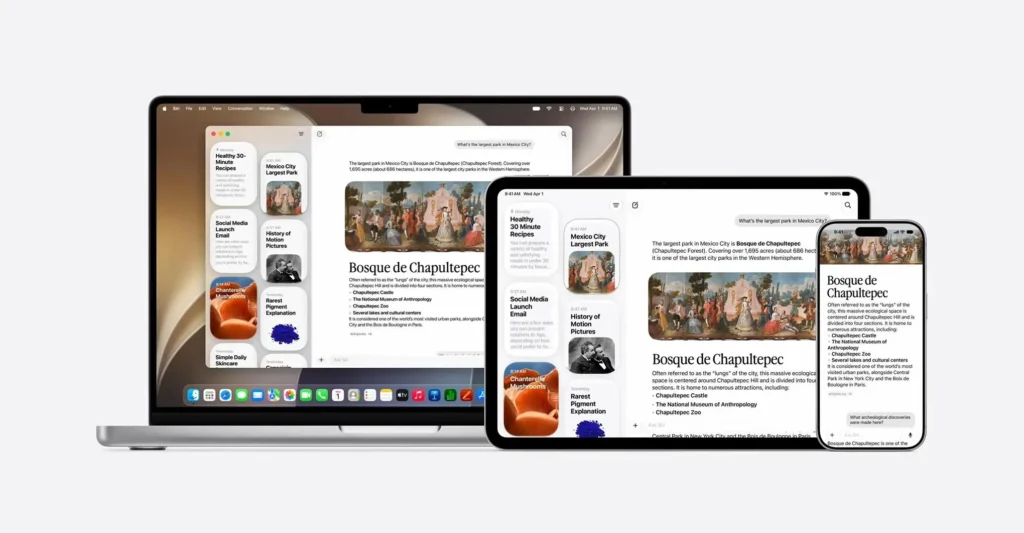
Apple wants to pay publishers to fuel the new Siri with their news
Apple is preparing for a significant transformation of Siri and aims to secure a vital resource for AI assistants: fresh and reliable information. According to The Wall Street Journal, the company is in talks with several publishers to use their content to enhance responses from its upcoming Siri, with a compensation model linked to how that content is utilized.
Apple Is Seeking Recent Content for Its New Siri
The new generation of Siri will not only need to better understand users but also be equipped to answer questions about recent events, an area where an assistant necessarily relies on regularly updated information sources.
As reported by The Wall Street Journal, Apple has approached various publishers in recent months to discuss the use of their content. The goal is to enable Siri to access up-to-date information and news, thereby improving the relevance of its responses.
These negotiations come as Apple has been working for several years to modernize its voice assistant in light of the rapid evolution of generative AI.
The new AI-enhanced Siri is expected to launch later this year, although the precise details regarding these potential agreements with media outlets are still being determined.
A Compensation Model Different from Traditional Licensing
The most interesting aspect concerns how Apple plans to compensate publishers. Instead of a traditional license that guarantees a fixed sum in exchange for broad access to a catalogue of content, Apple seems to propose a variable compensation system. This means that a publisher would be paid only when their content is actually used by Siri.
This approach closely resembles a pay-per-use model: the more frequently a media outlet’s information contributes to the assistant’s responses, the higher the potential remuneration.
According to the report, Apple has considered a budget of several hundred million dollars to fund these deals.
However, this framework could make negotiations particularly sensitive. For publishers, a fixed license provides immediate financial visibility, whereas an usage-based compensation requires clear definitions of what constitutes usage, how it is measured, and the value assigned to it.
Information Becomes a Strategic Raw Material for AI
These discussions extend far beyond Siri. Since the rise of generative assistants, the relationships between tech companies and publishers have become one of the key economic issues in AI. Models require vast amounts of knowledge, but assistants must also access recent information to answer questions beyond their training data.
For Apple, securing agreements with publishers could provide two significant advantages.
The first is obvious: improving the timeliness of Siri’s responses. An assistant that can conduct more research and actions becomes far more useful when it can rely on updated information.
The second relates to trust. Apple could favor an approach where the sources used are governed by commercial agreements rather than relying solely on open web indexing.
This strategy aligns with how the company traditionally builds its platforms: exerting more control over different components of the user experience rather than being entirely dependent on external resources that are hard to manage.
The Future Siri Must Catch Up with a Rapidly Advancing Market
For Apple, this challenge is especially pressing as Siri embodies the company’s ambitions in artificial intelligence. In the face of competitors like Gemini and ChatGPT, merely responding correctly to a voice command is no longer sufficient. Users now expect systems capable of understanding context, synthesizing multiple sources, and performing complex tasks.
Access to recent editorial content could therefore become one of the hidden yet essential components of the new Siri.
A crucial question remains: that of value sharing. If AI assistants progressively become a new gateway to information, publishers will inevitably seek to ensure that they are compensated adequately rather than having their audiences replaced without sufficient remuneration.
By proposing to compensate publishers directly for the use of their content, Apple could pioneer a different relationship between media and artificial intelligence. The true challenge for the future Siri may not only be determining what to answer but also deciding who should be compensated for providing that answer.



