

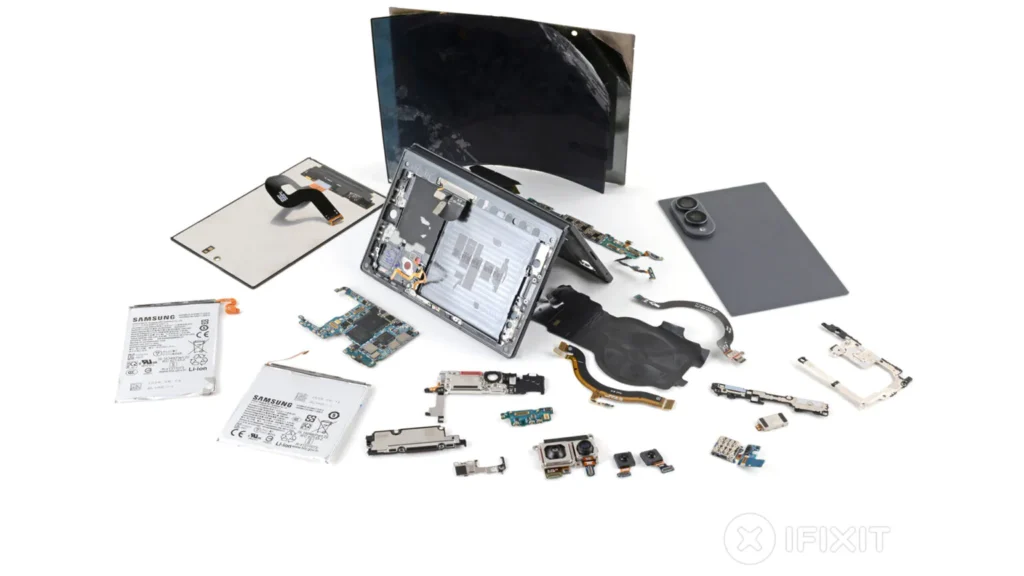
Galaxy Z Fold 8: iFixit’s teardown reveals the cost of an ever-thinner foldable
The Galaxy Z Fold 8 impresses with its sleekness and sophisticated architecture, yet this pursuit of miniaturization comes with a less appealing consequence. Following a teardown, iFixit awarded it a provisional repairability score of just 4 out of 10, highlighting the fragility of the foldable screen, the complexity of the hinge, and an imperfect dust protection system.
A Sophisticated Galaxy Z Fold 8… But Difficult to Repair
With each new Galaxy Z Fold generation, Samsung aims to eliminate the traditional compromises associated with foldable smartphones: reduced thickness, increased battery life, and a build quality closer to that of a traditional flagship.
However, the teardown conducted by iFixit reveals that this sophistication significantly complicates repairs.
Not all is negative. The Galaxy Z Fold 8 employs standard Phillips/JIS screws, and its USB-C port is modular, not directly soldered to the motherboard. These are welcomed choices since a charging connector is precisely the kind of component that may need replacement over a smartphone’s lifetime. Samsung also maintains its tab system to facilitate battery removal.
Yet, accessing these components on such a densely packed foldable remains a challenge.
Two Silicon-Carbon Batteries, One of Which Is Difficult to Access
The Galaxy Z Fold 8 features a particularly intriguing evolution in its power source: cells utilizing silicon-carbon technology. According to iFixit, this architecture allows for about an 8.8% increase in capacity compared to the Galaxy Z Fold 7, without a proportional increase in bulk.
This is precisely the type of technology that foldables need. In a smartphone made of two exceptionally thin halves, every cubic millimeter saved becomes invaluable.
The issue arises when it comes to repairs.
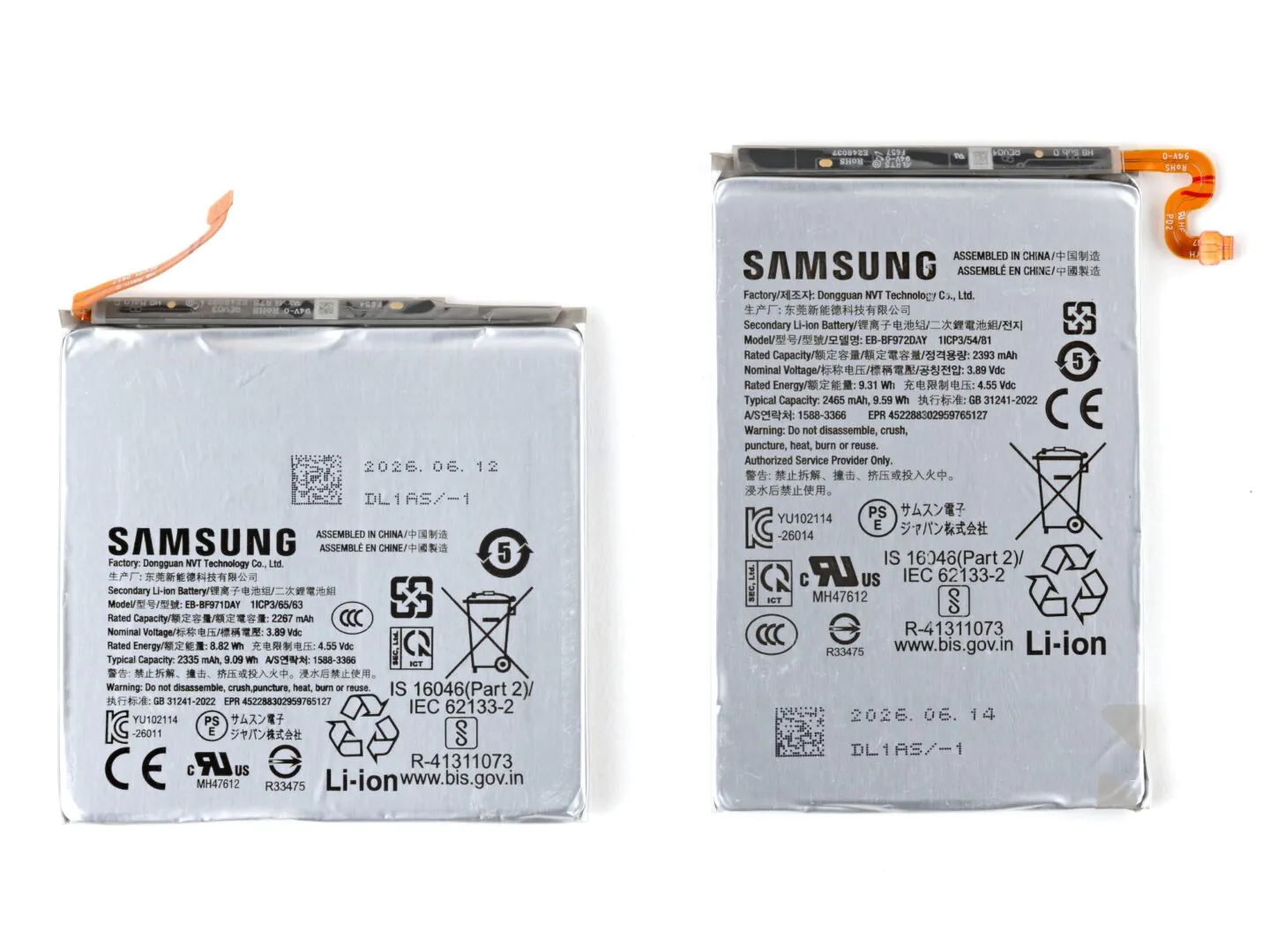
Like its predecessors, Samsung distributes the battery across two separate cells installed on either side of the phone. While the tabs make extraction easier once accessed, reaching one cell requires removing the external screen.
In other words, replacing a naturally aging consumable component may necessitate working on a costly and delicate piece. This exactly reflects the contradiction highlighted by iFixit’s score: a component can be technically replaceable without being genuinely easy to replace.
The Foldable Screen Remains the Critical Point
As expected, the most delicate aspect of the teardown involves the internal display. During the process, iFixit noted that the plastic frame surrounding the panel chipped and then broke. Ultimately, this led to the destruction of the fragile foldable OLED panel. This outcome underscores one of the fundamental issues in this category.
A traditional screen relies on a relatively rigid structure. Conversely, a foldable panel must endure thousands of flex cycles while remaining thin enough to accommodate the hinge’s movement. This flexibility, essential for its operation, also renders it considerably more vulnerable during a teardown.
The situation becomes even more complicated when intervention on the hinge is necessary.
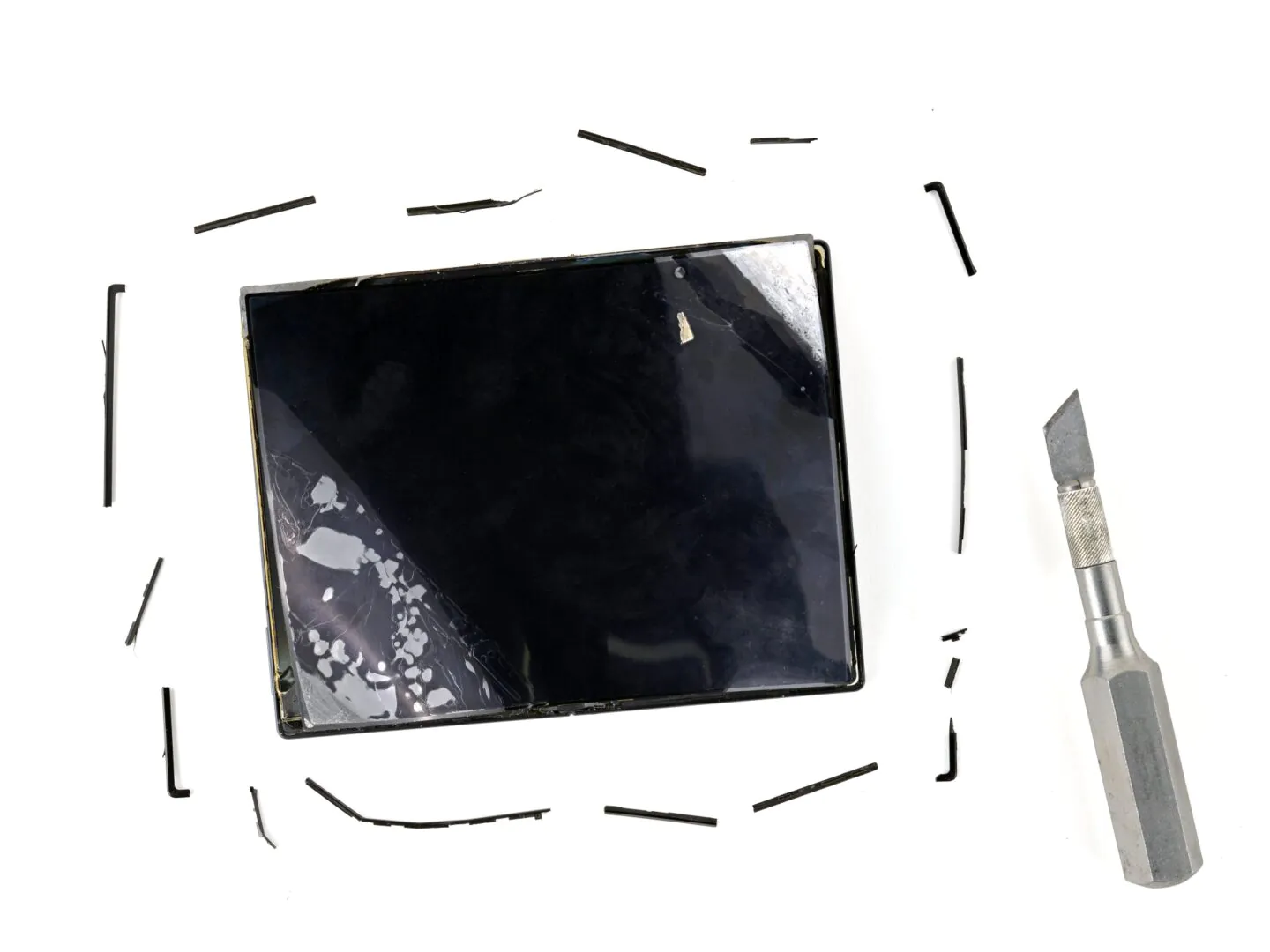
Samsung usually combines the hinge and the internal display into a single replacement assembly. A significant failure of one of these components can, therefore, necessitate the replacement of much of the mechanical heart of the smartphone.
For a DIY repair, this operation quickly becomes unrealistic.
The Dust Resistance Still Shows the Limitations of Foldables
Another warning pertains to the IP4X certification against solid particles. While this rating offers some protection, it doesn’t guarantee that the hinge is entirely dust-tight against fine particles. This is a critical distinction for a device expected to spend several hours a day in a pocket.
During tests with sand and particles, iFixit found that debris could enter the mechanism. The noise produced by the hinge then became particularly concerning.
This phenomenon serves as a reminder that the hinge remains one of the most challenging areas to protect on a foldable. It must simultaneously allow for smooth movement, precisely maintain the two parts of the chassis, and minimize the entry of particles that could damage the mechanism or screen.
Samsung has significantly improved this architecture since the first Galaxy Fold, yet physical constraints still impose limitations.
The Importance of Spare Parts Remains Crucial
Repairability is not solely dependent on internal design. Even a perfectly disassemblable smartphone becomes challenging to maintain if the necessary components are unavailable. iFixit highlights that some official parts for the Galaxy Z Fold 7 remain difficult to procure.
This raises an important question for the Galaxy Z Fold 8.
A high-end foldable smartphone represents a substantial investment and should logically last for several years. However, the longer this duration extends, the higher the likelihood of needing to replace a battery, USB port, or display.
The availability of parts becomes as critical as their accessibility.
The Thinness of Foldables Conflicts with Their Repairability
The provisional score of 4 out of 10 assigned to the Galaxy Z Fold 8 ultimately tells not just the story of a Samsung device that is difficult to disassemble. It illustrates a broader issue facing the entire foldable industry. Consumers want thinner, lighter devices with larger batteries and nearly invisible hinges.
But achieving these goals forces engineers to densely pack components and create a multitude of ultra-precise assemblies. While this integration enhances the product when it functions flawlessly, it complicates its second life when a part needs replacement.
Samsung has nonetheless made some smart choices, especially with its modular USB-C port, standard screws, and battery extraction system. However, these improvements alone do not sufficiently offset the structural complexity of the whole.
Thus, the Galaxy Z Fold 8 perfectly exemplifies the current paradox of foldable smartphones: they are becoming increasingly user-friendly like regular phones, without becoming any easier to repair.



