

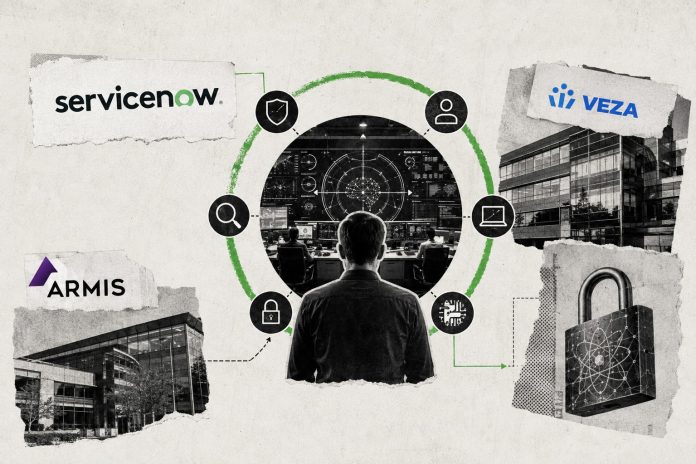
ServiceNow has unveiled a suite of six security solutions collectively known as Autonomous Security. This comprehensive solution encompasses exposure management, compliance, identity management, and incident response. The suite leverages technologies from Armis and Veza, two companies recently acquired by ServiceNow, and integrates with its AI Control Tower. Currently, eight out of the twelve proposed features are available, with the remaining four set to launch in December 2026.
As businesses accumulate various security tools, from SIEM systems to vulnerability scanners, each comes with its own console. ServiceNow estimates that companies utilize over seventy different security tools, though it hasn’t specified its source or the scope of this tally. The introduction of autonomous agents further complicates the landscape, creating non-human identities that log in, call APIs, and trigger privileged actions without adhering to controls designed for human users.
To address these diverse cybersecurity needs, ServiceNow made its announcement on August 4 at the Black Hat USA 2026 conference in Las Vegas, introducing the Autonomous Security suite. This set of six solutions aims to unify exposure management, continuously detect vulnerabilities, secure cyber-physical systems, manage identities and access, respond to incidents, and oversee risk and compliance. All of these components connect to the publisher’s AI Control Tower, which orchestrates client workflows.
From Exposure Management to Post-Quantum Compliance
The agent-based exposure management feature aggregates vulnerability reports from various sources into a single stream, enhanced by Early Warning intelligence and Fix Intelligence prioritization. Continuous detection extends threat modeling to AI-generated code and its dependencies, alongside a pre-deployment review of the supply chain, dynamic testing of running applications, and an inventory of external attack surfaces.
The third component, known as cyber-physical security, addresses the blind spots in this external view, focusing on operational technology (OT) systems, medical devices, and Internet of Things (IoT) devices, which traditional tools often interfere with, according to ServiceNow. This feature promises agentless discovery and modeling of attack pathways. The identity management aspect covers service accounts, cloud identities, and agents, ensuring automatic key rotation, account removal, and permission revocation.
The sixth component will enhance ongoing control over compliance with standards such as SOC 2, ISO 27001, PCI-DSS, and HIPAA, which ServiceNow describes as a quarterly pre-audit process. Agents will assess task separation, access rights, and configuration status, generating relevant reports. A separate module will address the migration from outdated cryptographic algorithms to quantum-resistant standards, which the French National Cybersecurity Agency (ANSSI) will require for certification starting in 2027.
Four Features Delayed Until December
Out of the twelve announced features, ServiceNow is now commercializing eight: agent-based exposure management, autonomous remediation agents, application security, dynamic testing, external surface inventory, cyber-physical security, agent access control, and remediation for non-human identities. Four additional features remain to be delivered.
The vulnerability resolution assistant, the second-tier incident response coordinator, continuous control monitoring, and compliance for cryptographic assets will only become available in December 2026. The resolution assistant is mentioned right at the start of the press release as enabling machine-speed corrections. Meanwhile, the second-tier assistant is critical for the agent-based incident response pillar, one of the six key components.
A CIO looking to make a purchase today would be acquiring a consolidated console that promises autonomy by the end of the year. The current capabilities can perform predefined actions such as key rotation, account removal, permission revocation, and rule-triggered remediation. However, the press release does not specify how autonomous remediation agents will decide their actions, which is the only delivered feature explicitly claiming autonomy. Two functions that will allow the system to autonomously create plans and categorize tasks will not be available until December: the second-tier assistant that builds a multi-phase response while escalating only high-risk decisions, and the assistant that will triage vulnerabilities before applying low-risk fixes.
Armis and Veza Provide the Backbone of the Platform
The most tangible contributions to this platform come from Armis and Veza, both acquired by ServiceNow. Armis offers continuous, non-intrusive visibility into connected devices, tracking billions of devices, according to the company. Veza maps effective permissions across human, machine, and agent identities.
This mapping from Veza answers a critical question: who holds what rights over which systems when the holder of those rights is a program. The identities of agents form a distinct layer of control, separate from human access management, with different rhythms and revocation mechanisms. “Machine identities double every eighteen months,” notes Yevgeny Dibrov, Vice President and General Manager of Cybersecurity and Risk at ServiceNow.
This data foundation shifts the cost burden towards recovery alongside existing SIEM and SOAR systems. A company specializing in ITSM that begins integrating security through workflow bridges these two domains and their existing tools. However, the licensing costs do not reveal the anticipated integration expenses or the number of consoles the organization will eliminate.
The contractual agreements signed with ServiceNow will clarify, far more effectively than the press release, which specific consoles will be phased out after deployment and what decision-making processes will remain subject to human validation—issues that will be resolved during commercial negotiations, not delivery schedules, and will be determined at the point of signature.



