

Apple Shows Interest in PrismML: This Startup Could Make the iPhone’s AI Much Faster… Without the Cloud
Apple is quietly pursuing its quest for a more powerful and privacy-respecting artificial intelligence. According to various reports, the Cupertino company is currently examining the technology developed by PrismML, a startup focused on compressing large language models. This advancement could enable future iPhones to run much more powerful AI models directly on the device.
The CEO of PrismML, Babak Hassibi, confirmed to CNBC that discussions are ongoing with Apple as well as other industry players. While the conversations are still in the early stages, the CEO believes that “things are moving in the right direction.” Apple, on its part, has not commented on the matter.
A Startup from Caltech Aiming to Revolutionize Embedded AI
Founded from research conducted at the California Institute of Technology (Caltech), PrismML is backed by Khosla Ventures and has an exclusive license on patents developed by the university. In March of this year, the company raised $16.25 million in its first funding round to accelerate the development of its technology.
Its goal is clear: to make artificial intelligence models compact enough to function locally on devices with limited resources, such as smartphones or laptops.
Bonsai 27B: An AI Model Reduced from 54 GB to Less than 4 GB
The source of interest lies in Bonsai 27B, PrismML’s latest model. Unlike a new model trained from scratch, Bonsai 27B builds on Qwen, the open-source model developed by Alibaba. The innovation lies in its extreme compression.
With its technology, PrismML has managed to reduce the model size from approximately 54 GB to just 3.9 GB in its most compact version.
Two versions are available:
- a ternary version, capable of running on a laptop
- a 1-bit version, light enough to fit in the memory of a smartphone like the future iPhone 17 Pro
According to PrismML, this would be the first model of its kind able to operate directly on a phone without relying on cloud infrastructure.
A Radical Approach to Save Memory and Energy
The gain comes from how the model stores its internal parameters. While traditional models use 16-bit coded values, PrismML reduces this information to just one or three possible values, depending on the version used.
This compression would have several immediate effects:
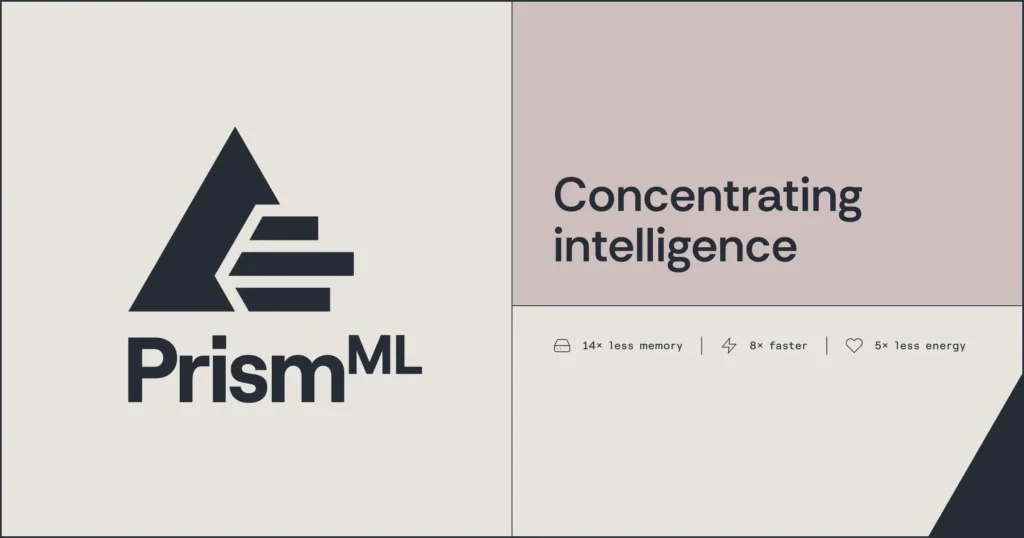
- a 10 to 15 times reduction in the required memory
- responses up to six to eight times faster
- energy consumption reduced by three to six times
However, this efficiency comes with a trade-off. Babak Hassibi acknowledges that the models lose some accuracy, particularly on tasks that require significant factual memory. However, reasoning, programming, or calculation abilities hold up much better under this compression.
PrismML claims to retain about 95% of the performance of the original model with the ternary version, and nearly 90% with the 1-bit variant.
Why This Technology Interests Apple
The timing is not coincidental. PrismML unveiled Bonsai 27B just hours after the public beta of iOS 27 was launched, which features a major overhaul of Siri and introduces new Apple Intelligence functionalities.
One of the primary challenges faced by Apple is running more processes directly on the device. Currently, the most complex requests are still routed to remote servers. Successfully enabling more powerful models to operate locally would offer multiple strategic advantages:
- better protection of personal data
- shorter response times
- features accessible even offline
- reduction in costs associated with cloud infrastructure
This approach perfectly aligns with Apple’s philosophy, which has focused on a hybrid AI model combining local processing and secure cloud services for several years.
A Response to Rising Memory Costs
Apple’s interest is also economic. According to a recent analysis by Morgan Stanley, the costs associated with memory components are expected to rise significantly in the coming years, particularly with the advent of increasingly demanding AI models.
Heavily compressed models would allow for advanced capabilities to be integrated without increasing the amount of memory embedded in future iPhones, thereby limiting the impact on production costs and potentially on retail prices.
A Technology Still to Be Validated
Despite these promises, several analysts urge caution. Tarun Pathak from Counterpoint Research believes that the real test will come when these models have to handle millions of requests across thousands of different devices.
Phil Solis from IDC emphasizes that energy consumption must be monitored in real-world conditions. Even a highly compact model could have a significant impact on battery life if it is continuously engaged.
Edge AI Becomes the New Battleground
Beyond just Apple’s case, PrismML exemplifies a major shift in the industry. Instead of indefinitely increasing the power of data centers, AI players are now looking to move some intelligence directly to users’ devices.
This approach, known as Edge AI, could profoundly transform usage by combining speed, privacy, and reduced operational costs.
PrismML also does not plan to stop with Qwen. The company is already working on optimized versions of Gemma, Google’s open-source model, before tackling even more ambitious next-generation models.
If Apple ultimately decides to integrate this technology into its future products, it could mark a significant step forward in its ambition to make embedded artificial intelligence a key asset of its ecosystem.



