

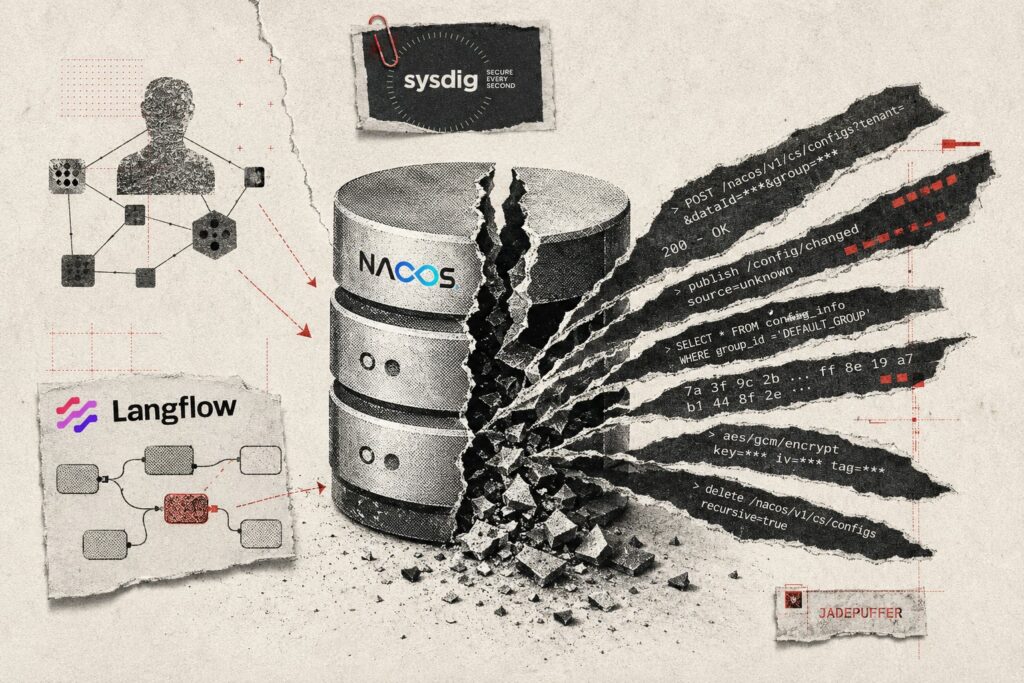
Sysdig Unveils JADEPUFFER: Investigating the First Full-Language Model-Driven Ransomware Operation
Sysdig’s research lab has uncovered what it describes as the first fully language model-driven ransomware operation, dubbed JADEPUFFER. This operation leveraged a vulnerability in the Langflow framework to encrypt and destroy a Nacos configuration database without any hardcoded scripts through real-time command generation. However, Sysdig acknowledges a lack of visibility into the system prompt or the configuration of the agent used by the attacker, raising questions about the genuine innovation behind the “language model-driven” label.
The report, released on July 1, 2026, by Sysdig’s threat research team, has garnered notable attention in the tech media landscape, appearing across various platforms such as BleepingComputer, The Register, The Hacker News, SecurityWeek, and Infosecurity Magazine. The exploited flaw, designated as CVE-2025-3248, is a legitimate and independently confirmed authentication issue affecting the Langflow code validation endpoint. This open-source framework is designed for creating applications and agent-driven workflows powered by language models. Versions prior to 1.3.0 are impacted, and the vulnerability has been listed in the U.S. Cybersecurity and Infrastructure Security Agency’s actively exploited vulnerabilities catalog since May 2025. It was also utilized to distribute the Flodrix malware, according to separate research conducted by Trend Micro, solidifying the factual basis of this case.
What warrants more careful scrutiny is how these facts have been narrated. Sysdig frames the incident as a demonstration of a language model conducting a complete reconnaissance and extortion operation entirely autonomously, with no human supervision at any step. However, the scenario described suggests that the operation relied on a “generic” agent facilitating the attack rather than a sophisticated malicious agent tailored with its own dependencies and scripts. Here, the interface consists of the prompt rather than orchestration or engineering, contrary to implications made in the report.
What Sysdig Actually Observed
The operation unfolded in two phases. On the compromised Langflow instance, the agent first enumerated the machine and harvested available secrets—such as API keys from model providers, cloud credentials explicitly covering Chinese providers, and cryptocurrency wallets—before plundering Langflow’s internal Postgres database. Following that, it probed a MinIO object storage service accessible using default product credentials, enumerated available buckets, and retrieved a configuration file containing an access key pair. An automated task was set up on the machine to periodically maintain contact with the attacker’s infrastructure.
The primary target of the operation was a second server, exposed to the internet, hosting a production MySQL database and a Nacos configuration service commonly used in microservice architectures. The agent connected with MySQL administrator credentials, whose origin remains unknown to Sysdig. It then exploited a combination of known Nacos vulnerabilities, including a referenced authentication bypass since 2021 and a default JWT signing key known since 2020, to directly inject a rogue administrator account into the service’s database.
Encryption affected 1,342 Nacos configuration items through MySQL’s native function before the original tables were deleted and a plaintext table containing the ransom note, a Bitcoin address, and a Proton Mail contact was created. A destruction phase ensued, with the agent removing entire databases that it identified as the most profitable to erase.
“Language Model-Driven” Refers to Real-Time Execution, Not Proven Autonomy
One of the most striking behaviors noted by Sysdig was the speed of correction. During the creation of the rogue administrator account, an initial login attempt failed. Just thirty-one seconds later, a fifteen-line patch diagnosed the probable cause, deleted the faulty account, and established functional access once again. This behavior, replicated multiple times across different failures, indeed sets this operation apart from a static script replaying a predefined sequence and underscores the shift towards machine speed that defense teams must now anticipate from both sides of the conflict.
However, this responsiveness does not prove lasting autonomy or learning. Each fix remains an inference confined to the context window of a single session, generating new text in reaction to tool outputs—similar to how a programming assistant reacts to an error message. There is nothing in the captured artifacts to indicate that persistent code has modified itself or that learning has transferred from one victim to another. The report notes that the same natural language context understanding behavior occurred across sessions spaced weeks apart, which is more naturally interpreted as the reuse of the same harness and instruction text by a human operator rather than as evidence of a self-improving system. Sysdig itself admits to having no visibility into this instruction text or the agent’s configuration, which is needed to draw a definitive conclusion either way.
No Individual Technique Was New
As Sysdig itself states in its conclusion, none of the techniques employed were new or sophisticated. The Nacos authentication bypass dates back to 2021, its default signing key has been publicly available since 2020, default MinIO credentials are known to anyone who has ever deployed the product, and privilege escalation probes via MySQL file primitives fall within the classic toolkit of penetration testers. Furthermore, the targeted infrastructure was described by its own discoverers as neglected, exposed on the internet without basic controls that have been expected for years.
Thus, if there is any real shift, it lies entirely within the orchestration layer—the ability to chain these known techniques without human intervention at every step—not within a new class of vulnerability or intrusion method. For IT security leadership, the actual technical exposure remains rigorously the same as it was before the emergence of language model-driven AI in the offensive landscape: an unpatched vulnerability, an exposed administrative console, and unchanged default credentials.
Areas of Uncertainty Acknowledged by Sysdig
The report contains several uncertainties recognized by its own authors without resolution. The Bitcoin address in the ransom note corresponds to a canonical example reproduced in Bitcoin’s technical documentation, a text that saturates training corpora for language models in the form of an illustration. It also corresponds to an actively used wallet, with 737 confirmed transactions and approximately 46 bitcoins received over its history. Sysdig states that it cannot determine whether the model hallucinated this address from its training data or if the operator deliberately configured a wallet matching the documentation example.
The assertion of exfiltration prior to encryption poses a comparable problem. Before deleting what it deemed the most profitable databases, the agent’s code comments that they had already been backed up to a remote server—an assertion with no independent verification in the report, but merely supported by a comment authored by the agent itself within its payload. Additionally, the ransom note claims AES-256 encryption, while the MySQL function utilized applies AES-128 in ECB mode by default unless the server is reconfigured. At least one practical consequence is clear: the encryption key was randomly generated, displayed on-screen only once, and subsequently neither stored nor transmitted to the attacker, meaning the victim cannot recover their data even if the ransom is paid.
What Will Actually Evolve: Architecture Over Power
The JADEPUFFER case subtly outlines the current limitations of such operations and precisely where architecture is likely to evolve in the coming months. An agent’s memory remains limited to a single session; there is no indication of a campaign journal wiki that would automatically store techniques that have worked from one victim to the next. Augmented research on the history of past operations entails a different level of engineering. In the current case, a human operator still selects the initial target and provides the initial access—the Langflow vulnerability. In the case of exploitative AI malware, the next step would involve coupling this type of exploitation agent with an autonomous reconnaissance agent, thereby further reducing the human involvement in the operation. However, that is not the case here.
The choice of underlying model represents another potential turning point. An operator migrating from diverted commercial APIs to locally-hosted open models removes dependency on stolen credentials and any visibility from the model provider, thereby making the attack infrastructure more resilient and harder to dismantle at its source. Finally, the verbosity of comments generated by the model, which Sysdig presents as a detection opportunity for defense teams, remains an artifact of the default style of commercial models rather than a lasting feature of this type of attack. An operator aware of this report has all the material needed to instruct their agent to eliminate this narrative or clean its traces before execution, effectively closing this detection window in subsequent iterations.
What CISOs Should Take Away
The defensive recommendations put forth by Sysdig come off as quite banal, and that is precisely what should raise alarms. Upgrading Langflow to a version beyond 1.3.0, never exposing a code execution endpoint to the internet, changing default credentials for Nacos and MinIO, never linking a configuration service to its database with a fully privileged account, and isolating AI orchestration servers from API keys and cloud credentials rather than leaving them accessible to a publicly exposed process—none of these measures are specific to the language model-driven threat; rather, they pertain to basic security hygiene that has been required of exposed infrastructure for years.
The most valuable lesson for IT security leadership lies in the vigilance needed against this kind of research communication, rather than the presumed novelty of the vector. A threat report published by a vendor specializing in behavioral detection warrants the same critical distance as any commissioned study, distinguishing what the artifacts demonstrate from what the report’s title implies. As the cost of running an exploitation agent continuously decreases, the production of reports claiming each a “first language model-driven case” should accelerate in the coming months, and the same critical reading exercise will have to apply to each of them in a wave of offensive AI that several organizations are already urging IT departments to prepare for.



