

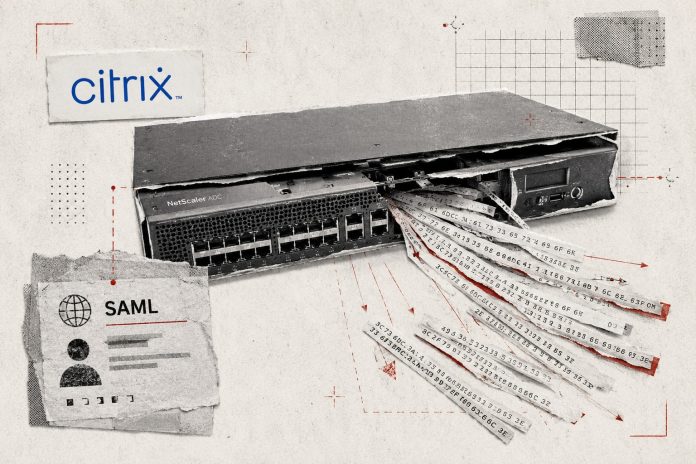
Citrix has patched six vulnerabilities in its NetScaler ADC and NetScaler Gateway appliances, including a critical memory leak flaw that was exploited in the wild less than 24 hours after its public disclosure. Designated CVE-2026-8451, this vulnerability allows an unauthenticated attacker to extract memory fragments from a device configured as a SAML identity provider.
The flaw was made public on June 30, 2026, affecting NetScaler ADC and NetScaler Gateway versions prior to 14.1-72.61 and 13.1-63.18, with a severity rating of 8.8 out of 10. Threat intelligence provider CrowdSec released a detection rule by July 1 and recorded the first exploitation attempts on July 2, marking a response time measured in hours rather than weeks. Similarly, the firm Lupovis noted active exploitation within just 24 hours of the disclosure, originating from an address based in Frankfurt. The CrowdSec network identified 71 distinct malicious IP addresses and 424 exploitation signals within the first four days, peaking at 127 in a single day. Moreover, functional exploit code is already circulating publicly, lowering the technical barriers for potential attacks.
This rapid pace of compromise is reminiscent of the “CitrixBleed” vulnerability from 2023, which has become a benchmark for incident response teams. In that case, a similar mechanism allowed attackers to hijack authenticated sessions for several months, even after a patch had been applied, by reusing session tokens stolen prior to the update. CVE-2026-8451 falls into the same category of memory bugs at Citrix, marking the third such incident within just over two years. This raises concerns not only about isolated cases but also about the overall reliability of the vendor’s authentication code. Organizations that expose their single sign-on (SSO) portal directly to the internet for remote access by employees or partners bear most of the risk, as this entry point is precisely where the vulnerability is targeted.
Memory Leak Targeting SSO
The vulnerability stems from NetScaler’s proprietary XML parser, tasked with interpreting SAML requests when the appliance acts as an identity provider for single sign-on. This component fails to recognize a newline as a terminator for a non-quoted XML attribute value. Consequently, an attacker can leave the AssertionConsumerServiceURL attribute empty and improperly terminated, reorder the document, and induce a memory read far beyond the expected boundary. This reordering prompts the parser to read past the intended limit, exposing adjacent memory chunks that may contain session keys or internal configuration elements.
Only instances of NetScaler explicitly configured as SAML identity providers are susceptible to this specific vulnerability. Appliances operating solely as load balancers or VPN gateways without this authentication mode are not affected by CVE-2026-8451. However, they are still vulnerable to five other flaws patched on the same day, which involve file reading and denial of service issues. IT departments that inventory their appliances based on model rather than authentication configuration may misjudge their actual exposure.
Detection Outpacing Vendor Channels
The short window between disclosure and observed exploitation, measured in hours by both CrowdSec and Lupovis, highlights the shift towards community-driven threat intelligence rather than reliance solely on vendor communications to clients. This responsiveness is attributed to the pooling of sensors from numerous clients that report exploitation attempts in nearly real-time. Blocklists powered by these sensors can cut off access to identified addresses even before a patch is applied, thereby reducing the exposure window while complementing the patch deployment itself.
This reliance on third-party detection mechanisms effectively adds another layer of security for appliances exposed to the internet, until a fix can be implemented. However, it does not absolve the need to address Citrix’s own alert, which remains the authoritative source for patched versions and official recommendations.
Recommendations for CISOs
Upgrading to NetScaler ADC or NetScaler Gateway versions 14.1-72.61 or 13.1-63.18 (as detailed in Citrix advisory CTX696604) is the only complete remediation. For organizations unable to immediately apply the patch, disabling the SAML identity provider function removes the attack surface in the interim. Management interfaces and SAML endpoints, in any case, should remain out of direct reach from the internet. Conducting an external exposure test, similar to those performed by IoT search engines, can confirm that no NetScaler management interfaces remain accessible without filtering.
The CitrixBleed incident of 2023 illustrated that a patch alone is insufficient to close the incident if session tokens have been stolen before its application. Revoking active sessions and rotating exposed secrets are essential steps in conjunction with deploying the patch on devices that were functioning as SAML identity providers before June 30.
Having had three memory vulnerabilities of this nature over two years from the same remote access vendor underscores the importance of not only applying this particular patch but also maintaining a precise inventory of appliances configured for SAML and regularly verifying the necessity of this configuration.



