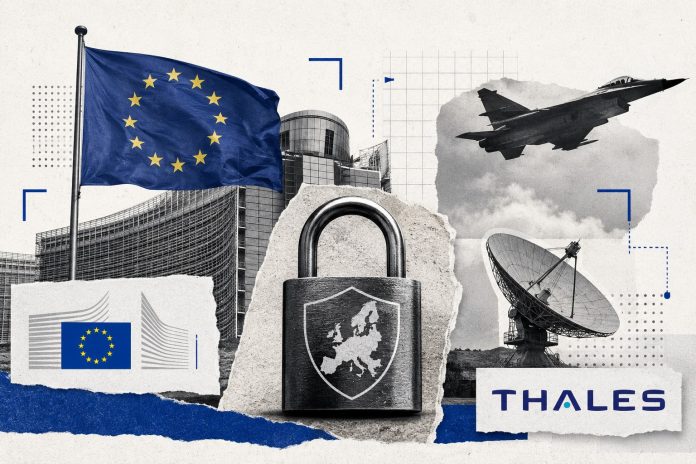
The European Commission is set to test Thales’ TrustNest R-Suite, a secure collaborative suite, for one year across projects funded by the European Defence Fund (EDF). This initiative has reached a significant milestone with the recent awarding of the Restricted European Union (R-UE/EU-R) certification by the Commission and the National Cybersecurity Agency of France (ANSSI) for the interconnection between TrustNest R-Cloud and the Commission’s classified network.
European defense industries have long faced the challenge of exchanging and co-editing sensitive documents remotely while adhering to strict security protocols governing classified data. To address this issue, the European Commission is partnering with Thales, whose TrustNest R-Suite relies on the TrustNest R-Cloud platform. This solution facilitates document exchange and storage, phone calls, video conferencing, and the management of shared workspaces tailored for projects funded by the EDF, which boasts nearly €8 billion in co-funding for defense research and capabilities among EU member states from 2021 to 2027.
The recent certification specifically concerns the interconnection between R-Cloud and the Commission’s R-UE/EU-R network, which is essential for member organizations to handle classified information at this level. The protection applies only to exchanges linked to a network that is itself certified, marking the lowest classification tier of the European Union’s four-level classification system, below Confidential, Secret, and Top Secret EU.
R-UE/EU-R: A Distinct Framework from SecNumCloud
R-UE/EU-R should not be confused with the SecNumCloud qualification granted by ANSSI to cloud service providers. The former governs the handling of classified EU information, following the general inter-ministerial instruction n° 2102 and inter-ministerial instruction n° 901, with a certification process jointly overseen by the Commission and the national security authority of each member state. In contrast, the latter qualifies the security of commercial cloud services based on criteria set by ANSSI, amidst a diverse landscape of European cloud certifications with varying ambitions for sovereignty.
TrustNest R-Cloud encompasses both frameworks. The platform has been certified for Restricted Dissemination in France since January 2022, and it has now added R-UE/EU-R for the European level, without one certification replacing the other.
A Suite Designed for Restricted Data since 2022
Thales has been marketing R-Cloud as a Restricted Dissemination certified hosting solution since January 2022. The R-Suite application, launched in 2023 on this same platform, enhances it with collaborative document editing, video conferencing, and project management functionalities. The extension to the R-UE/EU-R level addresses a noted need among defense industries, which have lacked remote collaboration tools compatible with classified data from joint programs involving multiple member states, such as those funded by the EDF.
“Strengthening secure collaboration among European defense actors is critical to the success of EDF projects. It is essential to implement sovereign, cybersecurity-compliant, and reliable digital tools that enable partners to share sensitive information confidently and in full adherence to the most stringent European requirements,” stated Christoph Siegelin, Vice President of Digital Transformation at Thales.
A Pilot Format Driven by European Public Procurement
The decision to pursue a pilot format rather than an immediate large-scale rollout stems not from uncertainty about the tool but from the inherent constraints of European public procurement. EU institutions often start with limited experimentation with an established player before considering a lengthy and costly competitive bidding process. Thales, with its strong foothold in European military cybersecurity and a track record of ANSSI qualifications alongside multi-state defense programs, is a natural candidate for this type of testing.
As Europe reassesses its sovereign technological choices, the speed of implementation has become as crucial as regulatory compliance. The pilot format allows the Commission to bypass the delays of a traditional competitive bidding process while leaving open the option for future competition if the pilot proves successful.
No Timeline: A Milestone in a Process Rather than an Endpoint
The announcement of this certification comes without a specific timeline, aligning with a pilot project aimed at advancing a process rather than marking a conclusion. The experiment is set for one year, and it remains unclear at this stage whether the Commission will standardize the use of TrustNest R-Suite for EDF projects or allow for other European providers to compete after this period. Communication regarding this milestone reflects the usual transparency procedures of European institutions concerning their digital tool choices rather than a one-off PR effort.
For industries engaged in EDF programs, the practical implications of this milestone are limited to a specific use case: network interconnection, rather than a blanket security guarantee for entire programs. Nevertheless, a European provider has achieved certification at this level, while no French or European competitor has yet reported comparable R-UE/EU-R accreditation in a sector where credible alternatives outside of the Cloud Act framework are scarce.