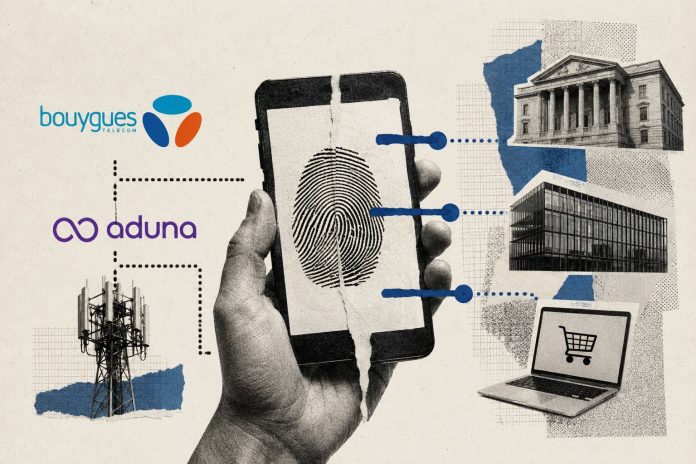
Bouygues Telecom is expanding its network capabilities to businesses through a partnership with Aduna, a joint venture between Ericsson and leading global telecom operators. Three security APIs are now available, targeting sectors such as banking, insurance, e-commerce, and social media, focusing on identity verification and fraud prevention. The operator leverages the GSMA’s CAMARA standard to provide unified access to these network capabilities.
Bouygues Telecom is now among the operators utilizing Aduna’s intermediary services, which grant businesses access to the operator’s network APIs. This allows external applications to query specific network data, such as the date of an end user’s last SIM card change or the association between a mobile number and its line. While Bouygues Telecom holds this information, it provides controlled responses without exposing the network itself. Aduna serves as the intermediary in this setup, gathering networks from over a dozen operators behind a single connection point.
This integration enables banks or e-commerce platforms to access these networks through a single interface, eliminating the need for distinct connections with each operator on a country-by-country basis. The technical framework relies on the CAMARA standard, established by the GSMA, which defines common and interoperable network APIs. Aduna brings together operators like AT&T, Deutsche Telekom, Orange, Telefónica, Verizon, and Vodafone under this standard, providing global deployment capabilities.
Three APIs for Fraud Prevention
The initial APIs focus on sectors where seamlessness and security are paramount, particularly in banking, insurance, credit, e-commerce, and social networking. Three solutions are already available: Know Your Customer Match enhances identity verification during account creation; SIM Swap Check identifies recent SIM card changes—useful before executing transactions or loan requests; and Number Verification authenticates the user’s mobile number in real-time, directly addressing transactional fraud and fake accounts.
Bouygues Telecom is already supporting over forty businesses in these sectors across the French market, processing more than five million API requests in the year 2025 alone. The responses are based on data related to the SIM card, network identity, or device, managed within the operator’s infrastructure and delivered as boolean responses—true or false—without exposing end-user personal data.
The Network as an Identity Backbone
This initiative goes beyond simple fraud filtering. By exposing its network data through standardized APIs, Bouygues Telecom positions itself as a source of identity for third-party applications. Network data is inherently difficult to falsify, serving as a robust countermeasure against transactional fraud or account creation schemes. “As fraud becomes increasingly sophisticated, businesses require more reliable methods to verify identities and secure their digital interactions,” stated Anthony Bartolo, CEO of Aduna.
The next step involves phasing out one-time password SMS messages. By the end of the year, Bouygues Telecom and Aduna plan to introduce an enhanced version of Number Verification aimed at gradually replacing these validation codes. For banks and e-commerce sites, number authentication will happen in the background, eliminating the need for users to enter codes. The once-standard one-time SMS messages for two-factor authentication are vulnerable to interception and SIM card hijacking.
Key Considerations for CIOs
For Chief Information Officers (CIOs), these APIs offer a robust layer for fraud prevention and identity verification without extensive integrations. Processing data within the operator’s infrastructure, with boolean responses, minimizes the exposure of personal data while facilitating compliance with GDPR. The reliance on a single operator is mitigated by the CAMARA standard, allowing for portability across networks.
The operator’s communications emphasize a commitment to sovereign digital trust. However, it is essential to clarify that Aduna is a global joint venture uniting operators from the U.S., Europe, and Asia, and CAMARA is an international standard. While Bouygues Telecom’s data processing in France supports local proximity arguments, the sovereignty of a system tied to a global platform must be assessed case by case, with contracts and locations taken into account.
With this launch, Bouygues Telecom transforms a portion of its network into a security product for businesses. This move aligns with a broader trend among operators seeking to generate revenue beyond connectivity by monetizing their network data through standardized APIs. However, the true test lies in assessing the actual adoption by business and security departments, as well as the ability of these interfaces to compete against established identity providers.