

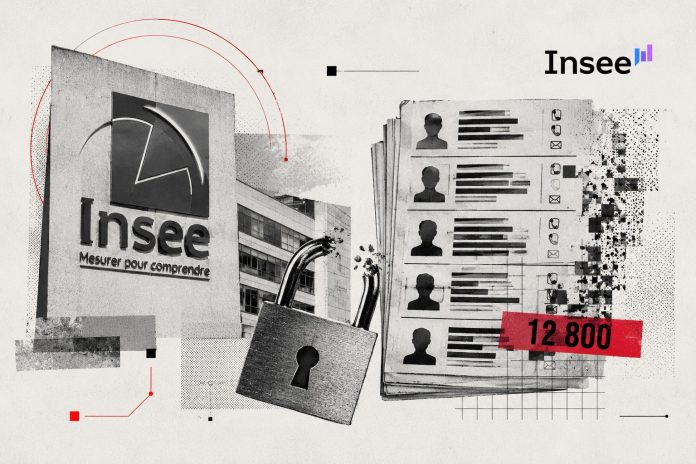
The National Institute of Statistics and Economic Studies (INSEE) has announced a cyberattack on its internal directory of employees, which has resulted in a data breach affecting personal information. Approximately 12,800 individuals currently or formerly associated with the institute have had their identities and professional contact details compromised. The INSEE has assured that no sensitive data or statistical information collected from businesses or individuals was affected.
The incident was detected on June 19, prompting immediate measures to halt the attack. The breach includes the identities of about 12,800 current and former employees, along with their professional contact information. INSEE confirmed that passwords, personal contact details, bank information, social security numbers, and health information were not part of this breach.
The institute is addressing the incident in collaboration with the Ministry of Economy’s Defense and Security High Official Service and the National Cybersecurity Agency (ANSSI). Following GDPR regulations, it has reported the breach to the National Commission on Informatics and Liberty (CNIL) and has filed a complaint with the public prosecutor’s office. Technical investigations initiated right after detection found no evidence of compromised data from businesses and individuals, which the institute claims are protected throughout the data collection and processing lifecycle.
A Publicly Claimed Directory Breach
The exact origin and circumstances of the data extraction have not been independently verified. An entity operating under the pseudonym “Saturne” has claimed responsibility for publishing a database allegedly sourced from trombi.insee.fr, the institute’s internal directory, according to the independent organization Cyberattaque.org. The leaked file reportedly contains 12,796 records related to the institute’s personnel, presented as an export generated in June 2026.
This targeted directory holds professional contact information, assignments, and various administrative details about the staff. While the claimed scope aligns with what INSEE has described, it does not validate the source. At this stage, the claim is based solely on the statements of the individual who made it, urging caution regarding the actual extent and provenance of the distributed data.
French Administration Under Continuous Pressure
This incident adds to a growing pattern of attacks targeting the French public sector. The CERT-FR’s Cyber Threat Panorama 2025, referenced as CERTFR-2026-CTI-002, documents a shift by attackers toward data exfiltration and targeting public administrations, where large files of personal data are sold or used for fraud. In a notable previous incident, France Travail suffered a cyberattack in 2024 that exposed data of millions, resulting in a €5 million fine from CNIL on January 29, 2026, due to inadequate security measures. Other public entities have also faced attacks in the first half of the year, ranging from Bercy’s FICOBA file to the French Office for Immigration and Integration. The recurrence of these events establishes the leakage of administrative data as a persistent risk rather than an isolated occurrence.
Furthermore, CERT-FR reported in March a resurgence of campaigns targeting the email accounts of key government sectors and administrative leaders. In this context, a complete internal directory presents a surface often deemed secondary, despite its significance in mapping an organization’s functions, hierarchies, and contacts.
Phishing Risks Shift to Third Parties
The primary consequence for decision-makers revolves around the potential use of this data for social engineering, rather than the isolated content itself, which lacks any banking identifiers or passwords. A detailed professional directory provides a foundation for targeted phishing attacks, where the attacker impersonates an identified agent to deceive an external counterpart. INSEE has proactively addressed this risk by advising both businesses and individuals to exercise heightened caution when receiving messages that appear to originate from its agents.
The institute emphasizes that it never requests payment for registration in the Sirene directory or the sharing of banking details or passwords, as these operations are entirely free. It encourages individuals to demand the official identification of any investigator and to verify the legitimacy of any inquiry through its publicly available investigation calendar. For Chief Information Security Officers (CISOs), this incident underscores that even a leak of internal directory data, despite lacking critical information, directly feeds into phishing chains targeting partners, suppliers, and users. Moreover, it highlights that effective cybersecurity risk management requires shared governance, where a designated authority must make decisions and assume responsibility.



