

OpenAI has expanded Daybreak, its cybersecurity initiative launched in May, and has released the full version of GPT-5.5-Cyber to a select group of verified defenders. The company updates its Codex Security plugin, opens a partner program, and, in collaboration with Trail of Bits, launches the open-source initiative Patch the Planet. The central theme of this endeavor is straightforward: the challenge is no longer about identifying vulnerabilities but rather about fixing them swiftly.
For years, uncovering serious vulnerabilities required scarce expertise and in-depth knowledge of complex code. Language models have shifted this balance, allowing for the exploration of vast codebases, the identification of attack vectors, and the reporting of flaws that might have otherwise gone unnoticed. The paradox, however, is that defense teams are now inundated with alerts. A vulnerability report provides no protection unless a fix has been written, tested, and deployed.
This shift is precisely what the extension of Daybreak aims to address, as announced on June 22, 2026. OpenAI is now taking on the entire process, from discovery to remediation, rather than focusing solely on detection. The company claims success with widely-used targets such as browsers and operating systems, including the Linux kernel and FreeBSD. The promise is to empower defenders with these capabilities before attackers can exploit them, in a landscape where the technical advantage shifts with each generation of models.
From Detection to Automated Remediation
The crux of the announcement is the transition toward remediation. OpenAI has updated its Codex Security plugin, which analyzes codebases, establishes or enhances threat models, checks if vulnerable code is exploitable, gathers evidence, suggests targeted fixes, and tests the results. Since its soft launch in March, the tool claims to have analyzed over 30 million commits across more than 30,000 codebases, with more than 70,000 vulnerabilities marked as fixed by human reviewers and upwards of 500,000 automatically corrected. This approach extends the security of developer tools, which have become a focal point for software supply chain attacks.
While these figures originate from the publisher and reflect processing volume rather than independent efficacy measures, they underscore the scale that OpenAI aims to achieve: bringing remediation in line with the pace of discovery. The plugin can also process existing reports from other scanners, security advisories, or bug bounty programs, generating patches in batches to tackle backlogs. Ultimately, the decision on which vulnerabilities to investigate and which fixes to apply remains with human oversight.
A More Capable Model for Credentialed Defenders
OpenAI has released the full version of GPT-5.5-Cyber, touted as its most powerful model for identifying and correcting vulnerabilities, as well as being more permissive regarding authorized security tasks. In the CyberGym test, which evaluates the ability to reproduce known vulnerabilities, the model achieves an impressive 85.6%, compared to 81.8% for GPT-5.5. In the ExploitGym assessment, which measures the conversion of a vulnerability into a working exploit, it scores 39.5%, up from 25.95%.
However, access remains a critical issue. GPT-5.5-Cyber is available only to verified defenders, with stringent controls, oversight, and review processes. For most organizations, OpenAI redirects them to the standard GPT-5.5 equipped with its Trusted Access for Cyber feature. The dual potential of a model that aids in correcting vulnerabilities while also enabling exploitation justifies restricted access. Nevertheless, this creates an asymmetry, as the most advanced defensive capabilities are not evenly distributed, with access criteria determined by the publisher. This situation mirrors concerns raised by the discontinuation of Mythos 5, which deprived Europe of similar capabilities.
Open Source and Europe in the Limelight
Two key initiatives broaden the scope of the Daybreak effort. The Daybreak Cyber Partner Program grants access to GPT-5.5 with Trusted Access for Cyber to security providers such as Cisco, CrowdStrike, Palo Alto Networks, Wiz, and Zscaler, allowing them to integrate the model into their products without diffusing direct access. Concurrently, Patch the Planet, established with Trail of Bits and involving HackerOne and Calif, funds researchers to assist maintainers of widely used open-source software, from cURL to Python and the pyca/cryptography library. Over thirty projects are already on board.
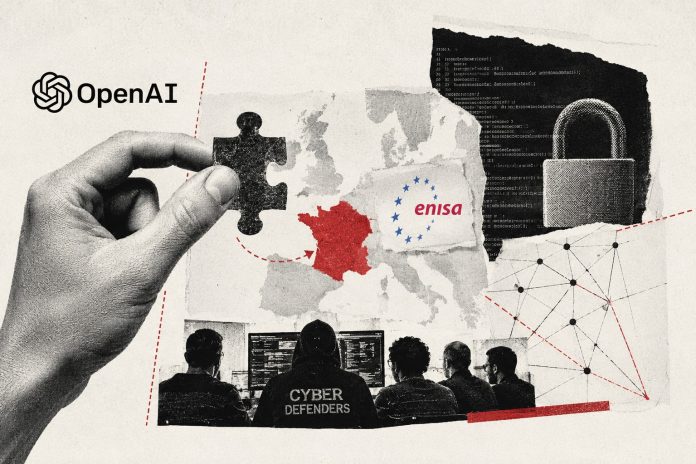
OpenAI’s European outreach deserves attention from French policymakers as it has established several Trusted Access for Cyber partnerships with countries including France and Germany, as well as institutions within the European Union, such as the European Cybersecurity Agency, ENISA. This expansion is complemented by growing ties with the U.S. government, around a presidential decree from June 2026 and ongoing assessments prior to the deployment of models. The reliance on an American provider for top-tier cybersecurity capabilities is now a factor to consider in sovereign strategy.
For Chief Information Security Officers (CISOs), the expansion of Daybreak raises questions of strategy rather than immediate adoption. Model-assisted remediation promises to reduce the backlog of vulnerabilities, but human review remains the crucial filter that distinguishes valid fixes from false positives, as emphasized by the central role that OpenAI and Trail of Bits assign to researchers in Patch the Planet. Ultimately, there lies a fundamental tension: the capability designed for defense is also applicable for offense, and conditional access delineates a landscape where not all defenders are equally equipped.



