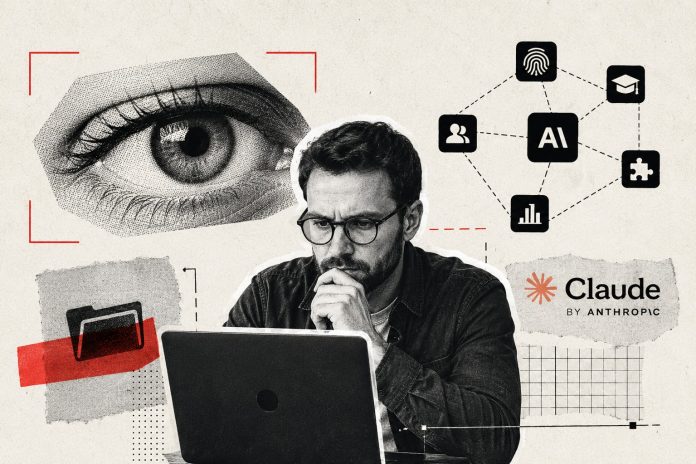
Anthropic is updating the privacy policy for its Claude Free, Pro, and Max offerings, effective July 8, 2026. The new version expands the scope of collected data, incorporating biometric age verification, survey participation data, connected app tracking, and personalized marketing usage. This change reflects Claude’s transition to an agentic mode, where the assistant actively interacts and connects to third-party services. Although marketed to the general public, the Pro and Max plans serve as essential tools for freelancers and small businesses without corporate contracts, putting them at the forefront of this expansion.
Anthropic has informed its users about the revision of its privacy policy, set to take effect on July 8, 2026. This update applies solely to the Claude Free, Pro, and Max accounts, while the Claude Team, Claude Enterprise, and Claude Platform offerings fall outside its scope due to specific contractual conditions. This distinction is significant; the Pro and Max subscriptions, targeted primarily at individual users, are widely utilized by independent contractors, freelancers, and micro-enterprises. The company presents this revision as a necessary clarification in response to its evolving product, now capable of handling broader tasks and connecting with user applications.
Comparing the new version with the previous one, effective January 12, 2026, reveals a comprehensive expansion of the data collection scope. No data category has been removed, while four have been added or expanded. Anthropic reiterates three unchanged commitments: it does not sell data, it does not include ads in Claude, and users can opt out of having their conversations used to train models.
New Data Categories Added
The most significant change relates to verification data. The updated policy allows Anthropic to collect images of official identification documents, containing relevant information, as well as photos or videos of the user, and facial geometry templates categorized as biometric data in certain jurisdictions. This category was absent from the January version, effectively introducing highly sensitive biometric information into the realm of consumer policy.
Another new category is survey participation data. When a user responds to a survey, interview, or study conducted by Anthropic—specifically using a tool called Anthropic Interviewer—the company collects their responses and associates them with other account data for analysis. This addition comes with new justification, framing verification as sometimes necessary for safety and security purposes, thereby broadening the amount of data users may consciously or unconsciously share.
Contractual Implications of the Agentic Shift
The most impactful extension relates to the redefinition of input data. The concept of “Inputs” now explicitly includes agentic sessions, where Claude carries out multi-step tasks or acts on behalf of the user, as well as connected services. The policy clarifies that certain actions taken by Claude can have effects outside the platform, such as sending communications, modifying files, or interacting with third-party services. Consequently, the data collected now encompasses not only what users input but also what the agent executes. Data concerning applications, services, and third-party content that users integrate or interact with is now explicitly included in the automatically collected usage data, which also covers navigation within connected services.
This logic extends into the section concerning third parties. Previously titled “How We Disclose Personal Data,” it has been renamed to “Recipients and Sources of Third-Party Data.” This shift is far from cosmetic, as the section now details not only the data sent to providers but also the data that Anthropic receives from connected third-party services. This policy formalizes the dual flow inherent in agentic systems, which read from and write to external systems. It represents one of the most concrete legal translations of agent governance.
This trend is not unique to Anthropic. Any artificial intelligence that transitions from conversation to action inherently broadens its data scope, as it interacts with content external to its environment. Therefore, the update from Anthropic serves as a precedent for any executive evaluating the deployment of agents, irrespective of the vendor. It signals the direction that other privacy policies will take as assistants become more autonomous.
A Governance Divide Between Consumer and Enterprise Offerings
For data security officers or compliance leads, the primary takeaway is not merely the list of new data categories but the boundary that this update emphasizes. Consumer offerings and enterprise solutions operate under distinct regimes. For Free, Pro, or Max accounts, this extended policy applies, and Anthropic acts as the data processor. Conversely, with Team, Enterprise, or Platform accounts, commercial terms govern data processing, and the client company retains control over data handling.
This distinction elevates a contractual detail to a significant point of oversight on two fronts. Within an organization, an employee using a personal Claude subscription for professional document processing does not provide their employer with the same assurances as a corporate contract would. More broadly, independent contractors and small businesses relying on the Pro or Max subscription as their primary work tool are subject to the extended consumer policy without the data handling controls of enterprise offerings—even while managing third-party data. This aligns with the issue of unregulated AI use previously discussed, where dependence on consumer-grade tools bypasses internal security policies. The expanded consumer data collection makes this oversight increasingly costly to ignore.
The regulatory landscape further intensifies these challenges. For users in the European Economic Area, Anthropic Ireland acts as the data processor, and the new policy bases direct marketing and personalized recommendations on legitimate interest—creating a legal foundation for opt-out rights. The introduction of biometric age verification, a category of sensitive data, requires particular vigilance regarding GDPR and the forthcoming AI Act, which will be applicable in August 2026. For the relevant departments, the practical takeaway is straightforward: distinguish between actions involving personal accounts and those necessitating an enterprise framework, treating this update as a signal of trends that will extend beyond Anthropic.