

Apple may use Nvidia Blackwell chips for the new generation of Siri
With only a few days left until WWDC 2026, new rumors are stirring up excitement regarding Siri’s overhaul. According to several reports from The Information, Apple is preparing for a significant evolution of its voice assistant by leveraging an unexpected infrastructure: NVIDIA’s powerful AI chips hosted in Google’s cloud.
If these reports hold true, Siri may finally bridge the gap between a conventional voice assistant and a true conversational agent capable of understanding the user’s personal context.
A New Generation of Siri Powered by Gemini
For several years, Siri has lagged considerably behind models like OpenAI’s GPT or Anthropic’s Claude.
Rumors suggest that Apple plans to replace its current generative model, which has around 3 billion parameters, with a customized version of Gemini that exceeds 1.2 trillion parameters. This vast difference in scale would enable Siri to handle complex queries, perform multi-step reasoning, and gain a more nuanced understanding of user context.
This strategy would also reaffirm the growing collaboration between Apple and Google in the realm of artificial intelligence, despite their historical rivalry in the mobile market.
Why Is Nvidia in the Picture?
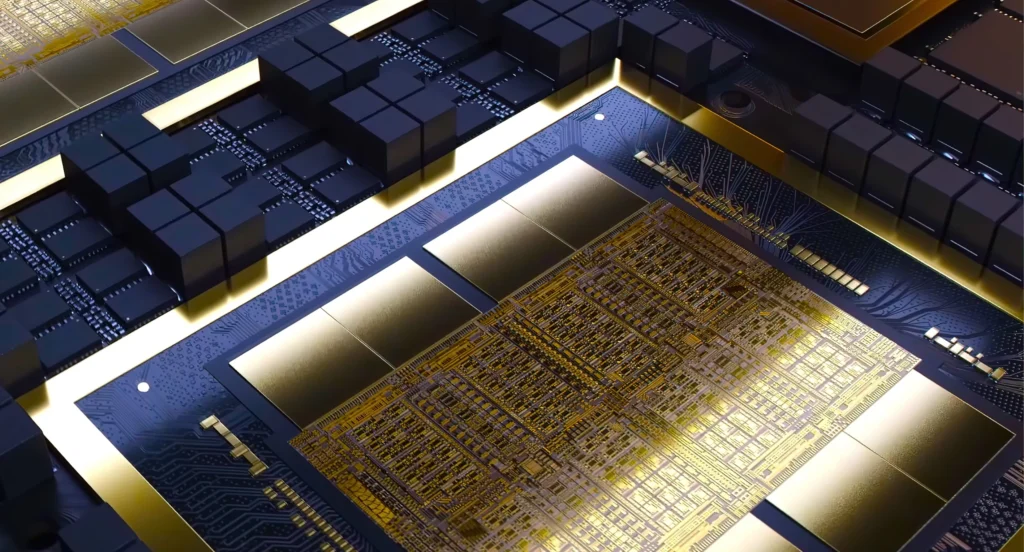
Another notable aspect concerns the infrastructure used to run this model. According to available information, Apple would leverage Google’s cloud resources equipped with NVIDIA Blackwell B200 AI accelerators.
This chip is currently one of the most powerful on the market for training and inferring large language models.
Here are some statistics to underline its significance:
- 208 billion transistors
- Architecture comprising two GPU dies
- Internal bandwidth of 10 To/s
- Data encryption during processing through the “Confidential Computing” mode
This last feature is particularly important for Apple, whose entire AI strategy relies on safeguarding personal data.
The Ambition: A Truly Contextual Siri
The real revolution may not merely lie in the model’s power but in its ability to comprehend the user’s digital life. For several years, Apple has been working on what the company internally refers to as “Personal Siri.”
The concept is straightforward: allow Siri, with the user’s permission, to access their entire personal ecosystem: Messages, Mail, Calendar, Notes, Photos, Wallet, Maps, and compatible third-party apps.
A frequently cited example illustrates this approach well: “Siri, what time should I leave to pick up my mom from the airport?”
To respond effectively, Siri would need to find the flight number in Mail or Messages, check the flight tracking data, analyze traffic conditions via Maps, calculate the travel time, and suggest a precise departure time.
This form of contextual reasoning embodies exactly what voice assistants have promised for over a decade without ever truly achieving it.
A Cultural Shift at Apple
The most surprising aspect may be the potential dependency on external technologies. Apple has always favored total control over its technological stack, from processors to operating systems. Seeing the company rely simultaneously on Google for models and Nvidia for infrastructure marks a significant strategic shift.
It also reflects a reality in the industry: developing a competitive AI assistant now necessitates immense computational power that even Apple seems unwilling to shoulder alone in the short term.
The WWDC 2026 Could Be a Historic Turning Point for Siri
Since its launch in 2011, Siri has remained one of the most promising yet frustrating innovations within the Apple ecosystem.
The advent of a customized Gemini model, combined with a deep understanding of user context and powered by Nvidia infrastructures, could finally birth the assistant that users have envisioned for years.
Thus, WWDC 2026 is poised to be more than just a conference focused on iOS 27. It could signify the true dawn of the Apple Intelligence era, featuring a Siri capable of understanding not only what you say but also what you are truly trying to accomplish.



