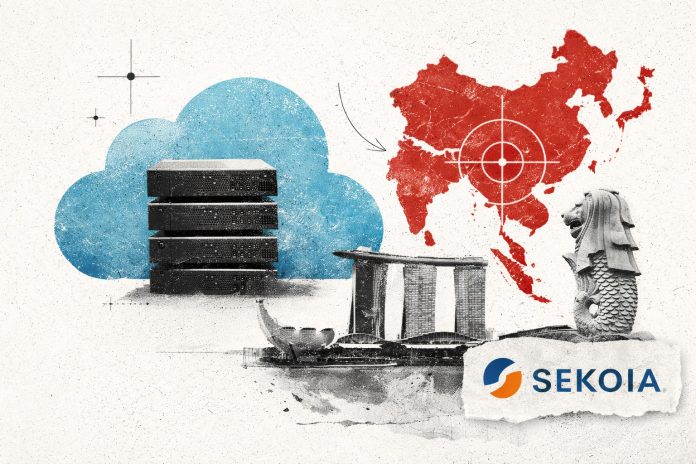
Sekoia has launched a SaaS region in Singapore, expanding its AI-driven Security Operations Center (SOC) platform across the Asia-Pacific and Japan (APJ) region. The French cybersecurity firm positions itself in a market where data residency requirements are becoming increasingly crucial, especially in the financial services sector, countering American competitors who are subject to the Cloud Act.
With the addition of Singapore, Sekoia now operates five dedicated hosting regions: France, Monaco, the United Arab Emirates, the United States, and Singapore. This local infrastructure ensures that security data for organizations in the APJ region is hosted within the area, facilitating compliance with local data residency regulations. Additionally, reduced latency enhances response times for critical security operations. The SaaS model eliminates initial infrastructure investment while maintaining access to advanced detection capabilities.
The primary targets for Sekoia in this expansion are large enterprises, financial institutions, and managed service partners across the Asia-Pacific and Japan. “Cyber threats are global, but for highly regulated industries like financial services, data protection remains intensely local. By bringing our infrastructure directly to Singapore, we empower our partners and clients to build fast and resilient security operations without ever compromising data sovereignty,” said Fabien Dombard, Vice President of JAPAC at Sekoia.
Singapore: A Gateway for Data Sovereignty
Sekoia’s business positioning emphasizes data sovereignty and regulatory compliance, aligning closely with European frameworks. Extending this model to Singapore, where data residency requirements fall under local law, is a logical step in delivering on this promise within a distinct regulatory environment. For Chief Information Security Officers (CISOs) of multinational organizations with entities in the APJ region, the benefits are tangible: a unified SOC on a single platform with locally hosted data according to jurisdiction, avoiding the proliferation of detection tools across different geographies.
Sekoia presents its multi-region architecture as a direct competitive advantage over American firms, whose infrastructures are governed by the Cloud Act, regardless of the physical location of their servers. The AI SOC platform combines attacker intelligence, automated detection, and incident response within an interoperable environment that works seamlessly with existing third-party solutions, allowing organizations to leverage their deployed tools without needing to overhaul their security architecture.
Black Hat Asia 2026 as a Business Catalyst
Sekoia is showcasing its new infrastructure at Black Hat Asia 2026, a premier cybersecurity event in the region. The conference brings together CISOs and security operations leaders, providing a platform where announcements of local infrastructure resonate directly with purchasing decisions in regulated sectors.
The publisher’s multi-region strategy enables it to respond to public tenders and the requirements of regulated sectors while adhering to its data sovereignty architecture. The APJ region represents a high-growth market for managed SOC platforms, driven by the professionalization of security teams and the tightening of local data protection regulations, particularly in Singapore, Australia, and Japan.