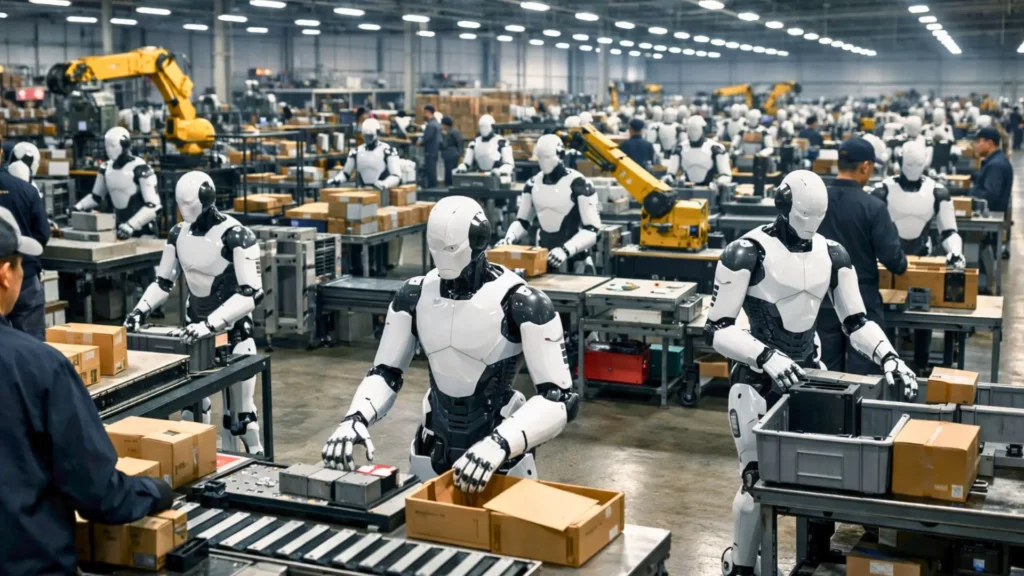
China is accelerating its humanoid robotics efforts with giant training centers. At these facilities, human operators repeat ordinary gestures to generate rare physical data. The goal is clear: to move beyond demonstrations and prepare for real-world applications in factories and beyond.
Why Robots Train in Large Facilities Rather Than Online: The True Shortage Is Physical Data
Generative models consume text, images, and sound. However, a robot must grasp, push, bend, and manage its strength. Unfortunately, these rare physical data do not exist in abundance online. Therefore, they must be produced, gesture by gesture, in real-world settings.
This is the crux of the issue. Researchers refer to it as embodied AI because the algorithm learns through a physical presence. According to Reuters, this data shortage is hindering the entire sector. This is why China is funding facilities dedicated to data collection, training, and sharing.
In Shanghai, Beijing, and Wuhan, Giant Centers Repeat Everyday Actions to Feed Models
The movement begun in Shanghai. The first major heterogeneous center opened in January 2025, covering approximately 5,000 square meters. Over 100 robots are practicing simple tasks. The aim remains consistent: to lower costs and accelerate learning.
In Beijing, the scale has expanded even further. A center announced in October 2025 spans 10,000 square meters and simulates sixteen scenarios. Robots there sort, package, and organize items. Local authorities report the generation of more than six million data points per year.
Other sites are advancing quickly, particularly in Wuhan, where operators guide the robots via virtual reality. They prepare coffee, fold laundry, or clean tables. The validated sequences are then uploaded to the cloud to train the underlying models.
How These Schools Are Already Changing the Industry: Sales, Testing, and Concrete Uses
This strategy is already yielding commercial results. Rest of World reports that UBTech sold 566 million yuan worth of humanoid robots to three collection centers. It is no longer just a simple pilot market. A pilot market is already in existence.
The initial outlets remain industrial. Automotive factories, logistics, and quality control offer repetitive and measurable tasks. This creates an ideal environment to enhance machine reliability. Simultaneously, several Chinese companies are promising mass production by 2026.
Why This Advantage Intrigues So Much: The Global Race for Humanoids Evolves Beyond Mere Spectacle
This rapid development is intriguing because it alters the nature of the global race. Previously, humanoids primarily dazzled in exhibitions or videos. Now, the competition focuses on the physical memory of machines. Those who gather the best motions can train their systems more quickly.
However, the outcome remains uncertain. Researchers quoted by Rest of World express doubt that massive data collection alone will lead to truly autonomous robots. Others place greater emphasis on simulation or terrain-derived data. The technical debate is far from settled.
What is changing now is the scale. With public assistance, local supply chains, and shared centers, China is establishing a cumulative advantage. If these robots gain reliability, you will see them first in factories, and only later will they target household tasks.