

Samsung Now Brief: The hidden setting that boosts AI… at the cost of your privacy?
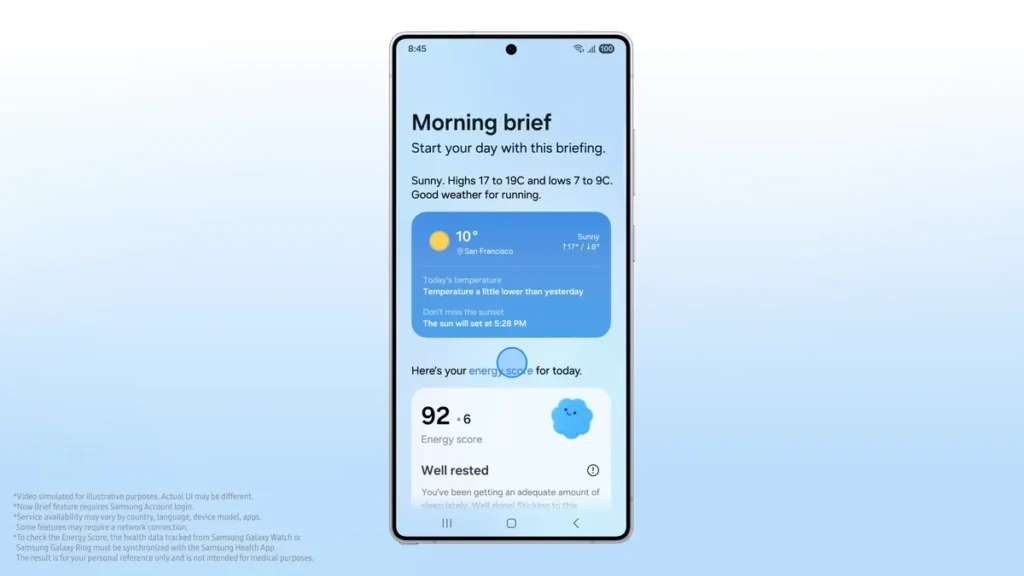
On paper, Now Brief ticks all the boxes of a modern smart assistant: a single card on the locked screen or home page that summarizes the weather, schedule, reminders, habits, and offers some suggestions. Samsung has also positioned it as a key element of Galaxy AI, designed to align with your context.
In practice, many users describe it as an inconsistent tool: suggestions that sometimes miss the mark, outdated news, and a feeling of redundancy with apps that are already in use. This is where the “invisible” toggle becomes interesting—and a bit more complicated.
“Get More Detailed Insights”: The Setting That Changes the Nature of Now Brief
Samsung has added an option in the Now Brief settings called “Get More Detailed Insights.” The idea: make the brief more relevant by allowing deeper customization through partners, including YouTube and Gemini (Google).
The sensitive point is what this entails: enabling these toggles can lead to sharing a much broader range of data than one might expect for mere “recommendations,” potentially including calendar, reminders, reservations, browsing activity, and content preferences (such as video history).
Samsung emphasizes two important points:
- It’s optional;
- The “basic” version of Now Brief operates without these toggles.
Why Is Samsung Doing This Now?
Now Brief is typically the kind of feature that only holds value if it is accurate. An “average” brief quickly becomes a widget that users ignore. Conversely, a truly useful brief requires… context.
Samsung markets Now Brief as a personalized briefing based on daily routines (planning, events, reminders). However, to achieve relevance, the company increasingly relies on third-party ecosystems—here, Google—that can feed a richer recommendation engine.
The Real Trade-off: Convenience vs. Privacy
This is the classic dilemma of “personal” AI:
- If you keep Now Brief simple, you limit data collection/sharing but settle for an assistant that can sometimes be overly generic.
- If you enable “Get More Detailed Insights,” you increase the chances of receiving more relevant suggestions… in exchange for a more nuanced understanding of your digital routine.
This isn’t an abstract concern: settings explicitly linked to YouTube and Gemini clearly indicate that personalization comes at the cost of data interoperability.
Ultimately, Now Brief isn’t “bad”; it’s revealing. The promise of a screen that understands you depends less on the UI than on the following question: how much do you accept being readable to receive more accurate suggestions?



