Apple C1X Modem: iPhone Air Finally Catches Up to Qualcomm According to Ookla
In the smartphone world, discussions often focus on chips, massive batteries, dazzling screens, and increasingly ambitious photo sensors. Yet, a fundamental truth remains: a phone primarily serves to keep us connected. On that front, Apple seems to have taken a significant step forward.
According to recent results from a study by Ookla, Apple’s in-house modem C1X in the iPhone Air (and iPhone 17) is closing in on Qualcomm’s Snapdragon X80, turning a once hesitant project into a compelling strategic asset.
From the Imperfect Apple C1 to the Much More Credible Apple C1X
Apple’s first modem, the C1, made its debut with the iPhone 16 in February 2025. Apple touted it as its first cellular modem, emphasizing its energy efficiency. However, the shift away from Qualcomm remained incomplete, as early generation network components need time to mature.
The second phase arrived with the iPhone Air, unveiled in September 2025. Apple introduced the C1X, claiming it to be up to twice as fast as the C1 and 30% more efficient than the modem used in the iPhone 16 Pro, while also asserting that it was the most power-efficient modem ever put in an iPhone.
On paper, the claims were ambitious; in actual usage, they are beginning to hold credible weight.
The Real Strong Signal Comes from Ookla: Apple Has Nearly Closed the Gap
This week’s data reveals that the C1X reaches nearly equal download speeds compared to Qualcomm’s X80 used in the iPhone 17 Pro Max, while also showing marked improvement over the C1 of the iPhone 16. The enhancement is especially noticeable in median network conditions, which reflect what most users experience daily, balancing typical congestion and imperfect coverage.
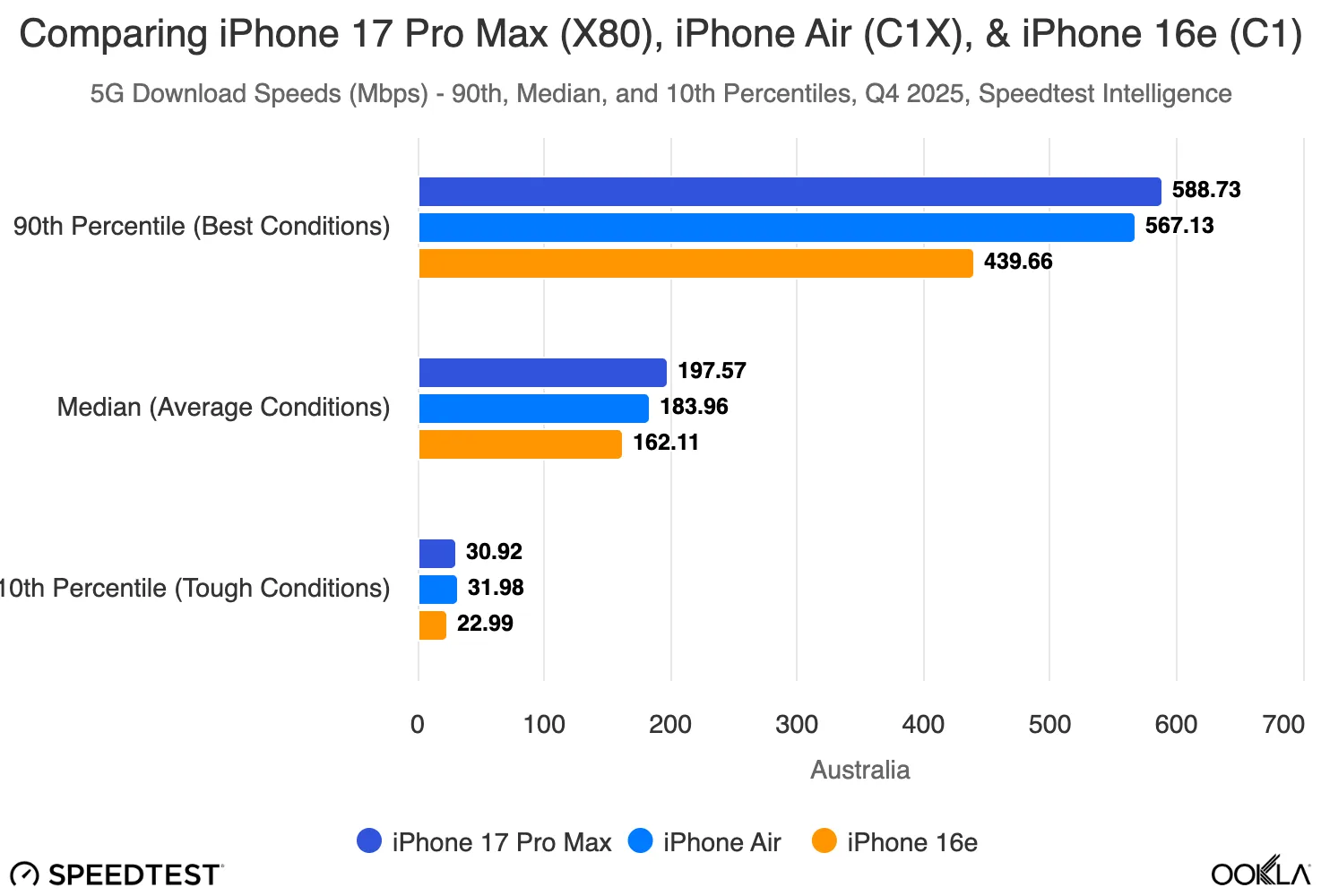
A particularly noteworthy point is latency. According to these results, the iPhone Air equipped with the C1X outperforms the iPhone 17 Pro Max in 19 of the 22 markets studied. However, Qualcomm still maintains an advantage in upload speeds, which can be significant depending on the region, a gap attributed by several iterations of the study to Qualcomm’s more mature upstream aggregation technologies.
Apple Isn’t Winning Everywhere, but the Trajectory Is Clear
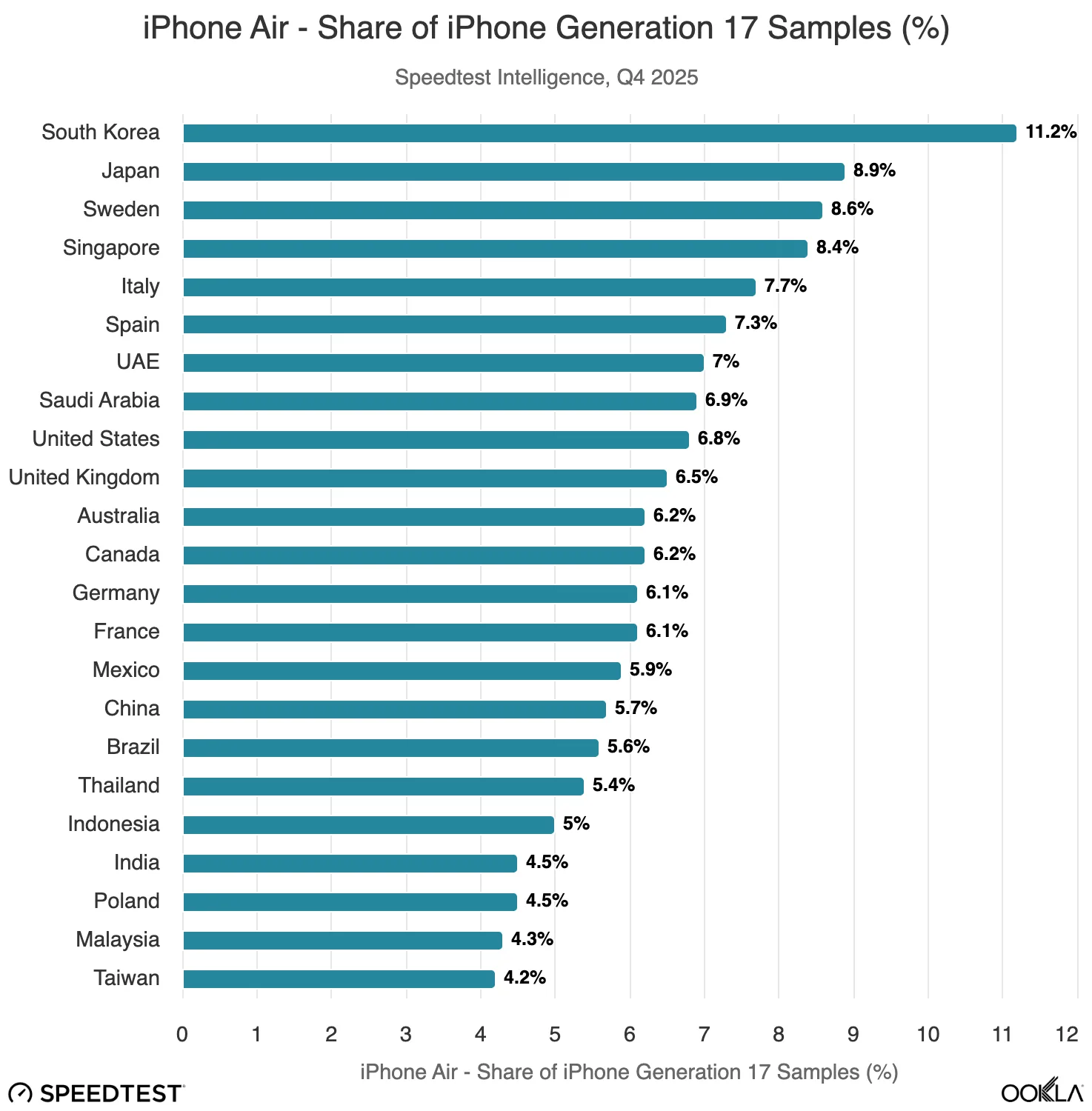
Improvements vary across markets. Gains are especially notable in countries like the United States, United Arab Emirates, Saudi Arabia, China, Sweden, Singapore, and Japan, where the modem appears to better utilize certain intermediate 5G bands in congested conditions. Conversely, the gap is narrower in Brazil, India, and Malaysia, where other network constraints more heavily impact the experience.
In other words, the C1X does not eliminate all structural disparities in mobile networks, but it demonstrates that Apple has finally established a competitive foundation.
This is where the strategy becomes clear. Apple is no longer just aiming to replace Qualcomm for reasons of vertical integration or margins. The company seems to be successfully integrating this modem into its overall vision: greater efficiency, tighter control between hardware and software, and a smoother perceived experience, even if it doesn’t dominate every benchmark category. This conclusion remains an inference, but it’s strongly supported by latency results and Apple’s narrative around the C1X.
Qualcomm Is Still in the Game, but Not for Much Longer
Apple has not entirely severed ties with Qualcomm yet. The iPhone 17, iPhone 17 Pro, and iPhone 17 Pro Max still feature Qualcomm modems, with the Snapdragon X80 identified in the iPhone 17 Pro Max and largely associated with the iPhone 17 series outside the Air model. However, the balance of power is shifting: where Apple’s first modem appeared as a compromise, the C1X now stands as a serious alternative.
Future developments are already hinted at with rumors surrounding the Apple C2. Multiple specialized sources suggest that Apple is preparing this next-generation modem for the iPhone 18 Pro. At this point, nothing has been officially confirmed by Apple, so it remains speculative. However, if this roadmap holds true, it’s clear: Cupertino aims to further reduce its reliance on Qualcomm, and much more quickly than many anticipated just a year ago.
Connectivity Returns as a Differentiation Factor
This narrative ultimately tells a broader story about premium smartphones. For a long time, the modem remained an invisible component in marketing narratives, despite its crucial role in the actual experience. Apple appears to be reclaiming a central place for this technical layer, integrating it into its ambition for total product mastery rather than showcasing it as a gadget.
In summary, the C1X does not yet signify total victory over Qualcomm. However, it represents something much more significant: the end of the notion that an Apple modem would inevitably be inferior. And in an industry where connectivity remains the most fundamental promise of a smartphone, that is no trivial matter.