

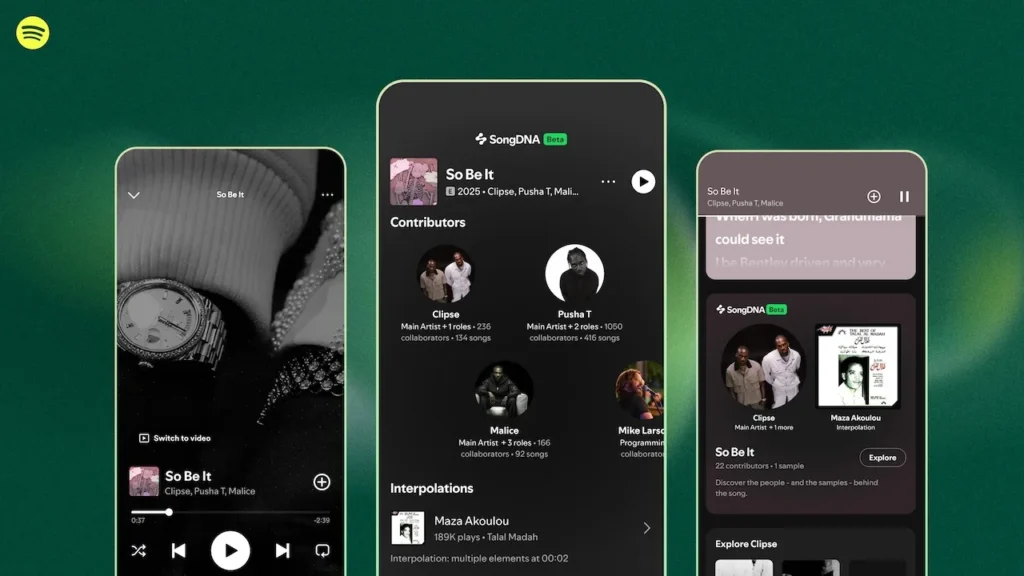
Spotify SongDNA: The Tool That Reveals the Secret Genealogy of Your Favorite Tracks
Spotify aims to go beyond simple algorithmic recommendations. With SongDNA, its newly announced beta feature this week, the platform offers a new way to discover music: not just through taste similarity, but through creative lineage.
Behind a title, it’s no longer just about listening to a track; it’s about tracing its genealogy—songwriters, producers, samples, interpolations, covers, and collaborations.
SongDNA: A Discovery Logic That Finally Goes Beyond Playlists
The concept of SongDNA is straightforward in theory but ambitious in execution. From the currently playing view, users can open a dedicated map and explore the people and creative connections behind a track. Spotify highlights songwriters, producers, and collaborators for a title, as well as the samples, interpolations, and covers that influenced or extended it. The track ceases to be an isolated unit and transforms into a node within a much larger musical map.
This represents an interesting shift in how Spotify narrates music discovery. Until now, the platform excelled primarily at predicting what a user might like next.

With SongDNA, Spotify seeks to answer a different question, one that is more cultural than mathematical: why does this track exist in this form, and what is it connected to? This shift is significant, as it adds narrative depth to music exploration that automated playlists often cannot provide.
Spotify Focuses on Credits, Relationships, and the Memory of Songs
In its official communication, Spotify states its desire to highlight “the humans” behind the music. SongDNA aligns with this broader strategy of valuing credits and creation stories. This feature allows users to trace an artist’s collaborators to other projects, creating a nearly encyclopedic chain of connections.
SongDNA partly relies on data from WhoSampled, a community database specializing in samples and musical lineage, which Spotify integrated into its ecosystem last year. This provides the tool with a depth that traditional metadata cannot offer.
A Product That Feels More Like an Experience Than Just a Feature
This is likely what makes SongDNA more intriguing than yet another recommendation tool. Spotify isn’t merely looking to enhance the relevance of its suggestions; it is building a musical navigation experience where one moves from a track to a producer, from one producer to another artist, and then from a sample to an older work. The act of listening becomes almost an act of investigation.

In this regard, SongDNA could enhance Spotify’s cultural value at a time when all platforms can already recommend “something to listen to.” The distinction now lies not only in prediction but also in the ability to enrich the relationship between the listener and the music. On this front, context can sometimes matter as much as personalization. This analysis derives from SongDNA’s official positioning.
Deployment: Beta Launched, but Not Fully Rolled Out Yet
Spotify indicates that SongDNA is beginning to roll out to Premium subscribers globally on mobile, within the playback interface.
In other words, SongDNA is no longer just a laboratory promise; it is already a tangible product direction that illustrates how Spotify plans to make its app more interactive, explanatory, and immersive.
With SongDNA, Spotify seems to recognize a limitation of traditional recommendations: they are effective but often opaque. While users discover new music, they may not always understand the path taken. By unveiling the “black box” of musical relationships, the platform adds a layer of intelligibility to listening.
In short, SongDNA does not replace the algorithm. Instead, it provides context, a narrative, and a visible logic. In a streaming economy where abundance can quickly become abstract, this ability to narrate the connections between works may become one of the most elegant tools for modern music discovery.



