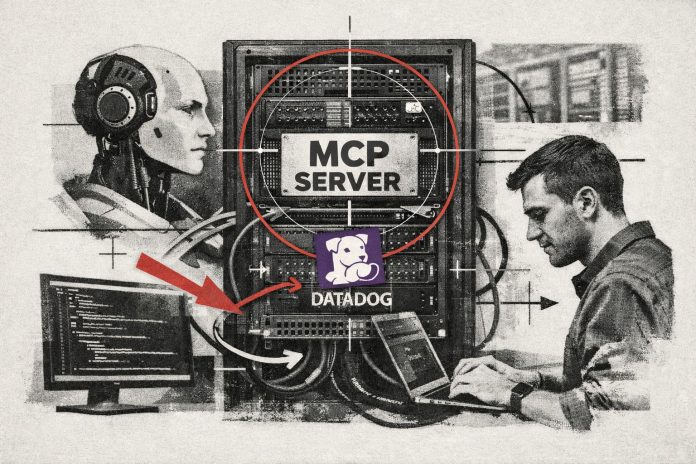
Datadog has officially launched its MCP Server, designed to connect AI agents to real-time observability data on its platform. Engineering teams can now query logs, metrics, and traces directly from their AI development environments—such as Codex, Claude Code, and Cursor—without changing context, while maintaining existing security and governance controls.
<p>This announcement aligns with the growing trend of industrializing AI agents in production environments, where secure access to data has become a technical prerequisite. In this setting, the Model Context Protocol (MCP) is increasingly establishing itself as the standard for interoperability between AI agents and company information systems. Initially developed by Anthropic, this protocol has garnered interest from an expanding number of vendors implementing it to expose their data and functionalities to third-party agents.</p>
<p>Datadog, whose platform centralizes telemetry from complex cloud systems, exemplifies a notable use case: development and operational AI agents require access to production signals to diagnose, correct, and automate tasks without the need for constant human intervention. The general availability of Datadog's MCP Server marks a transition from an experimental phase to large-scale deployment within organizations.</p>

<h4><strong>Real-Time Access to Datadog Telemetry</strong></h4>

<p>Datadog's MCP Server provides logs, metrics, and traces from its unified observability platform directly to AI agents working in development environments. Compatible coding agents, including OpenAI’s Codex, Anthropic’s Claude Code, and Cursor, can query this data without leaving their workflow context. For instance, a developer investigating a production incident from their IDE can instruct their AI agent to fetch relevant error traces from Datadog, identify anomalies, and suggest a fix—all without manually switching between interfaces. This mechanism reduces incident resolution time by eliminating context switches that disrupt engineering workflows.</p>

<p>The ability to support multiple coding agents simultaneously indicates Datadog's commitment to an open integration strategy, consistent with positioning MCP as an agnostic interoperability protocol. For CIOs and engineering managers, this openness simplifies adoption: teams using different agents based on individual preferences or projects can all access the same source of Datadog telemetry without the need for specific integration developments per tool.</p>

<h4><strong>Governance Features to Control AI Agents</strong></h4>

<p>Beyond data retrieval, the MCP Server allows AI agents to interact with systems, trigger alerts, initiate automated responses, and modify configurations within the security and governance frameworks defined by the organization. This aspect is crucial for Chief Information Security Officers (CISOs): the autonomy granted to AI agents in production must not circumvent existing access and authorization policies. Datadog positions its MCP Server as a structured access layer that inherits permissions and constraints from the observability platform rather than offering direct, unmediated access to production data.</p>

<p>Yanbing Li, Chief Product Officer at Datadog, articulates the challenge: “By combining the telemetry of Datadog’s unified observability platform with AI workflows, we are paving the way for the next stage of AI-native development, moving from simple AI copilot roles to AI operating within production systems.” This statement underscores the ongoing shift in mature organizations: AI agents are not only assisting developers in writing code but are actively involved in detecting, deciding, and remediating incidents in production environments. For DevSecOps teams, this necessitates clearly defining the authorized scope of action for each agent and tracking executed actions to meet auditing requirements.</p>

<h4><strong>Reduction in Integration Costs</strong></h4>

<p>Datadog’s MCP Server incorporates a dynamic protocol designed for communication between agents, which minimizes the risk of incompatible changes arising from API updates. In multi-agent architectures, where multiple autonomous systems query each other, the stability of communication interfaces is vital for operational reliability. A static protocol exposed via a conventional REST API forces teams to maintain specific adapters for each version, creating significant technical debt as system complexity increases.</p>

<p>For platform teams and IT architects, the general availability of Datadog's MCP Server alleviates integration challenges for AI-driven automation projects. A key consideration during evaluations will be the pricing model: whether access to the MCP Server is included in existing Datadog subscriptions or represented as an additional offering. Datadog has not clarified this point in its announcement, prompting users to review contractual terms before large-scale deployment.</p>
<div class="td-a-rec td-a-rec-id-content_bottom  td-rec-hide-on-p tdi_3_dff td_block_template_1">
    <style>
        /* custom css */
        .tdi_3_dff.td-a-rec-img {
            text-align: left;
        }
        .tdi_3_dff.td-a-rec-img img {
            margin: 0 auto 0 0;
        }
    </style>
</div>