

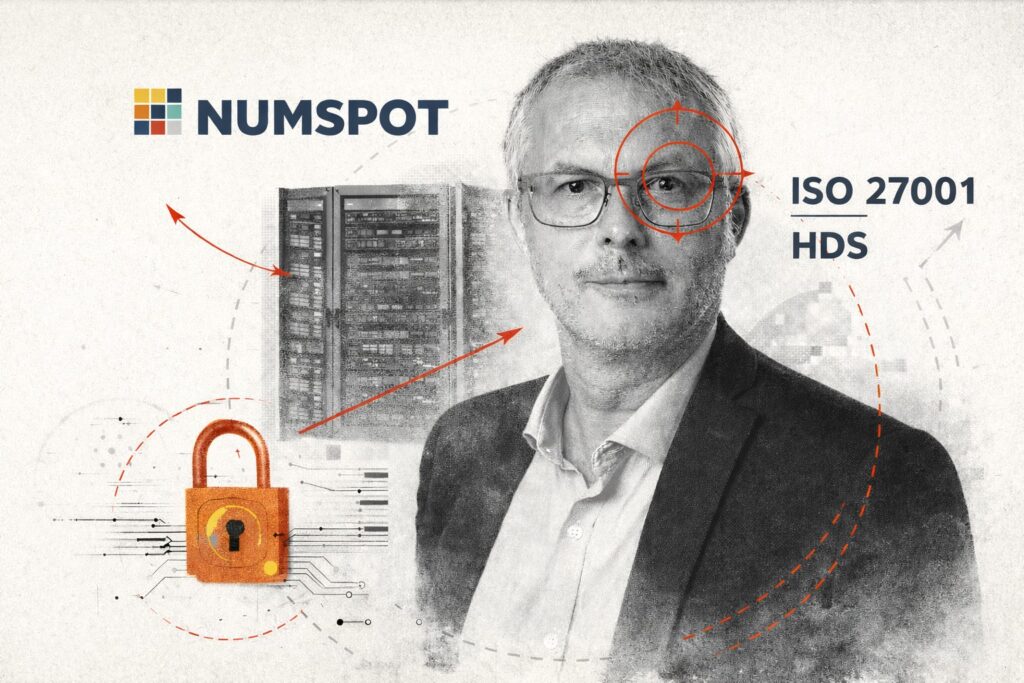
Numspot Expands ISO 27001 Certification to Cloud and AI Managed Services, Achieves Health Data Hosting Certification
Numspot, a prominent player in the cloud services sector, has announced an expansion of its ISO 27001 certification to encompass its cloud and AI managed services platform. The company has also secured the Health Data Hosting (HDS) certification, which now includes production environments within the audited scope. This achievement allows the hosting of personal health data, providing CIOs and CISOs with a certified foundation for handling regulated workloads.
With this certification extension, Numspot’s information security management system (ISMS) now covers the entire technical cycle—from development to production workloads—backed by organizational and technical controls audited by an accredited certifying body. This certified scope enables the hosting of regulatory-compliant workloads, including health data.
Numspot previously held ISO 27001 certification for its internal processes and development chain. “We started by certifying the manufacturing scope of our offerings, which includes the entire development chain and all cross-company processes. Now, what goes into production is also certified from both a technical and organizational standpoint, integrated within the ISMS with regular control plans,” explained Olivier Lavaux, Chief Information Security Officer (CISO) of Numspot. This extension integrates operational environments into the audited scope, featuring access controls, change management procedures, security logging, and periodic reviews as mandated by the ISMS.
Continuous Auditing and the HDS Certification
The introduction of HDS certification necessitates a regime of continuous auditing. Lavaux describes a system under constant scrutiny: “Beginning in March 2025, Numspot will undergo audits every three weeks. This includes internal audits, mandatory audits, and preliminary audits. We continuously measure ourselves, identify areas for correction, and take action.” This rigorous schedule directly influences the evolution of processes and technical configurations.
The HDS certification permits Numspot to host and process personal health data for healthcare institutions, software publishers, manufacturers, and e-health entities. This qualification imposes specific requirements concerning resilience, traceability, incident management, and infrastructure availability.
To maintain compliance, Numspot relies on architecture certified as HDS-independent physical infrastructure. Lavaux elaborates on a cross-data center portability mechanism: “If a HDS-certified data center loses its certification, we can seamlessly offer clients the option to relocate their data to another certified facility. This process is completely transparent to them—there’s no service disruption or need for renegotiation.” This mechanism hinges on infrastructure abstraction and redeployment procedures already integrated into the platform.
Integrated Logs, Evidence, and Investigative Processes in the Cloud Model
Numspot ensures that clients have access to technical logs and information necessary for their audits and security investigations. Lavaux states, “When clients come to us, we aim to facilitate their own certification processes. This involves providing evidence. A certification relies on proof; thus, we must deliver logs and information to help them investigate incidents more quickly.” These resources align with the compliance processes demanded by CIOs and CISOs.
Additionally, this model emphasizes strict isolation of client environments. Lavaux explains, “We ensure that any incident remains contained within the client’s environment. There is no propagation; one client cannot be affected by another, and even if something occurs at Numspot, the client remains unaffected.” This isolation is achieved through environment segmentation, centralized logging, and incident response procedures tailored for shared architectures.
Adhering to ISO 27036 for Supply Chain Security
Numspot also implements the requirements of ISO 27036 to guide security in its supplier relationships. Lavaux highlights the rising security risks associated with supply chains: “The supply chain poses a threat. An examination of incidents reveals it as a major attack vector. Therefore, we conduct dedicated risk analyses for our suppliers, manage information flows, and avoid any interconnection that could allow remote control of our information system.” This oversight includes providers involved in the platform’s operation.
Operating on an open-source and infrastructure-as-code basis, Numspot ensures the portability of workloads. Lavaux summarizes this approach: “We utilize infrastructure as code and open-source technologies. Numspot is portable; clients can restart services either locally or on another cloud. This internal resilience at Numspot directly benefits our customers.” The platform features native backup and recovery mechanisms, enabling rapid restoration of application environments.
A French Shareholding Structure Supporting Access to Regulated Markets
Numspot benefits from a shareholder structure comprising the Banque des Territoires, Docaposte, Dassault Systèmes, and Bouygues Telecom. Lavaux notes that this arrangement shields the company from extraterritorial constraints and enables collaborative responses to certain public sector markets, especially related to health data alongside Docaposte, while adhering to conventional award procedures.
Eric Haddad, President of Numspot, connects these certifications to the operation of a hybrid, portable platform designed for regulated data, AI, and application projects. For CIOs and CISOs, these qualifications translate into a certified production environment, documented incident isolation, cross-data-center portability, and direct access to essential evidence for internal and regulatory audits.



