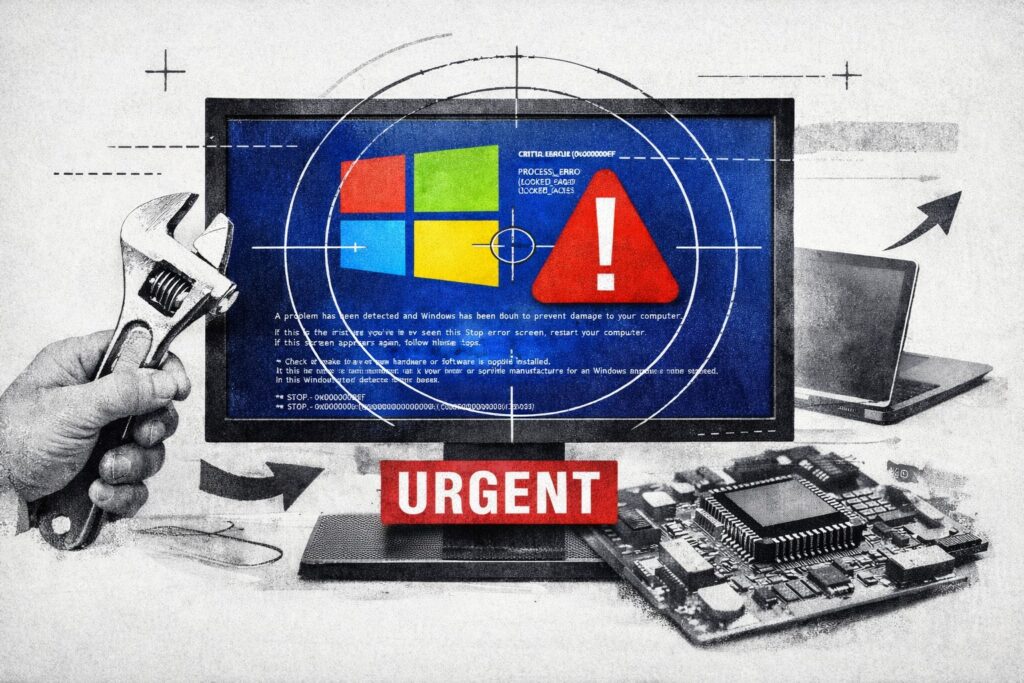
Microsoft’s January 2026 Windows 11 Update: A Case Study in Patch Management Gone Awry
The January 2026 update for Windows 11 is set to become a significant chapter in Microsoft’s support history, marked by the extensive operational failures it unleashed and the swift corrective measures that followed. Initially intended to bolster security for versions 23H2, 24H2, and 25H2, the cumulative update delivered on January 13 inadvertently triggered a series of serious incidents.
The original update sought to address 42 vulnerabilities identified in the CERTFR-2026-AVI-0044 advisory, including seven critical flaws affecting key components of the operating system. These vulnerabilities included privilege escalation issues through Win32k (CVE-2026-20589, CVE-2026-20605), remote code execution risks in Hyper-V (CVE-2026-20611, CVE-2026-20609), and potential attacks targeting the LSASS authentication service, NTFS file system management, and active vulnerabilities in Secure Boot. Some of these flaws were actively exploited, prompting Microsoft to expedite the rollout of the cumulative patch to mitigate the window of exposure to targeted attacks.
However, the deployment was accompanied by numerous functional regressions. Users quickly reported an inability to access files stored on OneDrive or Dropbox, repeated crashes of the Outlook client when handling PST files hosted in the cloud, and failures when attempting to resume remote sessions via Remote Desktop or Cloud PC. System logs also indicated unexpected reboot cycles on certain machines, particularly those equipped with TPM 2.0, which were linked to conflicts with Secure Launch or third-party security drivers.
Multiple Failures Uncovered
Technical analysis revealed several underlying issues: firstly, poor management of shared file locks in cloud environments led to application freezes and context loss in Outlook; secondly, defects in SMB synchronization resulted in data corruption or incomplete operations on network shares with snapshots. Furthermore, the Secure Launch process, aimed at enhancing the integrity of secure boot on newer configurations, caused conflicts, resulting in reboot loops or boot failures on certain devices.
In response to the scale of the reported issues, Microsoft released two out-of-band patches on January 24: KB5078127 for Windows 11 versions 25H2 and 24H2, and KB5078132 for version 23H2. These updates aim to restore stability across several areas:
- Resolving memory leaks and freezes associated with using the classic Outlook client with PST files synchronized to cloud storage (OneDrive, Dropbox).
- Fixing SMB synchronization issues on network shares with snapshots, ensuring data operation integrity.
- Addressing session resume problems in Remote Desktop and Cloud PC environments, particularly after prolonged sleep or system reboots.
- Implementing specific adjustments to Secure Launch and TPM 2.0 to prevent unexpected reboot cycles and secure boot failures.
Microsoft Urges Immediate Deployment of Fixes
This incident underscores the limitations of real-world validation processes and highlights that, despite the increasing sophistication of patch management tools, the complexity of Windows 11 environments makes it challenging to foresee all interactions. Microsoft now advises all system administrators to implement these out-of-band fixes as a matter of urgency, particularly in environments where cloud synchronization, virtualization, or remote access are critical functions. A thorough review of event logs and diagnostic tools (such as Event Viewer and Windows Health Dashboard) is recommended to ensure that anomalies have been resolved and compatibility is maintained with business-critical applications.
The CERTFR-2026-AVI-0044 advisory emphasizes the severity of the initial vulnerabilities and the urgent need to integrate all released patches without delay. This sequence of events illustrates that the goal of a seamless deployment with minimal impact has not been achieved in January. The proliferation of incidents and the rapid mobilization of out-of-cycle patches highlight the ongoing challenge of balancing security requirements with operational stability in a heterogeneous and extensively connected Windows 11 ecosystem.