Bouygues Telecom Business Unveils bSecure Managed XDR: A Comprehensive Cybersecurity Solution
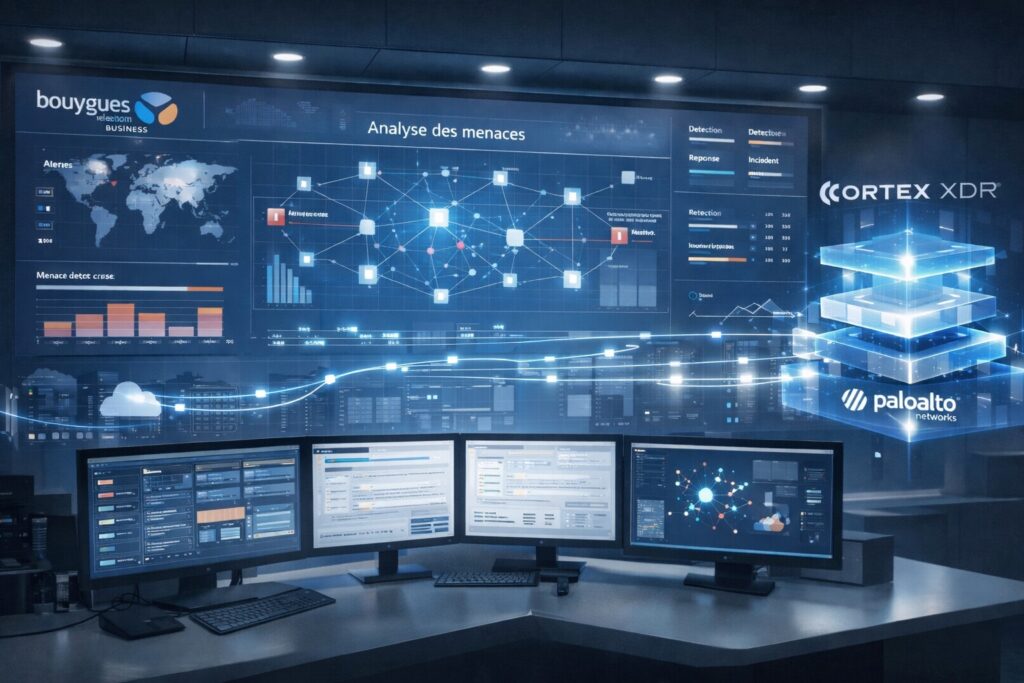
Bouygues Telecom Business has announced the launch of bSecure Managed XDR, an extended detection and response service operated through its Security Operations Center (SOC) and powered by Palo Alto Networks’ Cortex XDR platform. Tailored for large enterprises, mid-sized companies, and public organizations, this new offering represents a significant evolution in managed SOC services, transitioning towards industrialized solutions for the correlation, analysis, and remediation of security incidents.
The introduction of bSecure Managed XDR expands Bouygues Telecom Business’s cybersecurity service catalog, integrating XDR capabilities with managed SOC services. This solution utilizes Palo Alto Networks’ Cortex XDR technology along with the operational expertise of the operator’s SOC. It is specifically designed to monitor extensive, distributed information systems facing increasing pressure for threat detection and operational responsiveness.
Central to this offering, the Cortex XDR platform aggregates and analyzes data from multiple security sources to identify abnormal behaviors and complex attack chains. This comprehensive approach extends beyond traditional endpoint protection, encompassing network and application signals, thereby facilitating a contextual understanding of incidents and more nuanced alert prioritization.
Leveraging these advanced correlation and behavioral analysis capabilities, Bouygues Telecom Business aims to significantly reduce incident detection and response times. By automating certain remediation actions, the service also alleviates the operational burden on clients’ internal teams, which are often overwhelmed by a flood of disparate alerts.
A Managed Service to Navigate Complexity
Operated by Bouygues Telecom Business’s SOC, bSecure Managed XDR ensures continuous monitoring and real-time analysis of security incidents. SOC teams are actively involved in investigating alerts, validating threats, and guiding corrective actions, relying on contextual information provided by the XDR platform.
This model addresses a widespread challenge in the market: the escalating volume and sophistication of attacks coupled with a shortage of cybersecurity talent. Many organizations find themselves compelled to outsource critical detection and response functions. Managed SOCs supported by XDR platforms provide a practical solution to this operational dilemma.
Cortex Platform as a Technological Foundation
The choice of partnering with Palo Alto Networks stems from Cortex’s ability to unify detection, analysis, and automation functions within a single, cohesive environment. For Bouygues Telecom Business, this technological foundation enables them to scale their security services while ensuring consistency across operations.
Palo Alto Networks, in turn, benefits from the integration of Cortex XDR into an offering executed by a telecom provider, enhancing the reach of its platform in the managed services sector. Étienne Bonhomme, Vice President for France and NGS EMEA, emphasizes the synergy between the network visibility provided by Bouygues Telecom Business and the analytical capabilities of the platform, facilitating a tangible modernization of SOCs.
An Adaptive Architecture for Cyber Maturity
Bouygues Telecom Business highlights the scalability of bSecure Managed XDR, which is designed to progressively incorporate additional cybersecurity components and consolidate existing tools into a unified architecture. This modular approach allows organizations to adjust their protection scope based on specific needs and cybersecurity maturity levels.
With this offering, Bouygues Telecom Business reaffirms its commitment to enhancing value in the managed security services market. For client companies, the challenge lies in accessing advanced detection and response capabilities without bearing the full burdens of the technological and organizational complexities that contemporary cybersecurity demands at the scale of modern information systems.