

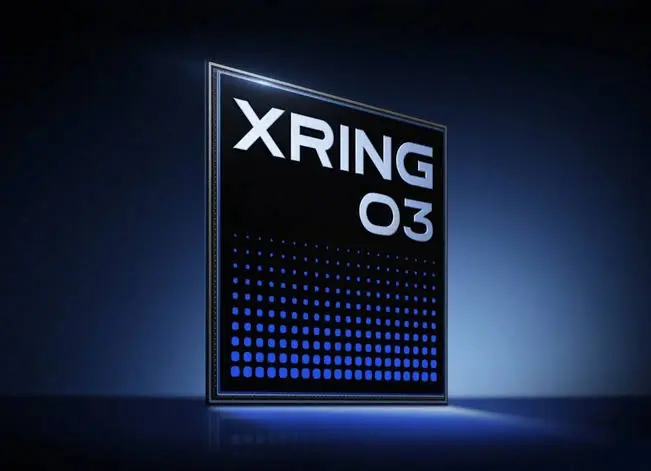
Xiaomi Xring O3: The new 3nm SoC manufactured by TSMC aims at future foldable smartphones
Xiaomi has taken a significant step in its silicon strategy with the Xring O3, its second major SoC developed for smartphones. Still manufactured by TSMC at 3nm, this chip is expected to help the Chinese manufacturer gain better control over the integration between hardware, HyperOS, and AI, without immediately phasing out Snapdragon and Dimensity from its lineup.
Xiaomi Officializes the Xring O3
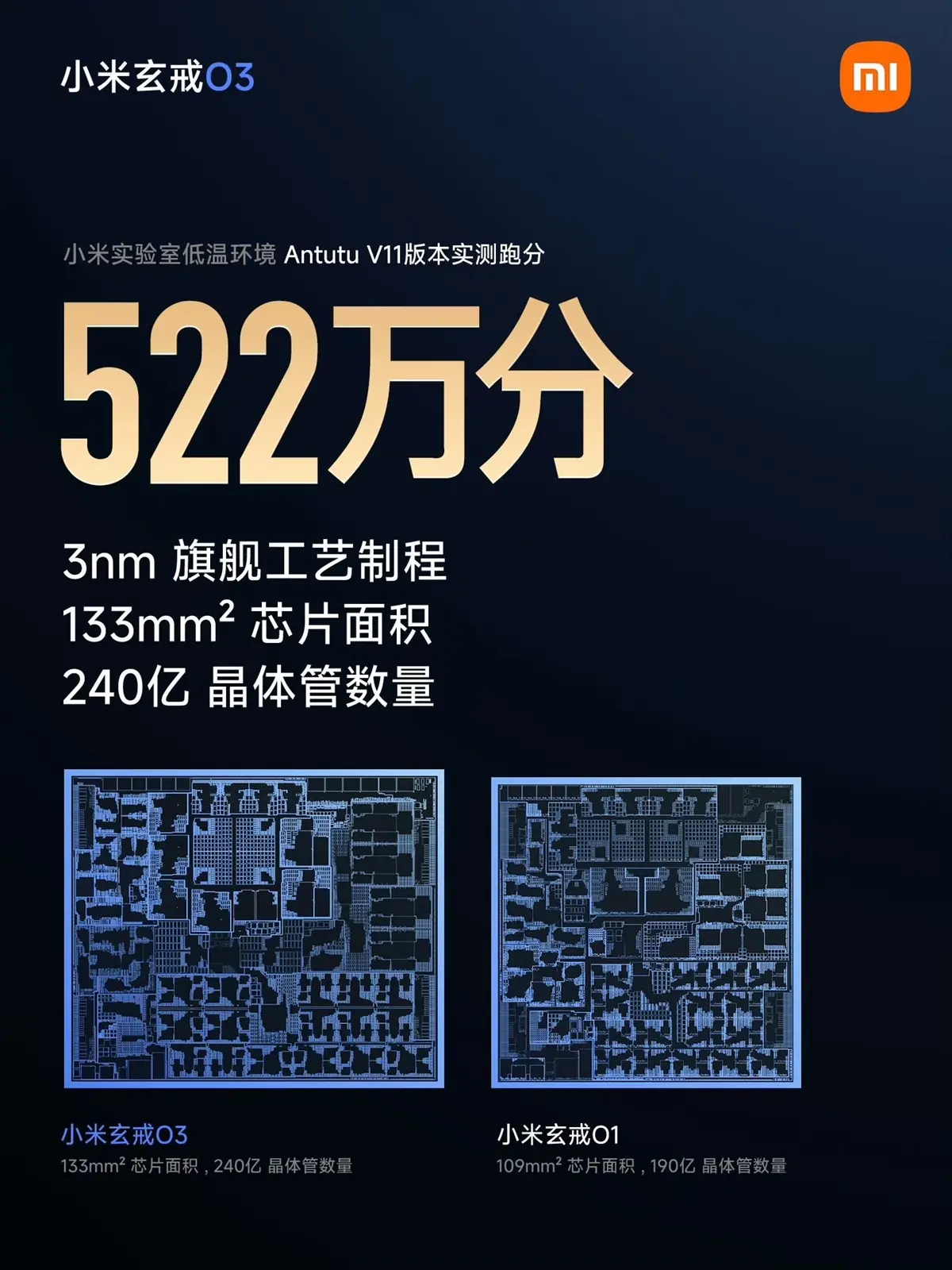
The Xring O3 is now official. Xiaomi introduced this new generation of smartphone processor on August 24, 2026, just over a year after the launch of the Xring O1. According to Reuters, the chip will be manufactured by TSMC using a 3nm process.
This choice is significant. Xiaomi continues its strategy of internal design while outsourcing fabrication to an external foundry, similarly to Apple with its A and M chips. The aim is not to become a new TSMC, but to have greater control over what happens inside its products.
Initial production volumes are expected to be relatively modest, with sources indicating an initial output of between 200,000 and 300,000 units. This is far from the tens of millions of Snapdragon or Dimensity chips shipped each year. However, this volume is already higher than what Xiaomi reportedly sold with the Xring O1 solely in smartphones.
The brand appears to be progressing in stages rather than abruptly transitioning its entire catalog to its own chips.
The Xring O1 Served as a Testing Ground
The Xring O1 marked Xiaomi’s return to high-end mobile processor design. Approximately 150,000 smartphones equipped with this chip are currently in circulation. When including tablets and smartwatches, Xring O1 product sales would exceed a million units.
This initial phase likely allowed Xiaomi to validate much more than the SoC’s performance, including drivers, thermal management, modem capabilities, app compatibility, HyperOS optimization, and production chain efficiency. These aspects are critical for a manufacturer aiming to reduce dependence on Qualcomm or MediaTek.
Why Build Its Own Processor?
The main advantage isn’t necessarily to outperform Snapdragon in benchmarks. An in-house chip allows Xiaomi to more closely design hardware around its software.
The manufacturer can decide which components to accelerate, what photo processing to integrate directly into the silicon, how much power to allocate to AI, and how to manage consumption across different use cases. Most importantly, it no longer needs to wait for an external supplier to incorporate a specific feature into its next SoC.
This reasoning has enabled Apple to gradually create one of the most tightly integrated hardware-software solutions on the market.
The 3nm Process Remains Highly Advanced
The Xring O3 is still manufactured at 3nm despite Samsung already introducing a 2nm Exynos 2600 and upcoming generations from Apple, Qualcomm, and MediaTek also shifting to 2nm. This doesn’t automatically imply that Xiaomi is lagging behind a generation.
The manufacturing node is just one part of the equation: CPU architecture, GPU, cache, memory, packaging, frequencies, and thermal management all influence the actual performance of a smartphone more than the mere number following “nm.”
For a second generation of in-house SoC, remaining at 3nm can also mitigate industrial risks and costs.
The Upcoming Foldable Xiaomi May Be One of the First Clients
The Xring O3 is expected to power Xiaomi’s next high-end foldable smartphone. Several leaks have suggested a large model, sometimes referred to as MIX Ultra, MIX Fold 5, or Xiaomi 18 Fold, with the nomenclature still being uncertain.
Choosing a foldable as a flagship device makes particular sense. This type of device imposes challenging constraints regarding power consumption and thermal dissipation. It must also manage two screens, advanced multitasking, and often a battery spanning both halves of the chassis.
A chip designed specifically for these needs could give Xiaomi more flexibility.
This Doesn’t Signal the End for Qualcomm
However, it would be excessive to conclude that future Xiaomi devices will completely abandon Snapdragon and Dimensity. The Xring O3 is expected to be produced in only a few hundred thousand units. Xiaomi sells tens of millions of smartphones each quarter. The scale difference is immense.
Qualcomm and MediaTek will therefore remain essential for Redmi, POCO, and a large portion of high-end Xiaomi models in the immediate future. The Xring seems more likely to become a third option, used for certain strategic devices.
Reducing Dependence Without Burning Bridges
This approach offers several advantages. Xiaomi can continue to utilize the best Snapdragon chips as needed, select MediaTek for certain ranges to optimize costs, and allocate Xring to devices where deeper integration provides a particular advantage. This avoids complete reliance on one supplier while mitigating the industrial risk of too rapid internalization.
This is likely the most realistic scenario for the coming years.
Xiaomi is Also Developing an AI-Optimized Chip
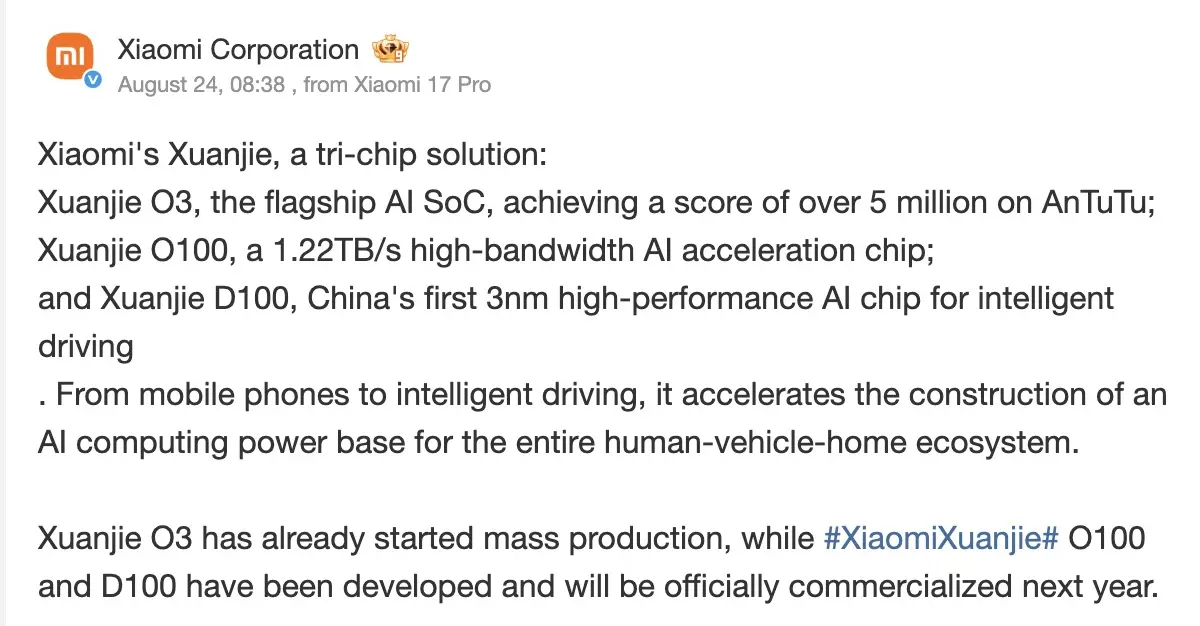
The Xring O3 is just one part of the project. According to Reuters, Xiaomi is collaborating with TSMC on at least two other components. The first is reportedly called Xring O100, which will be a NPU intended to accelerate Xiaomi’s AI models, particularly its MiMo family. This development is particularly interesting.
As AI functions become central to HyperOS, Xiaomi will benefit from optimizing silicon around its own models. The goal will not solely be to run Gemini or a third-party model, but to construct a complete end-to-end stack.
The Xring D100 Targets Autonomous Driving
Another chip, referred to as Xring D100, is designed for autonomous driving. Here again, the logic extends far beyond smartphones. Xiaomi is simultaneously developing smartphones, tablets, connected devices, electric vehicles, AI, and now humanoid robots. Gaining greater control over internal electronic components can thus become a strategic advantage for this entire ecosystem.
The in-house chip is no longer merely a mobile project; it is becoming a fundamental component of the “Human × Car × Home” model.
Over 20 Billion Yuan Invested Already
According to Reuters, Xiaomi has invested over 20 billion yuan, approximately 3 billion euros, into its semiconductor development. The group now boasts more than 3,000 personnel in its chip-related teams. These figures indicate that Xring is no longer a secondary experiment.
Developing a modern SoC is incredibly costly. It requires funding for architecture, EDA tools, physical validation, masks, prototypes, and the entire software team supporting the hardware. Only a few smartphone manufacturers can sustain such investment over several years.
Apple and Samsung Show Why the Effort Can Pay Off
Apple remains the benchmark. Its in-house chips allow for precise optimization of iOS, cameras, AI, and power consumption. Samsung follows a similar model with Exynos, although results have been more inconsistent across generations, while Google develops Tensor for the same reason: to differentiate the Pixel experience beyond a simple Qualcomm specification.
Xiaomi now aims to join this group. However, it will take several generations to determine if Xring truly delivers a lasting advantage.
Creating a good chip is not enough. It also requires reliable, sufficient production and acceptable costs. Industrial yield will be a key focus for the Xring O3. Producing 200,000 or 300,000 units helps limit exposure, but scaling to several million becomes much more challenging. This stage is often where an internal silicon program truly proves its maturity.
The Market Context Makes the Operation Even More Interesting
Xiaomi sold roughly 65 million smartphones in the first half of 2026, according to Reuters. At this scale, even a small portion of volume gradually transitioning to in-house components could represent several million chips in the long run. This would also enable the group to negotiate better purchasing terms with Qualcomm and MediaTek. An internal alternative, even partial, significantly alters the power dynamics.
Thus, the Xring O3 holds significant strategic value that extends well beyond the devices that will directly utilize it. It should not be viewed as the chip that will immediately phase out Qualcomm and MediaTek from Xiaomi smartphones, but rather as something far more important for the long term.
Xiaomi aims to gradually choose where its dependencies lie.



