

Red Hat Expands Co-developed Platform with Nvidia for Deploying Autonomous AI Agents
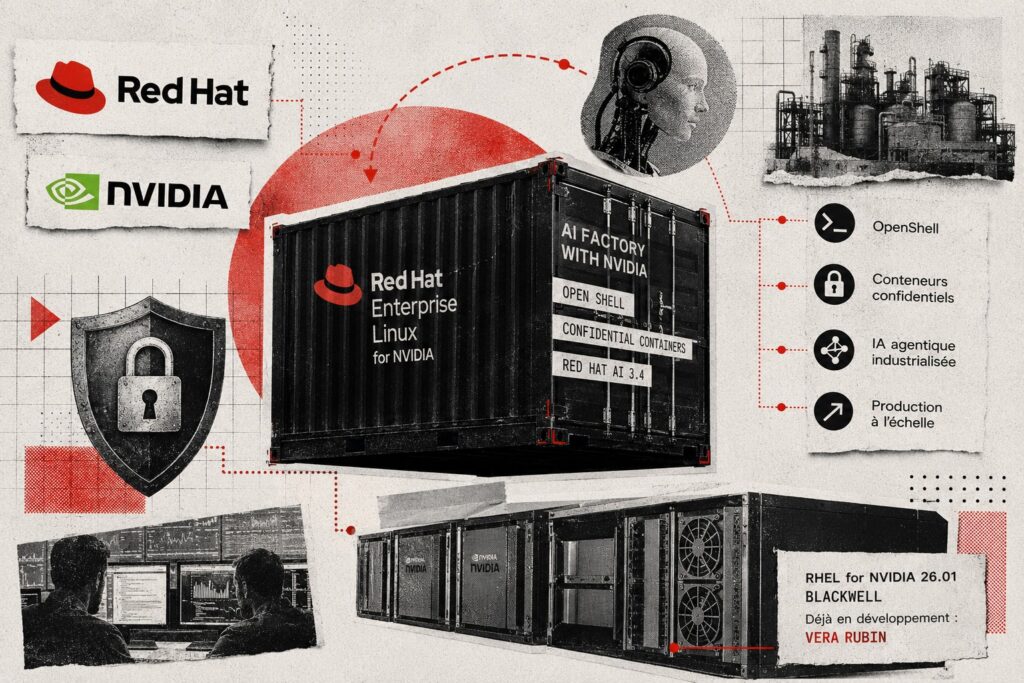
At the recent Red Hat Summit, Red Hat unveiled enhancements to its co-developed platform with Nvidia, specifically designed for the deployment of autonomous AI agents. The new features of the Red Hat AI Factory with Nvidia include OpenShell, confidential containers, and the Red Hat AI 3.4 offering. Additionally, Red Hat Enterprise Linux for Nvidia version 26.01 is now generally available, including support for the Blackwell architecture, with collaborative development already underway for the upcoming Vera Rubin platform.
The open-source leader claims to offer a production-ready AI platform that ensures uninterrupted operations and provides a secure runtime environment for autonomous agents, along with a unified lifecycle management chain for models. This update specifically addresses the critical transition from pilot to production, a phase where many agent-based projects traditionally struggle due to lacks in operational tooling, security, and compliance.
Four Key Building Blocks of the Announcement
The announcement revolves around four core components. OpenShell, an open-source project initiated by Nvidia, provides a sandboxed runtime environment for autonomous agents, complete with policy controls, tool usage security, and auditable operations. Confidential containers, currently in technological preview, extend the trust boundary at the hardware level using Nvidia Confidential Computing. The Red Hat AI 3.4 offering introduces a Model as a Service (MaaS) framework, which exposes selected models—chiefly Nvidia’s Nemotron—through the Red Hat AI gateway and an OpenAI-compatible interface. Lifecycle management leverages MLflow to ensure end-to-end tracking of large model calls, tool execution, and reasoning processes.
From Pilot Phase to Industrialization of Agents
The agent-based AI market has entered a pivotal stage. Initial experiments conducted in 2024 and 2025 with copilots integrated into office suites and development tools have transitioned to broader deployments of agents capable of executing chains of actions without needing validation at each step. Continuous operations introduce new requirements, including robust isolation between agents, traceability of tool calls, the secure handling of secrets and data access, and compliance with existing regulatory frameworks.
Red Hat positions its platform as an AI factory infrastructure, akin to industrial production lines. “Agentive AI is reinventing business operations. Every company will need an AI factory to design, deploy, and manage digital agents at scale,” stated Justin Boitano, Vice President of Enterprise AI Platforms at Nvidia. This trajectory mirrors that of the European AI Factories, as part of the EuroHPC program that mobilizes public high-performance computing centers around sovereign inference and training.
A Security Layer Designed for Continuously Operating Agents
OpenShell addresses the architectural risks associated with these new classes of challenges. Autonomous agents present a distinct threat profile compared to copilots, where every action remained under human supervision. An agent that decides, calls tools, and writes to third-party systems without intermediate validation can be compromised, potentially propagating the consequences of that compromise throughout an entire operations chain. OpenShell governs agent operations, access rights, and inference routing, enforcing policies at the infrastructure level.
Confidential containers extend this architectural logic to the hardware level. Deployed through Nvidia Confidential Computing within the sandboxed environments of Red Hat OpenShift, these containers aim to prevent the compromise of a running agent even if another agent in the same environment is breached. The Zero Trust architecture is built upon the SELinux security model, FIPS compliance standards, and real-time protection for execution environments leveraging Nvidia DOCA. Chris Wright, Chief Technology Officer at Red Hat, describes this approach as a response to the need for architectural control and open-source innovation to deploy agentive AI at scale in hybrid cloud environments.
Sovereignty, AI Act, and CIO Considerations
Red Hat’s sovereignty argument requires some clarification. As a subsidiary of IBM, an American firm subject to the Cloud Act, and with Nvidia also based in the U.S., the legal exposure of processed data depends on the underlying infrastructure provider. The promise of “technical independence” noted in their announcement is validated at the level of open-source code and architectural control but does not negate extraterritorial jurisdiction concerns.
Furthermore, Red Hat claims to assist organizations in complying with European AI governance and security obligations, particularly those introduced by the AI Act. The European regulation, which comes into effect progressively starting in 2024, mandates transparency, logging, and human oversight for high-risk systems—requirements that the OpenShell-MLflow combination can technically support. However, it is important to note that compliance cannot be established purely by the availability of tools; it necessitates application audits, use case mapping, and legal qualification on a case-by-case basis.
Updates to the Red Hat AI Factory with Nvidia and the Red Hat AI 3.4 offering are expected to be available later this month. Red Hat Enterprise Linux for Nvidia version 26.01 is already accessible through the customer portal. Nvidia Run:ai is integrated into Nvidia AI Enterprise for customers of the joint platform. Confidential containers and OpenShell remain in technological preview, preceding general availability and contractual support.



