

Apple may have up to two years of delay compared to Google in AI
The gap between Apple and Google in artificial intelligence is not closing quickly enough. This is the analysis from Mark Gurman, who now estimates that Apple is still lagging one to two years behind Google after the announcements of Android 17 and Gemini Intelligence.
The figure is slightly improved from his 2024 estimate, where he mentioned a delay of two to three years. However, he believes the problem remains the same: while Apple progresses slowly, Google continues to accelerate.
Android 17 highlights Apple’s unfulfilled promises
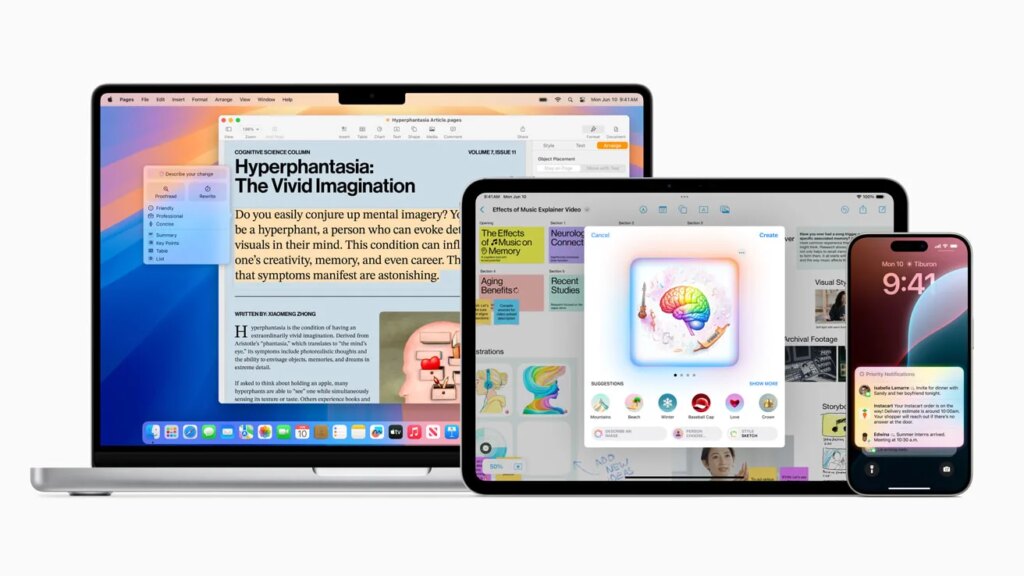
The recent announcements around Android 17 and Gemini Intelligence have revealed one key thing: several features presented by Apple at WWDC 2024 still do not exist within the iPhone ecosystem.
These features include an AI capable of functioning across multiple applications, an advanced dictation system with contextual rewriting, and dynamically generated widgets from simple text descriptions.
These functionalities embody the industry’s new direction: AIs that execute, organize, and personalize the system experience instead of merely answering questions.
Today, Google appears to be closer to this vision than Apple.
Siri remains a symbol of lag
The case of Siri is becoming particularly critical. For years, Apple dominated the mobile experience thanks to its hardware integration, software optimization, product design, and closed ecosystem. However, generative AI is changing the game.
In this new paradigm, the voice assistant can no longer just open an app, set a timer, or respond to simple commands. It must understand context, navigate between services, act proactively, and maintain a coherent conversational memory.
And this is precisely where Google, OpenAI, and Anthropic are advancing much more rapidly.
Apple seems to be managing expectations
The information surrounding Siri 2.0 reinforces this sentiment. According to multiple reports, Apple plans to introduce a system of extensions allowing Siri to use third-party chatbots, a hybrid approach with external integration, and even a “beta” label for certain advanced AI functions. These choices give the impression of a company aiming to temper expectations rather than suddenly reclaim leadership.
This is an unusual situation for Apple.
The most concerning aspect for Apple: even its fans are beginning to look elsewhere
The most revealing detail from Gurman’s report may not be technical. He notes that even some long-time Apple advocates on social media have publicly praised Google’s announcements regarding Android 17. Such reactions are uncommon in the Apple ecosystem, which is traditionally very loyal during transition periods.
The fact is, AI now touches on something much more fundamental than just a single feature: it is redefining the entire smartphone interface.
WWDC 2026 becomes a crucial moment
The WWDC conference on June 8 thus holds major strategic importance. Apple must demonstrate that it can either close the gap or present a different and credible vision of personal AI. Meanwhile, Google is transforming Android into an agentic system, OpenAI is building a persistent ChatGPT, and Anthropic is gaining traction with developers.
The risk for Apple is not only technological. It is also narrative.
For over a decade, the iPhone has represented the future of the smartphone. Today, the debate is starting to shift:
what if the most important innovation is no longer the hardware but the intelligence that powers it?



