

Why Google Photos Wants to Replace Your Beauty Retouching Apps?
Google is enhancing Google Photos, evolving it from a simple cloud gallery to a genuine mobile editing workshop. The latest update may seem modest at first glance, but it is quite significant: new retouching tools now allow for finer adjustments to faces, right within the app, eliminating the need for third-party services.
Google Photos: Lightweight Corrections Designed for Efficiency
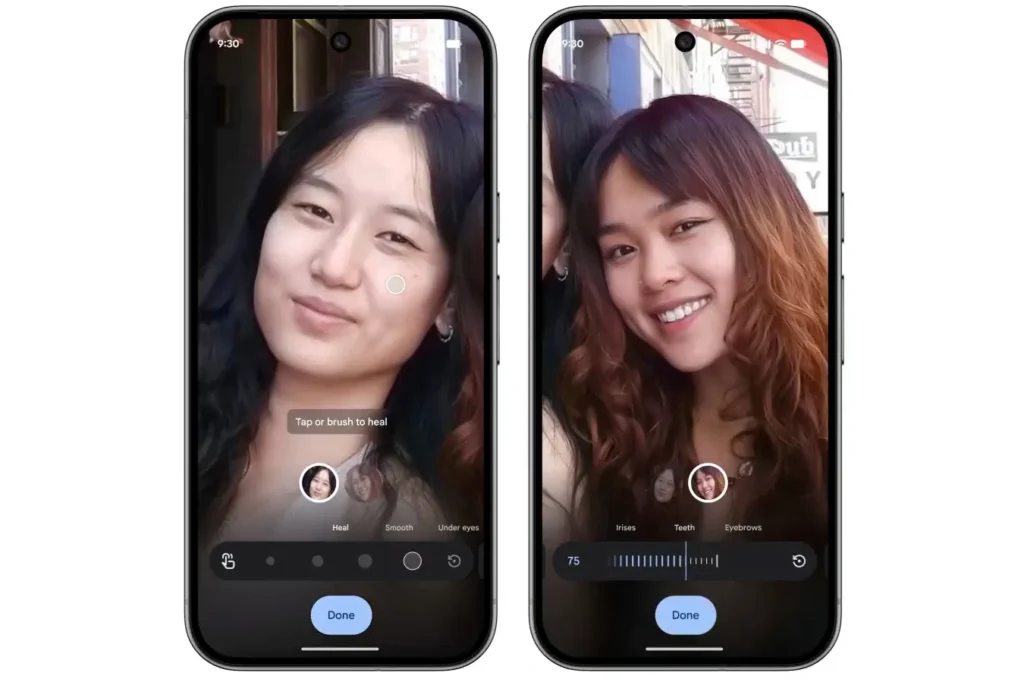
The new tools are activated when a face is detected in a photo. Users can choose specific types of adjustments—such as blemish correction, skin smoothing, dark circle reduction, iris enhancement, teeth whitening, or eyebrow and lip touch-ups—and then fine-tune the intensity of the effect using a slider.
Google clearly presents this feature as a means to make quick and subtle adjustments, rather than heavy-handed alterations to the image.
This approach is intriguing because it positions Google Photos closer to specialized applications that have traditionally dominated aesthetic corrections. In essence, Google aims to make editing “sufficiently comprehensive” to ensure that users don’t exit the app at a critical moment: when they are fine-tuning their images before sharing. This conclusion arises from careful analysis.
A Gradual Rollout on Android
Google has announced that these tools are being rolled out globally in the Google Photos app for Android. The requirements include at least 4GB of RAM and Android 9.0 or higher. At this point, the announcement explicitly targets the Android ecosystem, with no equivalent communication for iOS mentioned in today’s release.
This initiative is not isolated. Over the past few years, Google has been transforming Google Photos into an ever-richer editing platform, incorporating AI-assisted tools, Magic Editor, conversational editing, and automated correction functions. With these new facial retouching features, the brand continues along the same path: turning Photos into not just a storage space for images, but also a place to prepare them before sharing.
A Useful Feature, But Not Without Consequences
However, there is a downside to these types of tools. Even when presented as “subtle,” they contribute to the normalization of aesthetic corrections in everyday use. TechCrunch points out that several studies have linked repeated photo retouching to negative effects on self-esteem, body image, and mood. While Google is not creating this phenomenon, by integrating these functions directly into a mainstream app, the company further contributes to its normalization.
Ultimately, this update speaks to a broader trend in mobile photography in 2026. Apps are no longer just aimed at beautifying images; they are designed to capture the entire workflow, from shooting to final sharing.
And in this landscape, Google Photos is increasingly transforming from a simple gallery into a pocket studio.



