

Gemini + NotebookLM : L’écosystème ultime pour vos recherches est là
Google is enhancing Gemini as a workspace, transitioning it from just a conversational assistant. With the introduction of Notebooks in Gemini for free web accounts, the company is now making one of its most important features accessible on a larger scale: a well-organized project memory synchronized with NotebookLM, designed for long-term use.
A Key Component in the Evolution of Gemini
When Google unveiled Notebooks in Gemini on April 8, this functionality was initially exclusive to subscribers of Google AI Ultra, Pro, and Plus on the web. The company described these notebooks as personal knowledge bases capable of consolidating conversations, files, sources, and customized instructions into a single space.
Google also announced, at launch, that access would be extended “soon.”
This extension is now being rolled out for free users. According to Google, free accounts can now utilize Notebooks on the web version of Gemini, operating under the same principles as subscribers, albeit with lower limits on sources.
A True Project Space, Not Just a Chat Folder
The value of this function is clear: instead of starting from scratch with each new session, Gemini can build on a persistent context. A notebook allows users to centralize past exchanges, documents, and references around a single topic, using this collection as a working foundation for future queries. Google positions this system as a method to “stay on track” with complex projects, whether for research, writing, or analysis.
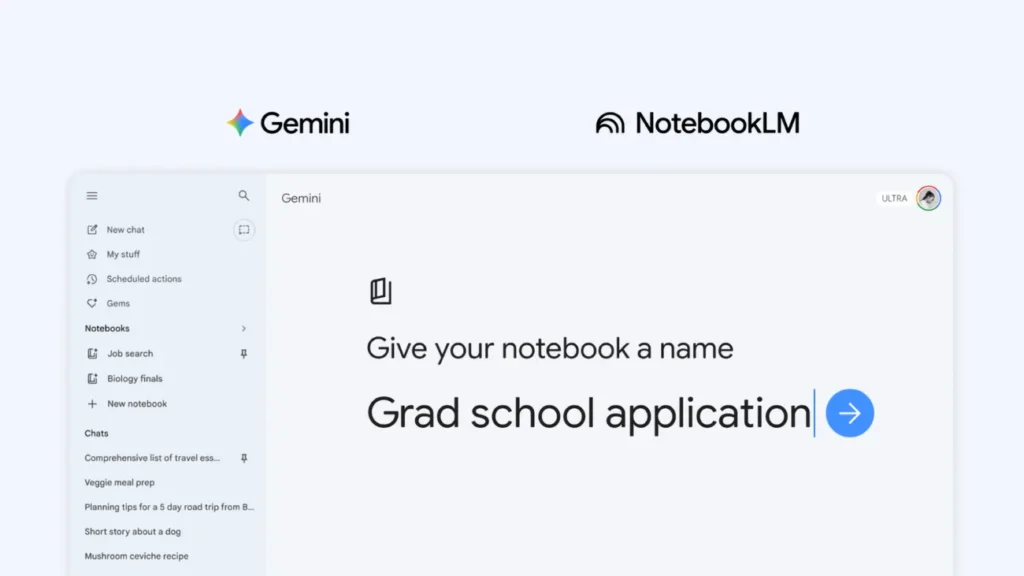
Within the interface, the Notebooks section appears in the sidebar of Gemini. Users can save existing conversations into a notebook, add sources, and define stylistic or tonal guidelines to shape responses. It’s also possible to disable the notebook’s “memory” if one prefers that Gemini does not use the saved history as context.
The Key Advantage: Direct Integration with NotebookLM
This is where Google takes a more ambitious step. The Notebooks in Gemini are identical to those in NotebookLM, Google’s assisted research tool. In practice, sources added in one will automatically appear in the other. This synchronization allows, for example, preparing a topic in Gemini and then switching to NotebookLM to generate additional formats using the same materials.
Notebooks in @GeminiApp are now available to Free users on web!
Access your personal, unshared notebooks directly in Gemini *and* use your chats with Gemini as sources in new or existing unshared notebooks.
Let us know what you think! https://t.co/BT8B3gktPR
— NotebookLM (@NotebookLM) April 17, 2026
This continuity strategy is crucial. It illustrates Google’s intention to stop fragmenting isolated AI experiences and instead create an ecosystem where Gemini becomes the overarching interface, while NotebookLM serves as the more analytical and documentary layer.
In other words, the company is finally linking conversation, memory, and a corpus of sources into a unified workflow.
Modest Limits for Free Users, Yet Still Very Useful
For free users, the announced limit is 50 sources per notebook. Higher tiers allow for 100 sources for AI Plus, 300 for AI Pro, and 600 for AI Ultra. These figures clearly illustrate Google’s strategy: to make the tool widely accessible while reserving the most intensive usages for paid subscriptions.
Even with this 50-source cap, the offering remains robust for daily use. For students, journalists, consultants, or project managers, this is more than sufficient to structure a working folder, retain useful exchanges, and avoid the “amnesiac chatbot syndrome” that requires re-explaining everything with each session. This limit seems designed more to manage heavier usages than to restrict everyday scenarios. This interpretation is based on the quotas published by Google and shared during the rollout.
Web First, Mobile Next
At this stage, deployment is focused on the web. Google had previously announced that the extension for free users and mobile platforms would follow in the upcoming weeks. 9to5Google notes that Notebooks are not yet available in mobile apps or the Mac app for Gemini, despite the recent release of the latter.
This point is noteworthy as it encapsulates Google’s approach in 2026: launching quickly on the web, observing usage patterns, and then gradually extending to other environments. While pragmatic, it also confirms that Gemini is currently more mature as a desktop tool than as a cohesive omnipresent assistant across all platforms.
Why It Matters
The introduction of Notebooks to free users is not just a superficial interface addition; it represents a fundamental shift in Google’s vision for Gemini. The assistant is no longer merely a responder; it is learning to work over time, maintain a framework, and integrate into a more credible production flow. Implicitly, Google is positioning Gemini as a genuine personal knowledge cockpit, with NotebookLM as the documentary engine running in the background.
Moreover, this is a direct response to the rise of project-organized AI tools. Where traditional chatbots excel in the moment, Notebooks positions Gemini in a more strategic realm: that of continuity, structure, and context.
And in today’s contest among assistants, it is likely here that the distinction between an impressive tool and a truly useful one is being made.
<!-- related wrap -->


