

WhatsApp will allow users to customize emoji reactions, but with WhatsApp Plus
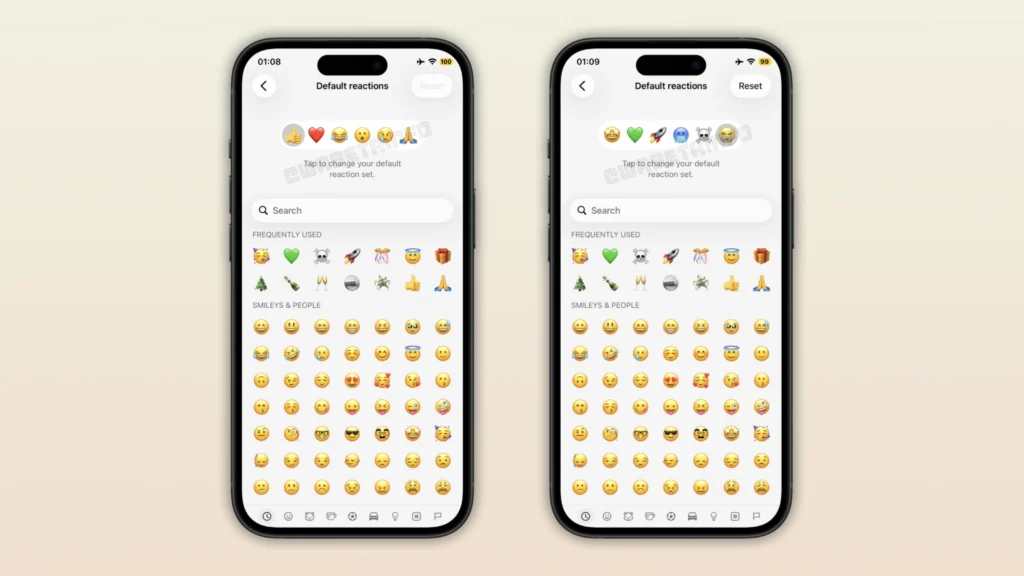
WhatsApp is set to make its reactions more personal. A new feature in development will allow users to replace the six default emojis in the quick reaction bar.
This is great news for those who rarely use the same symbols as WhatsApp; however, this customization is expected to be reserved for WhatsApp Plus subscribers.
WhatsApp finally wants to let users choose their quick reactions
Emoji reactions have become one of the fastest ways to reply to a message on WhatsApp. A long press is all it takes to bring up a small bar displaying several common reactions. Until now, however, this selection remained imposed by the app: 👍, ❤️, 😂, 😮, 😢, and 🙏 form the fixed core of the bar, while a “+” button allows access to the full emoji keyboard.
WhatsApp is now working to eliminate this constraint.
WABetaInfo has spotted in the WhatsApp beta for iOS 26.32.10.16, distributed via TestFlight, a new interface allowing users to replace these default reactions with emojis of their choice. However, the feature is still under development and is not yet available to beta testers, so this is just a glimpse of a future feature, not something currently accessible to the public.
Android was already ahead on this front
This news isn’t entirely surprising. WhatsApp had begun developing the same feature on Android with a previous beta version before it was spotted on iPhone. The fact that both platforms are involved suggests a broader rollout in the future.
In its summary from August 16, WABetaInfo also confirms that the customization of the reaction bar is among the new features currently in development for iOS. Meta does not seem to be experimenting with a feature limited to a single platform; the goal appears to be to offer the same level of customization on both Android and iOS.
Up to six fully customizable emojis
The principle should remain extremely simple. From the WhatsApp settings, users will be able to access a dedicated interface for their quick reactions, allowing them to replace a single emoji or all six. Someone who primarily uses 🔥, ✅, 👀, or 🤝 can place them directly in the main bar without having to open the full selector every time.
WhatsApp will also provide an option to easily restore the original selection.
This change may seem trivial, but it impacts one of the most frequently performed actions in modern messaging. A reaction is valuable precisely because it eliminates the need to type. If the desired emoji requires three additional actions to find, the feature loses some of its appeal.
A minor improvement that can change many conversations
The six reactions currently selected by WhatsApp cover very general emotions, but they do not necessarily align with everyone’s preferences. In a conversation among friends, some may prefer an ironic reaction or a recurring symbol from their group.
In a professional setting, others might opt for ✅ to validate a task, 👀 to indicate that a message has been seen, or 👍 to quickly confirm a decision. A customizable bar thus allows WhatsApp to transform a generic shortcut into a truly context-appropriate tool. This aligns perfectly with the logic described by WABetaInfo: reactions become quicker when they reflect user habits rather than a universal selection defined by the app.
The catch: the feature will be exclusive to WhatsApp Plus
The most controversial aspect is its business model. According to WABetaInfo, the customization of reactions will be part of the second set of features for WhatsApp Plus, the new premium offering of the messaging service. In other words, free users will retain the six imposed reactions, while subscribers will have the ability to customize them.
This decision significantly alters the perception of the novelty.
The customization of such a basic shortcut could easily have been considered a standard improvement to the app. By placing it behind a subscription, WhatsApp suddenly begins to transform small convenience functions into premium selling points. This strategy is already familiar in other digital services but feels less natural for a messaging platform used daily by billions of people.
WhatsApp Plus focuses precisely on customization
This restriction is not isolated. WABetaInfo indicates that the first set of features for WhatsApp Plus includes themes, custom app icons, premium stickers, and the ability to pin up to 20 conversations. The customizable reaction bar fits perfectly within this philosophy.
Meta seems to want to preserve essential messaging functions for free while monetizing more customization and comfort enhancements.
The parallel with Telegram Premium or the various paid offerings from other social services is evident: not blocking the main function but reserving additional options for the most engaged users.
For WhatsApp, the stakes are particularly interesting because the messaging app has historically provided a very uniform experience to its users. WhatsApp Plus is gradually introducing a new idea: two users could now have significantly different interfaces based on their subscriptions.
The feature is not yet available
However, expectations should be tempered. WABetaInfo clearly states that the customization of reactions is not currently enabled for iOS beta testers. It has merely been spotted in the code and interface under development. No public launch date has been announced yet, nor has Meta officially communicated the timeline for the availability of the second set of WhatsApp Plus features mentioned by WABetaInfo.
As always with features discovered in beta versions, some details may evolve before the final release. The number of reactions, the location of the setting, or even its final inclusion in the subscription could theoretically change.
A new step in the monetization of WhatsApp
Ultimately, what’s most interesting is not the emoji itself but what it reveals about WhatsApp’s evolution. For a long time, Meta primarily sought to monetize the platform through businesses, professional accounts, and commercial interactions while maintaining a largely uniform public experience.
With WhatsApp Plus, the application is starting to adopt a logic more akin to subscription services. Customization is gradually becoming a product. Themes, icons, stickers, pinned conversations, and now quick reactions may seem secondary when examined separately. Together, they begin to form a coherent premium offering.
The challenge for Meta will be finding the right balance: providing enough value to subscribers without making free users feel as if basic functions are artificially locked away. A simple bar of six emojis could very well become the first real test of this boundary.



