

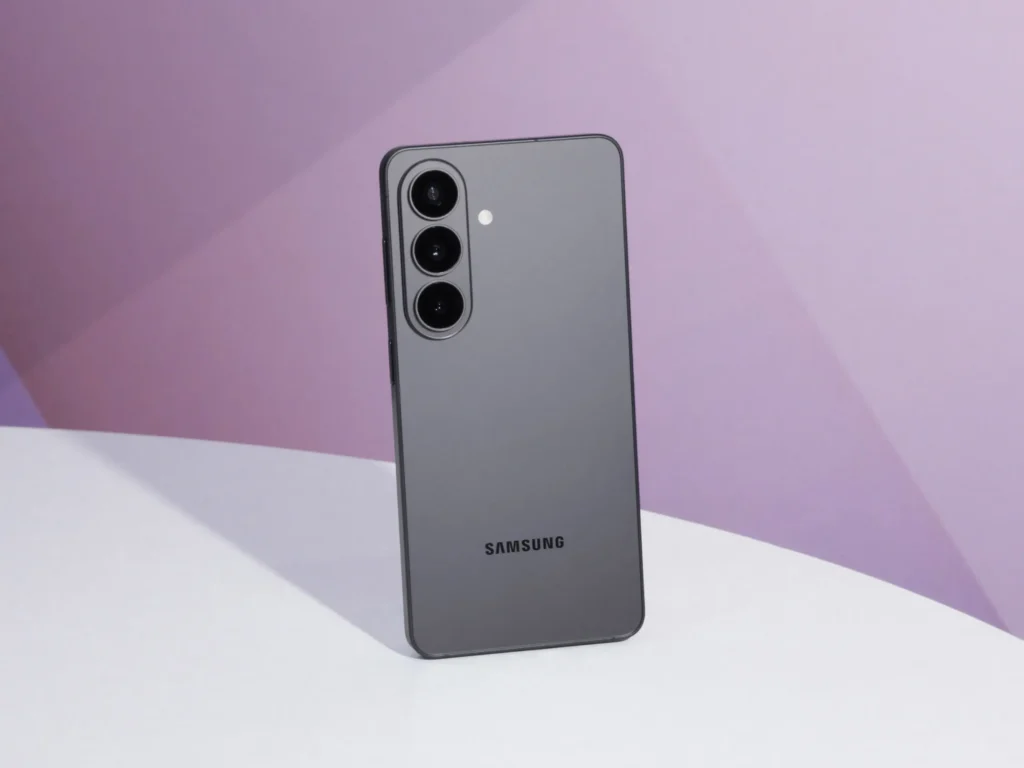
Galaxy S27: Samsung Might Adopt a Horizontal Camera Bar Like Pixel
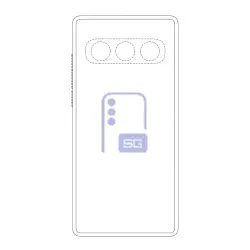
Samsung may be gearing up for one of its most visible design changes in several generations of the Galaxy S series. New designs linked to a design filing spotted in the WIPO database reveal three sensors grouped in a long horizontal bar, reminiscent of Google’s Pixel smartphones — as well as, to a lesser extent, the Galaxy S10.
A Horizontal Camera Bar for the Galaxy S27?
The images published by SammyGuru show a smartphone where the three rear cameras are aligned side by side within a single horizontal module. This marks a sharp departure from the aesthetic language adopted by Samsung in its recent Galaxy S models, where the sensors have been presented in a much more independent manner.
These designs come from the WIPO Global Design Database and could indicate a direction being explored for the future Galaxy S27. However, the rest of the phone appears much more familiar, sporting rounded corners and relatively flat edges.
In other words, Samsung does not seem to be aiming for a complete redesign of its flagship. Instead, the company might be focusing the change on an element that has become central to the visual identity of smartphones: the camera module.
Hard Not to Think of the Pixel
The most obvious visual inspiration comes from Google. The latest Pixel smartphones have utilized a horizontal camera module that spans a significant portion of the back for several generations. The design attributed to the Galaxy S27 follows a similar logic: the sensors no longer float individually but are integrated into a single element.
However, it would be premature to label it as copying. Horizontal camera modules have existed in the industry for quite some time, including at Samsung itself. The Galaxy S10, released in 2019, already grouped its three rear cameras in a long horizontal zone, confirming a configuration that combined an ultra-wide, main, and telephoto sensor in that integrated module.
If the Galaxy S27 truly adopts this shape, it would signify a return to an earlier Samsung idea as much as it would indicate a resemblance to the contemporary design of Pixel smartphones.
A Step Backward After Years of More Independent Sensors
The Galaxy S family has significantly evolved its camera module over the years. With the Galaxy S22 and S22+, Samsung still employed its Contour-Cut design, where the module visually extended into the metal frame of the device. The brand presented this integration as one of the distinctive elements of its series design.
Samsung then transitioned to a more minimalist presentation where each lens protruded more distinctly from the shell. The horizontal bar seen in these designs would thus represent a new turnaround. Rather than striving to visually conceal the camera module, Samsung seems to be reverting to a clearly identifiable structure — potentially with a much stronger graphic impact.
The Module Appears Nearly Flush, but Caution is Advised
One of the designs is particularly intriguing: the camera bar appears almost aligned with the back glass. Such integration would certainly make the smartphone sleeker and could reduce the wobble effect when set down on a table. However, this thickness shouldn’t be interpreted too literally.
Design filings or patent drawings typically aim to protect a general shape rather than convey final dimensions down to the millimeter. The nearly flat rendering could simply be a graphical simplification.
On a flagship device, completely eliminating the camera protrusion would also be technically challenging without reducing the space available for optics or significantly increasing the phone’s overall thickness. Therefore, a less pronounced bump seems more realistic than a perfectly flat module.
A Lower Bar Could Have Practical Advantages
Even without completely disappearing, a better-integrated camera block could improve several usability aspects. A reduced protrusion would limit snagging risks and potentially make the phone more stable when laid down. It could also facilitate the design of magnetic accessories.
Some previous rumors surrounding the Galaxy S27 series have indeed linked a possible redesign of the camera module to the more advanced integration of magnetic charging. While this hypothesis remains unconfirmed, it is not unreasonable from an industrial perspective.
The Qi2 standard relies on a magnetic alignment system intended to properly position the smartphone on the charger, aiming for better efficiency and simpler usage.
Reorganizing the internal component layout could, therefore, have very concrete consequences for external design.
The Design Could Also Serve to Visually Unify the Range
Samsung faces another issue: its smartphones have become quite homogenous. The Galaxy S, A families, and some other models have adopted similar visual codes, particularly around the separately placed rear lenses. This coherence enhances brand recognition but also makes it harder to differentiate a flagship priced several hundred euros from a much cheaper model.
A camera bar specific to the Galaxy S27 could restore a stronger identity to the premium series. Such a change is particularly effective because it remains immediately visible, even from a distance. Apple uses the square camera block as a recognizable feature of the iPhone. Google has its Pixel bar. Samsung may want to create a similarly strong marker for its next generation.
Evolution Might Primarily Concern the Standard Galaxy S27
The designs depict a three-sensor configuration, which naturally aligns more with the standard Galaxy S27 than the forthcoming Ultra model. However, this does not definitively identify which model is concerned. Samsung could use various design variations within the range or simply have filed different explorations in parallel.
Given the more complex photographic requirements of the Galaxy S27 Ultra, it may particularly require a different arrangement for its telephoto lens or additional sensors. For now, it is safer to refer to a potential design language for the S27 family rather than a definitive design applicable to all models.
A Design Filing is Not a Confirmation of Launch
This is the main caveat. Tech companies regularly file patents and designs that never see the light of day. These documents serve to protect ideas as much as they prepare for real products. Therefore, Samsung may have explored this horizontal bar before opting for a different solution for the final version.
Nonetheless, the fact that the design aligns with previous rumors of a more unified module adds to its credibility. It will likely take industrial renders, case files, or prototypes to determine whether Samsung has truly adopted this design.
The Galaxy S27 Is Not Expected Until 2027
Samsung still has several months to refine its project. The Galaxy S27 series is anticipated at the beginning of 2027, following the usual schedule for the lineup, but Samsung has yet to officially announce the presentation date or design. Meanwhile, some features may still change, especially visible elements like the thickness of the camera module or materials.
This timeline also explains why current information remains fragmented: we are still in a phase where design sketches, patents, and supply chain elements circulate more than actual images of the final product.
Samsung May Want to Break Away from the Overly Common Minimalism
This potential change also speaks to a broader trend in smartphone design. For several years, manufacturers have sought to make their devices sleeker: flat edges, smooth backs, individually integrated sensors. However, this pursuit of simplicity has gradually made many models look alike.
The camera module remains one of the few places where a brand can still impose an immediately recognizable signature without completely redesigning the phone. Samsung seems to perhaps be arriving at this conclusion. A horizontal bar would not revolutionize the ergonomics or photography of the Galaxy S27, but it would immediately transform its silhouette.
And after several generations where the Galaxy S has evolved mainly through small touches, this return to a unified camera module could ultimately be just what is needed to give the S27 a clearer identity.



