

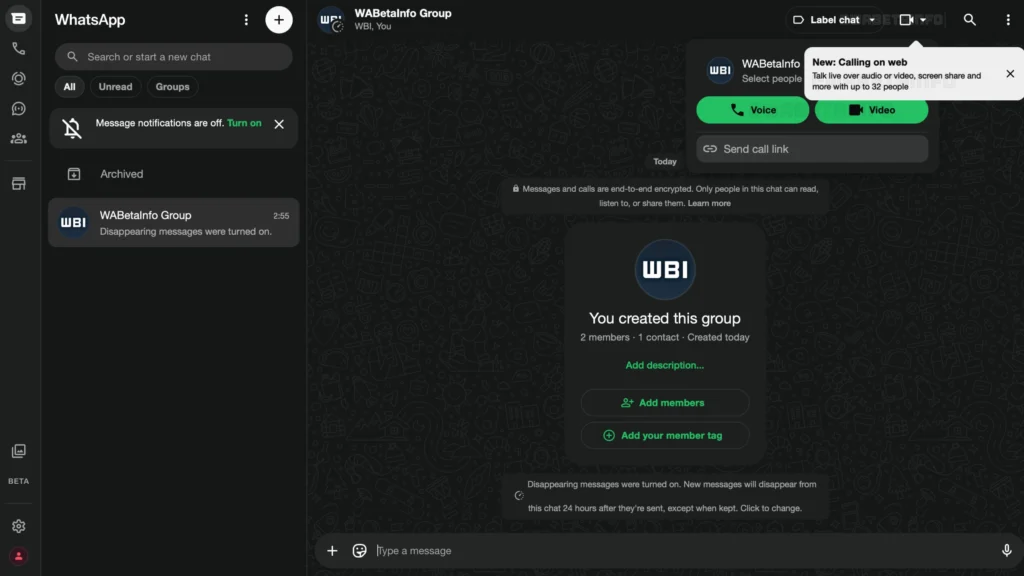
WhatsApp Web catches up: group calling arrives in the browser
After introducing one-on-one audio and video calls on its web version earlier this year, WhatsApp is taking another significant step forward. The messaging platform is now preparing to fully support group calls directly from the browser, a feature that active users have eagerly awaited.
The information, spotted by WABetaInfo, reveals that this new feature is currently being rolled out to beta testers of WhatsApp Web.
Up to 32 participants directly from the browser
With this update, users will be able to initiate group voice or video calls without relying on the mobile app or desktop client. The limit is set at 32 participants, the same cap already available on WhatsApp’s mobile and desktop versions.
The objective is simple: to create as comprehensive a web experience as possible and reduce functional disparities between different platforms.
This evolution particularly addresses professional and collaborative use cases, where group calls are becoming increasingly important.
Invitation links and a waiting room
WhatsApp is also adding several tools designed to simplify the organization of meetings and group discussions. Among the new features is the ability to create shareable call links. Similar to some professional video conferencing platforms, it’s now as easy as sending a unique URL to invite new participants to join a conversation.
A waiting room feature has also been integrated, allowing organizers to control access before a participant enters the call.
This approach gradually aligns WhatsApp with solutions like Microsoft Teams, Zoom, or Google Meet, although the platform still maintains a focus more on consumer messaging.
Screen sharing is also included
Another notable addition is screen sharing during group video calls. This feature has become essential with the rise of hybrid work and remote learning. It allows users to present a professional document or share a demonstration or multimedia content with multiple people simultaneously.
With this integration, WhatsApp continues to expand its capabilities beyond simple instant messaging.
A major win for Linux users
This deployment is particularly significant for the Linux community. Unlike Windows and macOS, WhatsApp has yet to offer a native application for Linux distributions. Until now, users had to switch to their smartphones when a group call came in.
The arrival of group calls in the browser eliminates this constraint. Linux users can now participate in conversations directly from their web browser without any additional software.
Security and encryption remain top priorities
Like the individual calls already available on WhatsApp Web, group calls benefit from end-to-end encryption based on the Signal protocol. This protection is enabled by default and does not require any special configuration. Conversations thus remain accessible only to authorized participants.
In a context where the confidentiality of communications has become a major selling point for messaging platforms, WhatsApp continues to prioritize this aspect as a core component of its offering.
WhatsApp advances its transformation into a universal platform
This new feature may seem modest at first glance, but it is part of a broader evolution within the WhatsApp ecosystem. For several years, Meta’s subsidiary has been striving to make WhatsApp a platform capable of catering to both personal and professional needs. Between communities, channels, enhanced video calls, and now group calls directly in the browser, the boundaries between messaging app and collaborative tool are becoming increasingly blurred.
The introduction of this feature on WhatsApp Web represents not just a simple addition but a further step towards a truly multi-platform experience.



