

The Shifting Landscape of AI: Financial Results Redefine the Market
In its early years, the battle for dominance in artificial intelligence (AI) revolved around models, benchmarks, and funding announcements. However, the financial results and key indicators from the first half of 2026 are steering the conversation towards a clearer battlefield. The AI market is now being structured around four interrelated layers: infrastructure, software productivity, agency, and trust. A crucial dividing line emerges between those who are monetizing AI at scale and those who are financing the next phase of its deployment.
Microsoft and Alphabet have begun to provide transparent financial results, including identifiable cloud segments, auditable revenue streams, and financial commentary that explicitly details AI’s contributions to their bottom lines. In contrast, private companies like OpenAI and Anthropic report their success through fundraising efforts, announced annual recurring revenues, infrastructure commitments, and enterprise adoption signals — all without ever undergoing public auditing. This disparity of information presents a significant editorial reality.
Analyzing the operations of these four companies allows us to map four distinct, yet interwoven markets, each approached with different business models and timelines. The first market covers infrastructure, including computing, chips, and data centers. The second focuses on software productivity, where AI is being integrated as a native layer in office suites, development environments, and business applications. The third deals with agency, which encompasses systems capable of executing complete tasks within information systems. Finally, the fourth market revolves around trust, addressing security, governance, sovereignty, observability, and usage control.
AI as Measured by Cloud Revenues and Infrastructure Backlogs
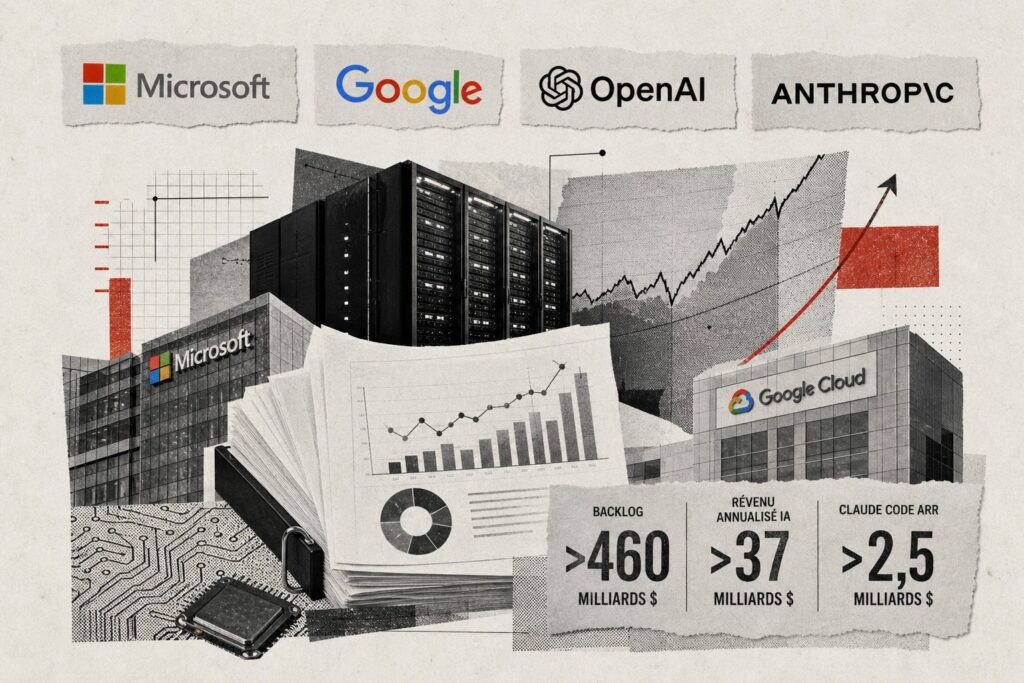
Microsoft offers the clearest indicator of AI’s monetization in production. Its financial results for the third fiscal quarter of 2026 report that AI-related activities have now surpassed an annualized rate of $37 billion — a remarkable 123% increase year-over-year. Meanwhile, Microsoft Cloud has exceeded $54 billion in quarterly revenue, reflecting a 29% increase. These figures confirm that AI is now a core revenue driver integrated into its cloud services, productivity tools, development environments, and business services.
Alphabet provides a complementary signal. Google Cloud reported surpassing $20 billion in quarterly revenues for Q1 2026, a 63% growth fueled by demand for AI products and infrastructure. The company’s cloud backlog exceeds $460 billion, and its Gemini Enterprise has seen a 40% quarter-over-quarter increase in monthly active paying users. These metrics suggest that companies are committing to long-term investment in AI infrastructure, as evidenced by Google’s unprecedented backlog.
Microsoft’s and Google’s Strategies: Extending Existing Contracts
Microsoft excels in its ability to weave AI into existing budgeted layers within IT departments. Azure, Microsoft 365, GitHub Copilot, and enterprise agents create an economic continuum where each AI application enhances an existing contract. The post-AI market that Microsoft targets spans workplace transformation, assisted software development, business processes, and cloud infrastructure, all without requiring businesses to initiate new budget lines.
Conversely, Google follows a different yet equally systematic approach. Its integrated chain—from TPU chips to Gemini, from data to cloud, and from search to enterprise applications—captures demand at every level of the technology stack. The challenge for Google lies in converting its foundational research advantages and massive data volumes into recurring cloud revenues, especially in a landscape where competition for IT infrastructure budgets is intensifying. Notably, as U.S.-based providers, both Microsoft and Google are subject to the Cloud Act, a factor European IT leaders must consider in their architecture and sovereignty decisions.
OpenAI and Anthropic: Financing Infrastructure
OpenAI does not disclose complete financial results. Its recent fundraising round of $122 billion, aimed at developing computing capacity to meet demand for ChatGPT, Codex, and enterprise AI, represents the most significant structural signal available. Market sources indicate some strain around internal revenue and user targets, urging caution in interpreting these figures. OpenAI is built on a mass-platform model serving individual users, developers, businesses, and cloud partners, yet faces the challenge of directly financing an expensive demand for computing without a proprietary cloud comparable in scale.
Anthropic presents a more concentrated profile, announcing a $30 billion Series G fundraising round at a post-money valuation of $380 billion, backed by precise operational metrics. Claude, the company’s AI system, has surpassed $2.5 billion in annualized revenue — more than doubling since the start of 2026. Over 500 clients spend more than $1 million annually on its services, with Claude being utilized by eight of the ten companies listed in the Fortune 10. These figures indicate a shift in value towards economically intensive use cases, especially in software development, complex processes, regulated environments, and professional applications where reliability trumps audience size.
The AI Battle Shifts Towards Agency, Computing, and Trust
Following the wave of models and conversational assistants, competition is pivoting towards agents capable of acting autonomously within corporate information systems, the requisite infrastructure to operate beyond prototypes, and the trust market encompassing security, governance, sovereignty, observability, and usage control. The recent agreement between Anthropic, Google, and Broadcom serves as a clear illustration. Deploying AI agents in regulated environments necessitates securing computational capacity, infrastructure costs, and multicloud resilience.
For CIOs and CISOs, this transition carries direct implications. Agency-based AI now demands the same rigor in governance, observability, and usage control as critical information systems. The four identified markets (infrastructure, software productivity, agency, and trust) converge around a shared imperative for IT leaders: to deploy agents that can operate within enterprise systems while ensuring traceability, security, and regulatory compliance.
The available results portray a post-AI market with varying maturity across its layers. Infrastructure and software productivity are entering a monetization phase led by publicly traded cloud platforms. Agency and trust represent the next competitive battleground, where private labs are launching massive fundraising efforts to underpin their future business models. For enterprises, the focus is shifting from deploying AI to understanding the conditions governing its use, particularly regarding pricing, governance, and sovereignty guarantees.



