

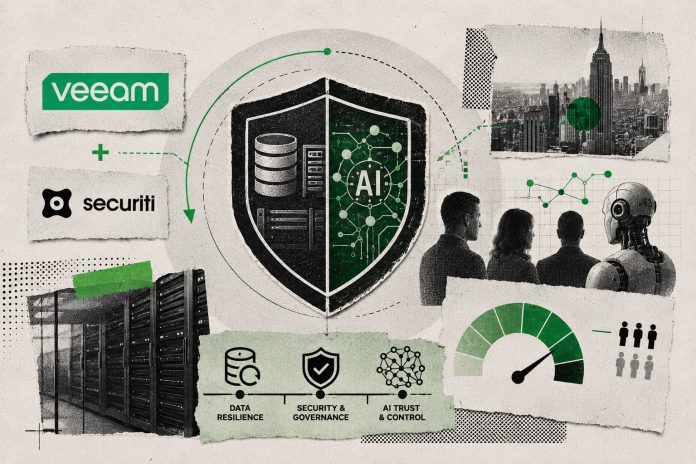
Veeam is merging data resilience and AI security into a platform designed for the age of autonomous agents. Announced on May 12, 2026, at VeeamON in New York, the DataAI Command Platform combines the historical strengths of the Seattle-based company with those of Securiti AI, acquired earlier this year. Additionally, Veeam introduced Intelligent ResOps, the first contextual resilience module, alongside a self-assessment framework for “Data and AI Trust,” based on a survey of 300 executives.
The company claims to have created a groundbreaking category of infrastructure aimed at environments where AI autonomous agents operate at enterprise scale with machine-like speed. This promise relies on a unified layer that integrates data, access, identities, and AI, extending to both production data and backups. The platform is structured around six key integrated capabilities, featuring a DataAI Command Graph powered by over 300 connectors, a security posture management module based on Securiti AI’s industry-leading technology, a governance module applied at the data source, a compliance module mapped against over 100 regulatory frameworks, a privacy management module, and a precision resilience module.
Complementing this architecture are additional announcements. Intelligent ResOps is the first resilience module hosted on the platform, driven by the Command Graph, and initially deployed on Microsoft 365. The Data and AI Trust Maturity Model offers a four-pillar assessment framework (Understood, Secured, Resilient, Unleashed), spanning twelve dimensions and forty-nine sub-dimensions across five maturity levels, from ad hoc to leadership.
A New Infrastructure Category Addressing Market Realities
The market rationale for this new category is underscored by three striking figures. According to Veeam, autonomous agents have now outnumbered human employees by a ratio of 82 to 1, and 97% of those agents possess excessive privileges. A study linked to the Trust Maturity Model, conducted by the Emerald Research Group with 300 executives, reveals that while four out of five organizations express confidence in their ability to scale AI securely, only one in three can produce corresponding auditable evidence. Additionally, more than half of AI projects have faced budget cuts over the past eighteen months, with nearly three in ten being entirely abandoned.
“The infrastructure to deploy AI exists, but the infrastructure to trust it does not. With the DataAI Command Platform, Veeam is building the missing layer that combines resilience, security, governance, compliance, and privacy into a single platform,” stated Anand Eswaran, CEO of Veeam. A key industrial asset in this effort is the acquisition of Securiti AI, which brings its data security posture management engine and identity intelligence graph, merged with Veeam’s two decades of resilience history and its 550,000 clients in over 150 countries.
Contextual Resilience for Agent-Driven Incidents
Intelligent ResOps formalizes a concept of resilience that relies on context rather than blind restoration. This module connects data, identities, and AI agent activity to backup and recovery decisions. The goal is to precisely identify what has changed, who or which agent has modified what, and which data are sensitive or redundant, allowing for targeted restoration of only what is necessary. The first supported workload is Microsoft 365, which is already protected by Veeam for 25 million users.
“Too many companies navigate blindly without clear visibility into the data they hold, what has changed, and what is truly at risk,” said Rehan Jalil, President of Products and Technologies at Veeam and former leader at Securiti AI. The Agent Commander feature enables investigations into agent activities and the reversal of undesirable changes; an integrated intelligence agent, dubbed “Ask Veeam,” provides natural language insights regarding the status of data and AI.
Trust Maturity, Compliance Vocabulary, and CIO Trade-offs
The Data and AI Trust Maturity Model addresses the gap between expressed trust and the ability to document it. “Three-quarters of organizations are already executing AI deployments in various stages of maturity or production, but less than one-third back up at least half of the data generated by AI, leading to real risks,” commented Krista Case, Principal Analyst at theCUBE Research. Inference, corruption, poisoning, and exfiltration attacks now directly target the data layer.
According to Veeam, the platform is mapped against over 100 regulatory frameworks, explicitly citing the European AI Act, DORA, GDPR, HIPAA, NIST, and the NIST AI RMF. However, European CIOs should take note of certain caveats. The NIST AI RMF is a voluntary American framework with no binding force in Europe. Mapping a platform against regulation provides useful technical controls, but does not demonstrate legal compliance for the deployed use case. Veeam Software is an American company based in Seattle, subject to the Cloud Act, raising the usual sovereignty trade-offs concerning the processing of data and metadata by the platform for European organizations.
Veeam is now explicitly positioning itself as a “Data and AI Trust Company,” placing the convergence of resilience, security, and governance at the center of its narrative. The Intelligent ResOps modules and the Data and AI Trust Maturity Assessment will be announced throughout the year, with a gradual rollout to partners.



