Google I/O 2026: Gemini, Android XR, and the immense pressure now on Google
Google kicks off the 2026 edition of Google I/O today with one of the most ambitious programs in recent years. The new Gemini model, Android XR, smart glasses, Gemini Intelligence, Googlebook, and Android 17 will see the Mountain View developer conference packed with strategic announcements.
However, beneath this showcase of product power lies a more pressing question: Is Google still competitive with the best AI models available today?
The Real Challenge of Google I/O 2026 Is No Longer Android
For a long time, Google I/O primarily showcased Android, Chrome, and the company’s web services. In 2026, however, the focus has shifted entirely to Gemini. The competitive landscape has changed dramatically.
Since April, Anthropic introduced Claude Mythos Preview, OpenAI launched GPT-5.5, and AI benchmarks have turned into an open war of cognitive performance, autonomous reasoning, and agentic programming.
In this arena, a “good” Gemini model is no longer sufficient. Google must prove it remains at the technological forefront.
Gemini Intelligence: Google Aims to Transform Android Into an Autonomous Assistant
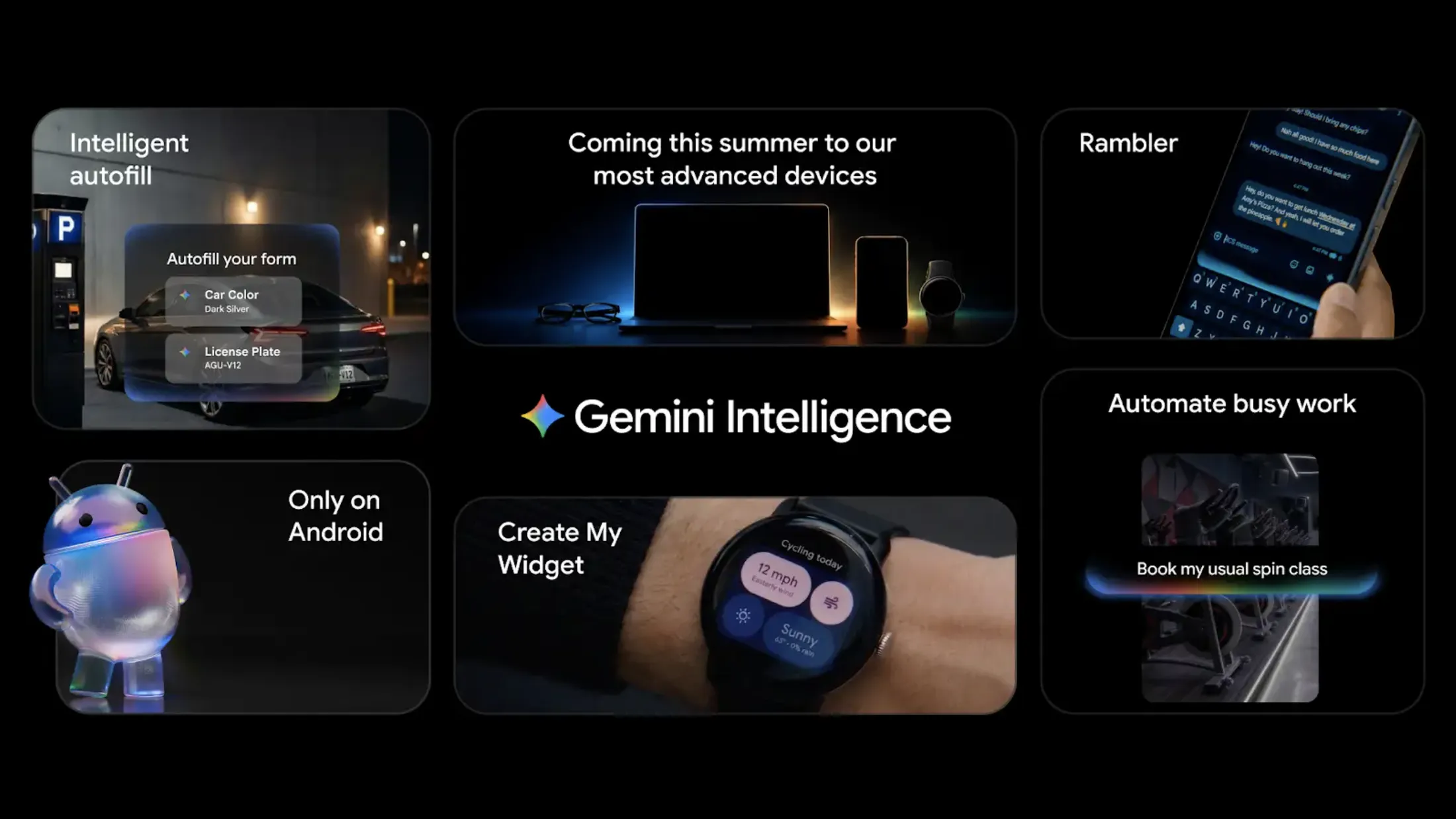
The most significant new feature from the conference may not be a model, but a capability. With “Gemini Intelligence,” Google seeks to evolve Android from a reactive system to a proactive platform capable of taking independent actions:
- Booking parking spaces
- Managing web tasks
- Organizing lists
- Navigating between applications
- Executing multi-step workflows
The clear objective is to move AI from being a mere chatbot to one that operates autonomously.
This transition is becoming the central battle of the industry. OpenAI, Anthropic, Microsoft, and Google are now gravitating toward a shared vision: AIs capable of directly orchestrating digital actions rather than simply answering questions.
Android XR: Google Returns to Smart Glasses
Google will also use I/O to introduce updates for Android XR, its new platform tailored for smart glasses and mixed reality devices. However, this category now enters a markedly different landscape compared to the original Google Glass.
The shadow of Meta looms over all of Android XR.
Meta’s Ray-Ban glasses have shown there’s a market for stylish smart eyewear. However, they have also sparked multiple inquiries related to privacy and the use of video data captured by these devices.
Google is therefore stepping onto turf that has become extremely sensitive: continuous video processing, contextual recognition, cloud storage, and data use for AI training.
Currently, the company remains vague on several key points: data retention duration, potential use for training Gemini, deletion mechanisms, and human access to recordings.
Googlebook and the Android + ChromeOS Fusion
Another major announcement is Googlebook. Google confirms the arrival of a new generation of premium laptops operating a system that merges Android and ChromeOS, internally known as “Aluminium OS.”
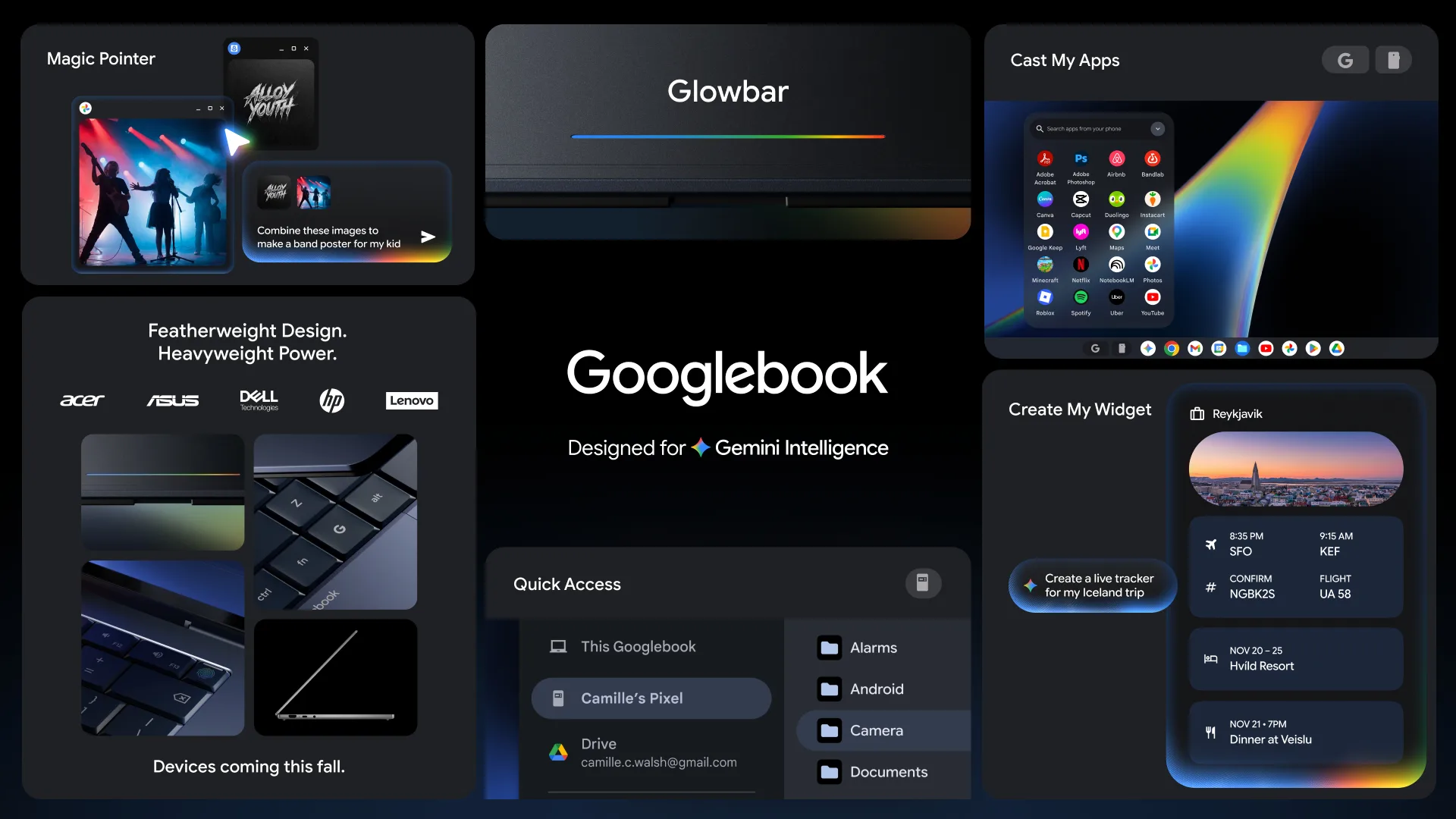
Several manufacturers will participate in the launch: Acer, ASUS, Dell, HP, and Lenovo. The strategic message is clear: Google aims to create a coherent alternative to the MacBook + iPad duo.
Moreover, Gemini will be deeply integrated at the operating system level.
AI Becomes Google’s Primary Interface
What’s unfolding at Google I/O goes far beyond the launch of new products. Google is attempting to reposition its entire ecosystem around one idea: Gemini as the universal interaction layer.
Smartphones, watches, cars, glasses, and computers… every device becomes a terminal connected to the same contextual intelligence.
This vision gradually moves Google toward a model where:
- Android becomes agentic;
- Chrome transforms into an AI execution engine;
- Gemini evolves into a permanent personal infrastructure.
Yet, the fundamental question remains: Is Gemini sufficiently robust? This is where the conference could hinge. Google likely possesses the broadest hardware ecosystem today, the best global distribution, massive software integration, and billions of Android users. However, in 2026, all of this depends on the quality of the core AI model.
According to several analyses leading up to the event, the new Gemini may still lag behind Claude Mythos and be at a comparable level to GPT-5.5 in several advanced tasks.
In other words, Google appears to have built a gigantic AI ecosystem. The question remains whether the cognitive engine at its center is powerful enough to sustain it in the long run.