

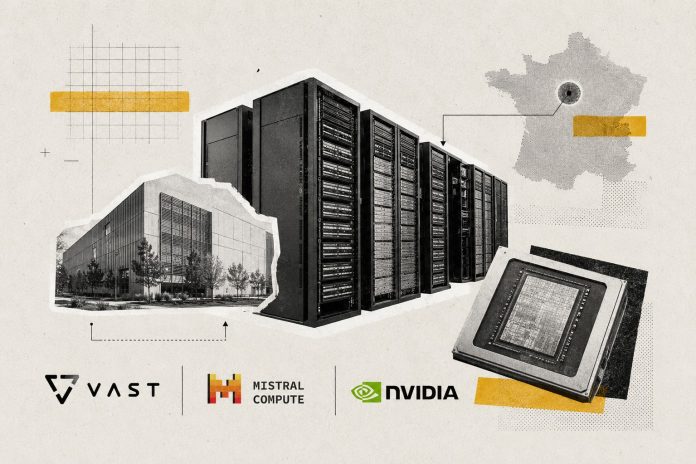
Vast Data and Mistral Compute have announced a collaboration focused on deploying the Vast AI Operating System as the data layer for Mistral AI’s inference computing center in Les Ulis, Essonne. This infrastructure, powered by Nvidia’s GB300 NVL72 accelerators, is touted as the largest of its kind in Europe, encompassing the entire lifecycle of AI models from training to production.
The announcement was made at the AI Now Summit hosted by Mistral AI on May 28, 2026, in Paris, where the French company elaborated on its positioning as a full-stack provider for major industrial clients. The partnership with Vast Data aligns with the infrastructural aspect of this strategy. Set to launch in the third quarter of 2026, the 10-megawatt data center in Les Ulis will rely on a unified data architecture provided by the American vendor and complemented by Nvidia’s GB300 NVL72 accelerators, organized in 72-unit racks. Mistral Compute, the infrastructure division of the group, plans to offer inference services to both its industrial and public sector clients based on this technical foundation.
The collaboration of these three entities establishes a distinct layered architecture where Vast Data supplies the data management foundation, Nvidia provides the computational power with its GB300 GPUs, and Mistral Compute orchestrates the entire system as the platform operator. This model aims to reduce friction between the storage, acceleration, and inference layers, which often create bottlenecks in large-scale deployments.
Vast AI Operating System: Unifying Data Flows
The cornerstone of this initiative is the Vast AI Operating System. This platform simultaneously manages the data flows necessary for training models, enhanced retrieval operations, and production inference pipelines. Its key feature is the elimination of the silos typically found between high-performance storage, object storage, and vector databases, which reduces latency and simplifies the architecture for MLOps teams.
“AI is poised to surpass existing data architectures, and the Vast AI Operating System is the foundation for building the future,” sums up Alon Horev, Chief Technology Officer at Vast Data. This assertion reflects a precise technical reality for large-scale deployments. Effectively managing data between training and production phases remains one of the most time-consuming challenges for organizations that have moved beyond experimentation. The Vast platform aims to reduce this friction without requiring a complete rewrite of existing pipelines.
Yann Léger, Vice President of Cloud Compute at Mistral AI, confirms that the decision to partner with Vast Data stems from its ability to align storage and processing needs across the entire model lifecycle. Instead of relying on the shared offerings from hyperscalers, Mistral has chosen to build proprietary infrastructure to ensure direct control over GPU resources and maintain visibility on processing security.
Nvidia GB300 NVL72 Racks Define Capacity
The selection of the Nvidia GB300 NVL72 accelerator shapes the architecture. Each NVL72 rack houses 72 interconnected GB300 GPUs utilizing NVLink, enabling the distribution of inference for large models within a compact physical unit while maintaining high memory bandwidth. This configuration directly influences the inference throughput per task and the cost per token charged to clients for Mistral Compute.
Rod Evans, Vice President of EMEA Supercomputing at Nvidia, positions this deployment within the broader trajectory of large-scale AI infrastructure development in Europe, stating, “Mistral Compute is creating world-class AI infrastructure.” This statement anchors the announcement amid the race for sovereign computational capacity in Europe, a topic that has engaged both industry players and public institutions since the European Commission released its AI strategy in 2024. According to provided data, the Les Ulis center is set to be the largest deployment of GB300 NVL72 racks in Europe upon its opening.
Pursuing Sovereignty
Mistral AI, a company operating under French law, is not subject to the American Cloud Act. This legal status, combined with ownership of the Les Ulis center, presents a tangible regulatory advantage for clients processing sensitive data under the GDPR or those subject to obligations defined by NIS2, which was transposed into French law in October 2024.
The involvement of Vast Data and Nvidia in the architecture introduces a nuance that procurement and compliance teams of public organizations will need to scrutinize. Vast Data is an American company, and Nvidia is an American manufacturer, both subject to US export controls. Data hosted in Les Ulis passes through a software layer developed in the US and accelerators designed by an American entity. Claims of sovereignty focus on the platform operator and the localization of processing, rather than ensuring neutrality throughout the entire established chain.
The Les Ulis center has yet to receive formal qualification from ANSSI (National Cybersecurity Agency of France). Public buyers and critical infrastructure operators considering Mistral Compute will need to verify the qualification level obtained and the contractual conditions regarding access for Vast Data and Nvidia support teams to production environments at the time of tendering. The commercial availability of the service has not been specified at the Summit.
All That’s Left is the Launch Date
For industrial organizations embarking on large-scale AI model deployment projects, this announcement raises three pertinent questions. The first revolves around the service model. Mistral Compute positions itself as an operator of shared infrastructure. Contractual guarantees ensuring data isolation and resource partitioning between clients will need to be included prior to deploying models handling sensitive data.
The second question addresses compatibility with third-party models. The infrastructure is presented as designed for Mistral models, but there is nothing in the Vast or Nvidia architecture that technically prevents deploying other open-source models. Mistral Compute’s business policy on this point was not detailed at the Summit. Thirdly, timing is a factor. The Les Ulis center is slated for launch in the third quarter of 2026, but a firm commercial availability date has not been established. For projects set to start before the end of the year, validating the commissioning schedule will be a prerequisite for Mistral Compute’s integration into reference architectures.



