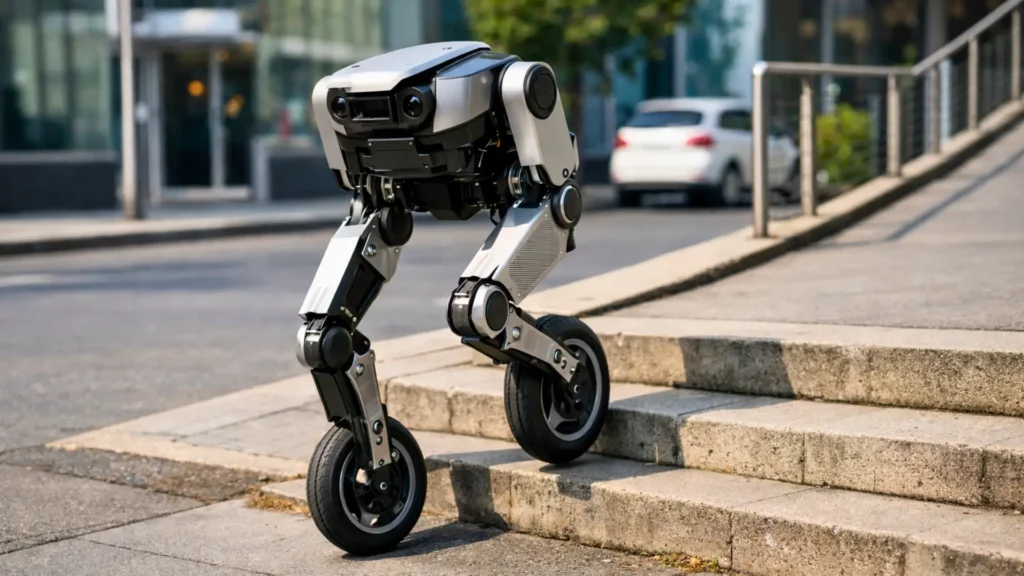
This Amazing Robot Blurs the Lines Between Walking and Rolling. Developed by the Robotics and AI Institute, it adapts its locomotion in real-time through a unique control system. This spectacular advancement could sustainably transform mobile robotics.
A Minimalist Bipedal Design Aimed at Maximizing Stability, Efficiency, and Terrain Versatility
First, the Roadrunner robot adopts a radically different approach with a simplified structure. Indeed, being arm-free, it focuses on the essentials with two articulated legs equipped with wheels. Thus, this design highlights a minimalist robotic architecture designed to maximize efficiency while reducing mechanical complexity.
Moreover, despite this apparent simplicity, Roadrunner proves to be surprisingly versatile. For instance, it can self-right after a fall and maintain its balance in various postures. Additionally, this capability relies on a dynamical balance management that allows it to adjust its position instantly according to terrain constraints.
A Hybrid Locomotion That Utilizes Wheels and Walking for Effective Adaptation to All Terrains
On one hand, the major innovation lies in its ability to switch between multiple modes of movement seamlessly. Specifically, the robot can roll quickly on flat surfaces or, conversely, lock its wheels to walk on more complex terrains. This approach illustrates an intelligent hybrid locomotion suited for diverse environments.
On the other hand, Roadrunner can also climb stairs and navigate ramps, challenges that are still complex for many robots. Furthermore, thanks to its symmetrical joints, it can move in all directions without turning around, offering remarkable directional agility in confined spaces.
Lastly, the robot can balance on a single wheel, a technically impressive feat. This performance relies on an advanced active stabilization system that continuously adjusts the exerted forces to prevent falls.
A Unified Control System That Orchestrates All Modes of Movement Fluidly and Precisely
Furthermore, one of the most impressive aspects of Roadrunner lies in its control system. Unlike many robots that use multiple distinct algorithms, this one operates with a single command policy. This translates to a unification of robotic control that significantly simplifies behavior management.
Moreover, this system allows the robot to transition from one mode to another with no perceptible interruption. Whether it’s rolling, walking, or balancing, the transitions are fluid and natural. Consequently, this continuity is based on an optimized motor coordination resulting from advanced research in artificial intelligence.
Zero-Shot Simulation Learning Accelerates Development and Limits Real Robot Trials
Finally, the Robotics and AI Institute, led by Marc Raibert, employs modern learning methods. Notably, certain behaviors were acquired in simulation before being directly transferred to the real robot. This zero-shot approach illustrates a robot learning in simulation that is particularly effective.
Moreover, thanks to this technique, Roadrunner can perform complex tasks without lengthy training phases on the hardware. Consequently, this reduces costs and accelerates development cycles. This strategy thus aligns with an optimization of robotic development already explored in several advanced research laboratories.
In conclusion, this type of innovation paves the way for robots capable of quickly adapting to new environments. By combining simulation and artificial intelligence, engineers are thus exploring a flexible and evolving robotics that could transform industrial and urban applications in the near future.