

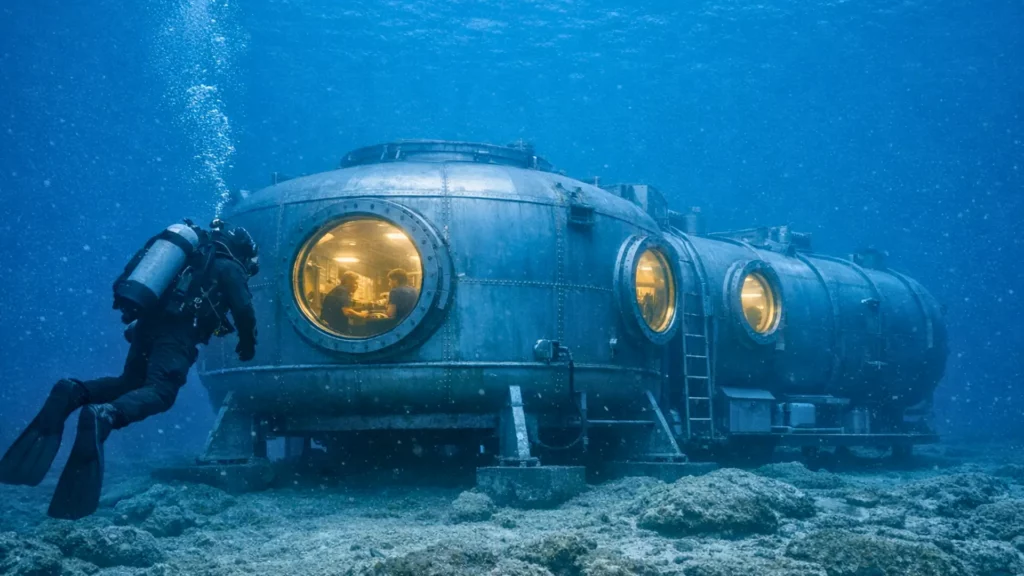
Humanity looks up to the stars, but its near future may be decided beneath the surface of the seas. A British start-up, DEEP, aims to establish permanent human habitats in the oceans by 2027. This ambitious initiative could permanently redefine our relationship with the blue planet.
3D Printing and High-Strength Steel: DEEP’s Strategy for Building Viable Cities Under the Ocean
Sometimes, we know more about the surface of Mars than our own unexplored seabeds. DEEP aims to change this narrative by focusing on the 70% of Earth’s surface covered by water. The plan is to deploy metal structures that can withstand extreme pressure while sustainably accommodating human life.
The key lies in advanced additive manufacturing using electric arc technology. The Vanguard module, expected this year, will host divers in a compact, secure, and functional space. These 3D-printed habitats mark a new phase in human exploration of the depths.
Autonomous Bases Designed for a Month of Living 200 Meters Deep, Aiming for Continuous Human Presence
Engineers envision more than just occasional scientific missions. The future Sentinel units promise complete comfort, with integrated bedrooms, laboratories, and sanitation facilities. These modules will allow for living up to 200 meters deep for nearly a month.
The stated ambition is clear: to establish a permanent human presence, not brief forays. The company even mentions the possibility of a submarine birth by 2050. This would be a strong symbol of a sustainable return of our species to its biological cradle.
Claiming to be the SpaceX of the oceans, the company plans to deploy multiple bases around the world in the next decade. A mobile vehicle could connect these stations to create a structured underwater network.
Pressure, Darkness, Isolation: The Major Physiological Challenges Before Sustainable Installation
The human body undergoes changes when it remains under high pressure for extended periods. Joseph Dituri has spent 100 days underwater to study these effects on his body. His observations reveal a decrease in cholesterol, but also a marked decrease in body density.
The lack of natural light profoundly disrupts biological rhythms and affects the morale of aquanauts. Humans remain reliant on sunlight to maintain their psychological balance. Medicine must offer solutions to mitigate these effects before any large-scale colonization.
Between Scientific Advancement and Ecological Risks, the Fragile Balance of Marine Ecosystems in Question
Installing artificial infrastructure within sensitive ecosystems raises significant environmental concerns. The danger of disrupting local wildlife or generating noise pollution is real. Project proponents assure that they will work closely with marine biology specialists.
The goal is to explore these environments without repeating past terrestrial mistakes. These bases could help better study and protect endangered species. A respectful coexistence is essential for the success of this bold technological and scientific challenge.
This movement toward the ocean offers an alternative in the face of contemporary climate challenges. It is not about abandoning the surface but learning to occupy it differently. We must establish ourselves in the depths as responsible hosts rather than as predators of resources.



