

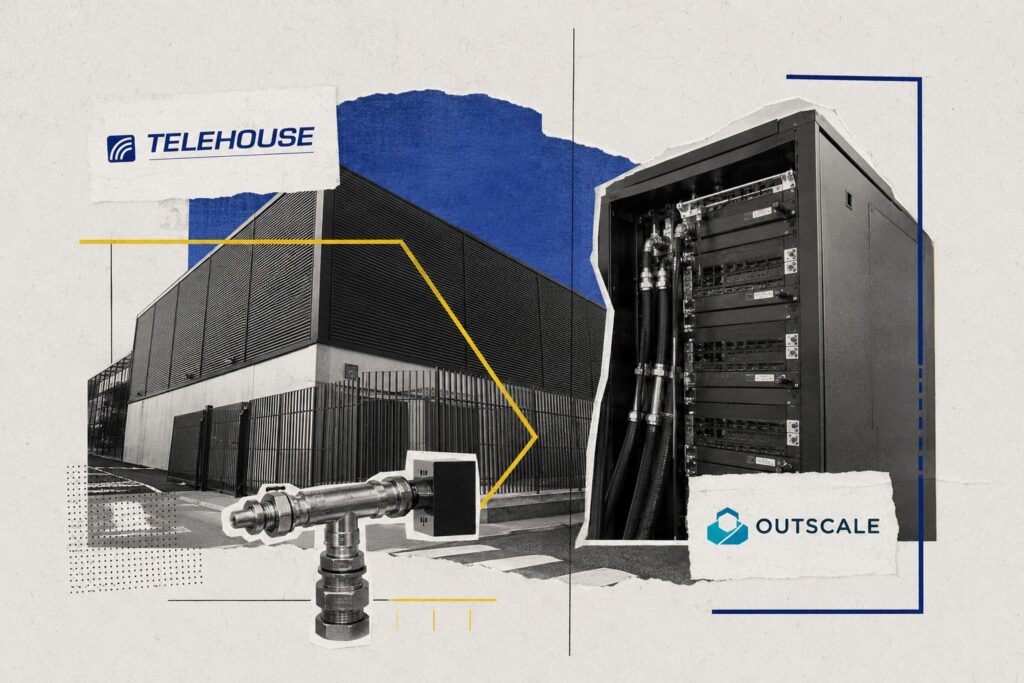
Telehouse Launches AI-Ready Module Magny 2 at Paris Campus
On May 5, 2026, Telehouse unveiled its latest AI-ready infrastructure module, Magny 2, at the TH3 Paris Magny campus in Île-de-France. This advanced module boasts a remarkable power density of up to 132 kW per rack, achieved through direct liquid cooling (DLC), and features a Power Usage Effectiveness (PUE) of less than 1.2 across 2,000 square meters of IT space, with a total capacity of 3 MW. Among the first users of this cutting-edge facility is Outscale, the sovereign cloud brand of Dassault Systèmes, certified by SecNumCloud.
The computational demands associated with training and inferring large artificial intelligence models have significantly altered the technical requirements for colocation operators. Five years ago, a standard data center might have handled between 5 and 10 kW per rack; today, AI-focused GPU clusters require densities that are ten to twenty times higher. In Europe, this shift compels operators to invest heavily in their cooling and power supply infrastructures, or risk being unable to meet AI clients’ needs.
Telehouse, part of the Japanese KDDI group, has opted for direct liquid cooling as the foundational technology for Magny 2. This approach circulates a coolant close to the components that require cooling, effectively managing thermal loads that cannot be adequately handled by air cooling alone, while also reducing overall air conditioning power consumption. The result is a PUE of less than 1.2 for the TH3 Paris Magny campus, a benchmark achieved by only a limited number of colocation facilities in Europe at this point.
Magny 2: 132 kW per Rack for GPU Architectures
The Magny 2 module encompasses 2,000 square meters of dedicated IT space, with a total capacity of 3 MW. It features two distinct operational areas: one cooled by conventional air, providing 400 kW of IT capacity, and a DLC zone capable of handling up to 1,800 kW of IT load with rack densities reaching 132 kW. This upper technical limit is at the forefront of available colocation facilities in Europe, compatible with the latest high-performance GPUs needed for intensive AI projects.
For CIOs and CTOs considering outsourced AI infrastructure, rack density is just one of many deciding factors. PUE has emerged as a crucial sustainability benchmark, especially with the reporting requirements set forth by the Corporate Sustainability Reporting Directive (CSRD). A PUE of 1.2 indicates that for every kilowatt consumed by IT equipment, an additional 0.2 kW is required for supporting infrastructure. This performance significantly outpaces the average PUE of existing European data centers, which typically ranges from 1.5 to 1.6.
Additionally, the module incorporates redundant power supplies and enhanced connectivity to key internet exchange points in the Paris region, both vital for AI workloads that generate massive data flows between compute clusters and distributed storage systems.
Outscale: A Sovereign Argument
The presence of Outscale within the TH3 Paris Magny campus holds strategic importance for the market. As a sovereign cloud brand of Dassault Systèmes, certified by SecNumCloud by the ANSSI, this infrastructure provides a critical option for public sector organizations and sensitive industries seeking to outsource AI workloads without exposing their data to extraterritorial jurisdictions.
Telehouse, as a subsidiary of a Japanese company not subject to the U.S. Cloud Act, offers a distinct jurisdictional profile compared to the major American hyperscale platforms and their European branches. For financial institutions, defense operators, or critical infrastructure providers, this represents a colocation option that balances GPU performance with stringent control over sensitive data processing.
This distinction has become increasingly relevant in light of obligations stemming from the NIS2 and DORA regulations, which require affected entities to map their dependencies on third parties and assess the associated risks of each critical infrastructure provider. The jurisdictional profile of a host, once considered a secondary criterion, has now emerged as a central element in the risk assessments conducted by Chief Information Security Officers (CISOs).
France: A Favorable Ground for AI Density
The opening of Magny 2 marks a significant acceleration in investments for high-density AI infrastructure across Europe. In the past year, several colocation operators have announced expansions or AI-ready modules, driven by the growing demand from sovereign cloud players, research laboratories, and large enterprises repatriating part of their computing needs from hyperscalers.
France enjoys a structural advantage in this regard, benefitting from a low-carbon electricity mix that eases the environmental impact of compute-intensive infrastructures, as well as a strong tradition of excellence in data center engineering. However, the primary challenge remains the availability of electrical power at sites. Connecting additional megawatts to the distribution network can take several years in Île-de-France, thus giving a competitive edge to operators that have proactively planned for these connections.
Telehouse benefits from the existing infrastructure of the TH3 Paris Magny campus, originally designed to accommodate significantly higher density levels than the conventional standards of its time. This initial investment now serves as a competitive advantage in a market where the scarcity of available power is as impactful on client decisions as the cost per kilowatt.
For IT teams weighing the options between in-house infrastructure, hyperscale cloud, and colocation, the Magny 2 module adds another compelling choice in the high-density, sovereign-profile category. The combination of liquid cooling, a PUE below 1.2, the presence of a SecNumCloud-certified operator, and affiliation with a company outside the Cloud Act jurisdiction presents a cohesive strategy at a time when AI infrastructure decisions hinge on both regulatory requirements and purely technical specifications.



