SoC Market: Why Revenues Are Skyrocketing Despite a 7% Drop in Sales?
The smartphone market is often referred to as “mature.” However, 2026 is shaping up to be a turning point: the volume of System-on-Chip (SoC) shipments is projected to decline, yet revenues will continue to rise.
This paradox reflects the current state of the industry: an uptick driven by AI, constrained by a new scarcity—memory—drawn into data centers.
The Facts: -7% Decrease in SoC Shipments in 2026, According to Counterpoint
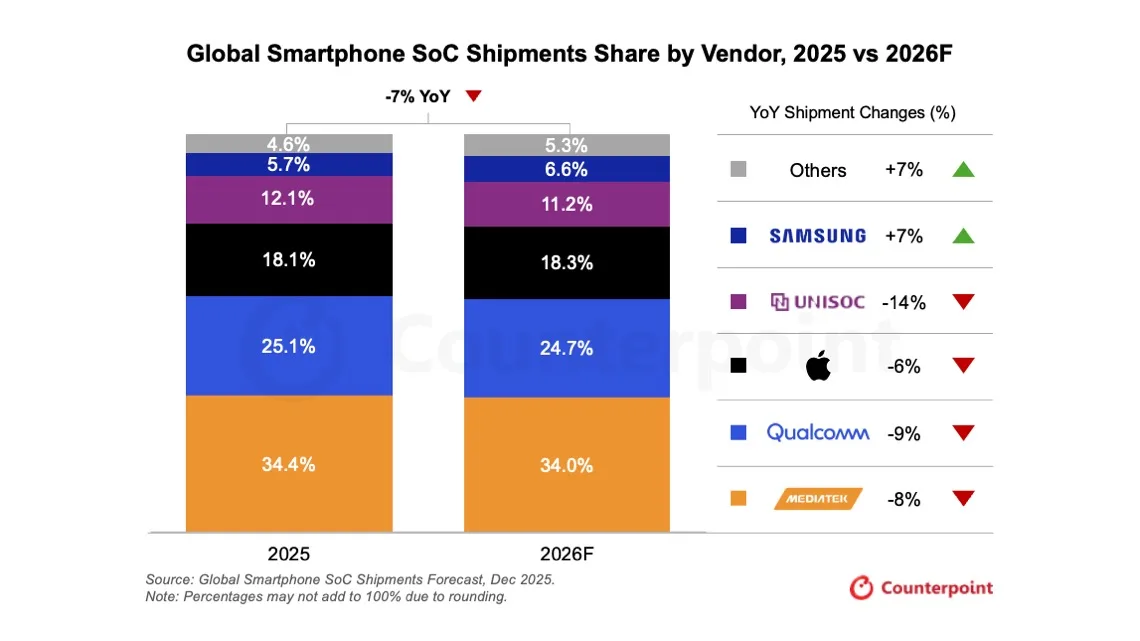
Counterpoint anticipates a significant slowdown in the global smartphone SoC market, forecasting a 7% decrease in shipments in 2026 (Year over Year), following several years of growth.
The research firm does not expect a genuine rebound in volumes until 2027, as manufacturers streamline their product lines and absorb rising costs.
The Real Culprit: Memory, and the HBM vs. Consumer Battle
The most significant dynamic is not a new innovation from Qualcomm or MediaTek, but rather an industrial compromise: foundries and memory manufacturers are prioritizing high-margin products, particularly High Bandwidth Memory (HBM) intended for AI infrastructures. This has resulted in supply tensions and increased component costs, affecting the low end of the market the most.
Reuters describes the same phenomenon on a consumer hardware scale: the surge in AI-related demand “captures” a significant portion of memory supply, driving up prices for smartphones, PCs, and consoles.
The concrete effect is significant: Counterpoint notes a 20% to 30% increase in bill of materials (BoM) costs for entry-level devices (priced under $200) since the start of 2025, with pressure expected to continue.
The Red Zone: Smartphones Priced Under $150 and Entry-Level 4G/5G SoCs
Counterpoint highlights a particularly vulnerable segment: smartphones priced under $150, where even a slight increase in memory or storage costs can disrupt the business model. SoC providers active in the entry-level 4G and 5G market will likely bear the brunt of this shock.
In contrast, brands that design more in-house (such as Samsung, Google, Huawei, and Xiaomi) are better positioned to negotiate, adapt, and realign their strategies.
It’s not that memory becomes “cheaper” for them; it’s that they have more options to absorb, shift, or offset the costs.
The Surprise: Premiumization Continues, Supporting Revenues
Even with declining SoC shipments, Counterpoint estimates that market value will remain strong due to a trend toward premium devices: nearly one in three smartphones is projected to sell for over $500.
In other words, the industry may be selling less… but at higher prices, driven by demand for high-performance devices—and the escalating cost of components.
As for the “structural winners,” Counterpoint identifies Apple and Qualcomm as the best positioned to benefit from this shift to premiumization, while MediaTek will ramp up its efforts in the Android premium segment, intensifying the competition.
2 nm: A Technological Transition Amidst a Storm
As if cost pressures weren’t enough, the market is moving toward a transition to 2 nm technology in the high-end segment. Counterpoint notes that Samsung has already unveiled the Exynos 2600 as the first smartphone SoC based on a 2 nm GAA process.
On its official page, Samsung positions this chip as a next-generation AI & gaming platform, emphasizing performance and energy efficiency.
This transition to 2 nm is never easy: it requires massive investment, involves tricky ramp-ups, and tends to push prices higher—especially when the supply chain is already stressed.
AI, Finally, as a Price Driver… and as a Technical Constraint
Counterpoint directly links the GenAI wave to rising average selling prices (ASP), projecting an AI “on-device” power peak of around ~100 TOPS by 2026 in the high-end segment, with nearly 90% of premium smartphones capable of handling AI functions locally.
However, AI has a downside: it consumes memory, storage, and internal bandwidth—all of which are rising in cost. Hence, an interesting trend emerges: Counterpoint anticipates that the mid-range segment ($100–$500) will increasingly rely on cloud offloading (processing AI on the server) to manage hardware costs.
And in the middle lies a simple truth: the smartphone remains a mass-market product, but its value chain is rapidly “data-centering.”