

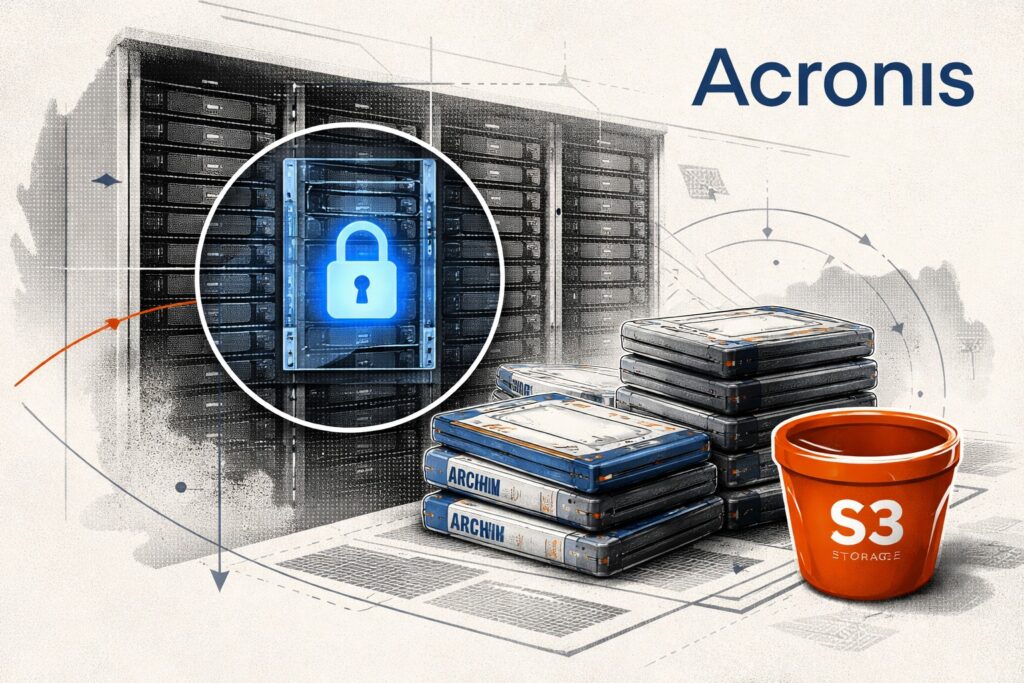
Acronis Expands Cyber Protect Cloud with New Archival Storage Service
Acronis has unveiled Archival Storage, a significant addition to its Cyber Protect Cloud, aimed at managed service providers (MSPs) and small to medium-sized enterprises (SMEs) facing increasing data retention obligations. This new offering features native encryption, WORM (Write Once Read Many) immutability, an impressive durability rating of 99.999999999% (11 nines), and a cost model devoid of exit fees, making it an attractive solution for regulatory compliance without spiraling costs.
As backup portals evolve into comprehensive data lifecycle management platforms, archival storage is gaining prominence. Driven by regulatory requirements, burgeoning data volumes, and the analytical reuse of historical data, archiving is transitioning from a peripheral function to a core aspect of cybersecurity. Acronis has positioned its Archival Storage service at the heart of this transformation, with seamless integration into its Cyber Protect Cloud platform.
Acronis Archival Storage is based on S3-compatible object storage, offering unified billing for MSPs directly through the Cyber Protect Cloud platform. The technical promise includes millisecond retrieval times, the aforementioned 99.999999999% durability, and 99.5% availability—ensuring that infrequently accessed yet legally critical data remains accessible. With built-in native encryption and WORM functionality, the integrity of archived data is safeguarded. Additionally, the absence of API fees and external transfer costs aims to stabilize total cost of ownership, addressing a common concern for MSPs operating on public clouds.
Stability, Immutability, and Predictable Costs
According to Acronis, this layer adds low-maintenance archiving capabilities to their “warm” backup storage, making it suitable for audits, investigations, and analytical processing. Gaidar Magdanurov, president of Acronis, notes that “many clients must comply with regulations that require them to retain their data for several years.” He emphasizes that the native integration of Cyber Protect Cloud simplifies the operational management of these extensive data volumes over the long term.
Operationally, Acronis highlights preconfigured plans, S3 API support, and built-in controls to streamline implementation. The solution is deployed across seven data centers to ensure global reach and compliance within multi-region environments. Acronis also aims to eliminate unforeseen costs associated with data egress—a common practice among hyperscalers that complicates the creation of stable-margin archiving solutions for MSPs.
By internalizing long-term archiving within its platform, Acronis enables service providers to offer end-to-end management of data protection and retention, presenting a clearer pricing model for their SME clients. This strategy seeks to transform a historically burdensome aspect into a differentiating service, backed by a unified cybersecurity solution.
Strategic Partnership with Seagate
The infrastructure layer leverages Seagate’s Lyve Cloud in a partnership designed to ensure physical availability and resilience of storage. Melyssa Banda, SVP of Edge Enterprise Storage and Services at Seagate, stated that this collaboration makes archived data accessible for compliance, artificial intelligence, and analytics, all while maintaining predictable economics. This industrial backing enhances Acronis’s credibility for long-term retention solutions, independent of the volatile pricing models often associated with major public clouds.
With Archival Storage, Acronis continues to enhance its unified platform that combines backup solutions, cybersecurity, and now cold storage. This development reflects a broader market trend where archiving moves beyond a purely technical perimeter to become essential components of governance, compliance, and the valuation of historical data. For MSPs, the ability to orchestrate protection, retention, and quick access from a single platform paves the way for more robust offerings tailored to regulatory constraints and emerging analytical use cases.
In the medium term, integrating archiving into cybersecurity platforms could reshape value chains, bridging cold storage, security, and data utilization. For IT managers at SMEs, the anticipated benefits include more predictable cost trajectories, reduced operational complexity, and an enhanced ability to reactivate dormant data for audits, analysis, or artificial intelligence projects—all without the need to construct a parallel technical stack.



