

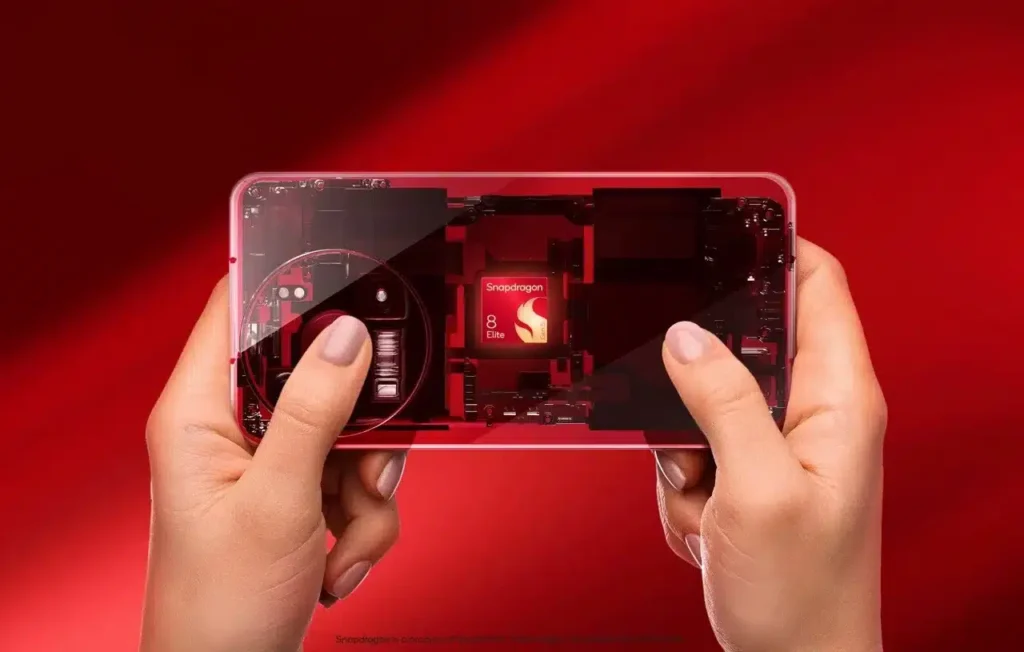
Snapdragon 8 Elite Gen 6: Has the 5 GHz Barrier Finally Been Crossed on Smartphones?
The usual leaks are in action: a number appears, circulates across the web, and a mobile chip is suddenly compared to a desktop CPU. Last week, the buzz was about “5 GHz” regarding the upcoming Snapdragon 8 Elite Gen 6, hinting at an even more powerful Pro version.
On the surface, it sounds impressive. In reality, it reveals a critical point: mobile SoCs no longer just face a power challenge but also an overheating issue.
What the “5 GHz” Claim Means
The source of the rumor comes from a Weibo post attributed to leaker Fixed Focus Digital, picked up by several media outlets: early tests allegedly reached 5 GHz, with a “ceiling” suggested between 5.5 and 6 GHz—even though 5.5 GHz is considered the more “realistic” estimate by the same source.
However, it’s essential to read between the lines: such frequencies are almost always peaks (bursts) in controlled scenarios, not guaranteed consistent performance over several minutes. In smartphones, the frequency isn’t a straight line: it’s a curve influenced by temperature, power consumption, and the chassis limits.
The Key Factor: A “Mini Heatsink” Built into the Package
What lends credibility to this leak on a technical level is the accompanying argument: the use of a thermal solution known as HPB (Heat Pass Block), popularized with Samsung’s Exynos 2600. The idea is to incorporate a conductive element (like a heatsink) within the packaging to reduce thermal resistance and disperse heat more effectively.
Several sources suggest a 16% improvement in thermal resistance with HPB, which in real-world terms can mean “less throttling”—and thus more stable performance, not just higher peaks.
Additionally, Samsung has shifted the DRAM (typically stacked) to facilitate more direct contact between the SoC and the heat dissipation block, indicating noticeable thermal gains on the Exynos 2600.
In essence, if Qualcomm “borrows” this type of solution, the goal isn’t merely to flaunt 6 GHz on a slide. Instead, it’s about maintaining high-performance levels for longer periods—which users will genuinely notice.
2 Nm: The Perfect Fuel…but Not a Magic Wand
Another crucial aspect of the discussion is the transition to a 2 nm process (often referenced regarding TSMC’s N2/N2P family). TSMC has confirmed that its N2 entered high-volume production at the end of 2025, and the ecosystem is already talking about N2P as an upcoming “evolution” of 2 nm.
The 2 nm process can aid in two ways:
- Reducing consumption at equivalent performance levels,
- Or allowing higher frequencies at equivalent thermal envelopes.
However, caution is warranted: physics does not vanish. Even with a finer node, pushing for higher frequencies disproportionately increases consumption (due to the required voltage), which is precisely what drives up heat.
What a 5 GHz Chip Means for Smartphones (and What It Doesn’t)
To put the figure in perspective: the Snapdragon 8 Elite Gen 5 already peaks around 4.6 GHz on its “prime” cores. Moving from 4.6 to 5.0 GHz is more of a symbolic threshold—the real question is “how long” it can maintain that frequency.
In single-core situations, frequency peaks can boost responsiveness (UI, instant processing, minor tasks). However, in gaming/video/AI over longer durations, it’s dissipation and throttling that ultimately dictate the end results.
In other words, a Snapdragon “Pro” at 5 GHz is only appealing if it can convert that peak into sustained performance rather than merely a benchmark fireworks display.
Why Qualcomm Might Offer Two Versions (Standard + Pro)?
The rumor of a dual variant resembles a strategy already employed in the industry: creating a “Pro” peak reserved for Ultra models (and Ultra price tags), while retaining a standard version for the classic high-end. Qualcomm already has a parallel segmentation (8 Elite/8 Gen) in the current generation.
Moreover, there’s another, more subtle reason: the thermal lottery of smartphones. Not all chassis dissipate heat equally. A more aggressive SoC may require a larger vapor chamber, more conductive materials, and stricter thermal management from the manufacturer.
A “Pro” version allows for optimization of the chip for designs that can handle it.
Indeed, seeing “5 GHz” on a mobile SoC is an obvious marketing milestone. Yet, if this leak conveys something significant, it’s this: raw performance is no longer the primary hurdle; it’s heat. HPB and the 2 nm process are tools to push the boundaries—not to eliminate them.
The Snapdragon 8 Elite Gen 6 Pro, if it exists, won’t be judged solely on its maximum frequency. It will be evaluated on its ability to maintain speed when the phone heats up, when the camera is active, when gaming, and when AI processes run. And that presents a far more intriguing challenge than any rounded number.



