

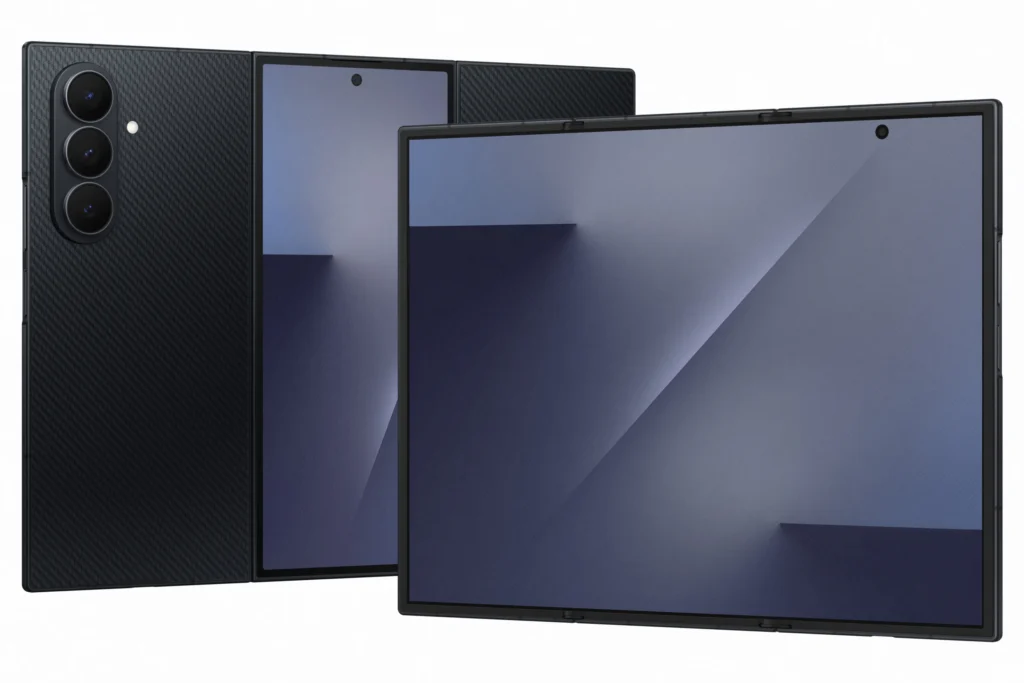
Samsung is not giving up: The Galaxy Z TriFold 2 and a ‘sliding’ model already in the works
Just as the Galaxy Z TriFold is being pulled from the market, Samsung appears to be gearing up for its next steps. According to a recent leak shared by several media outlets based on a post from the Korean leaker yeux1122 on Naver, the company is reportedly working on both a Galaxy Z TriFold 2 and a smartphone with a sliding screen, currently nicknamed Galaxy Slide.
While nothing is official yet, the simultaneous emergence of these two projects indicates that Samsung has not abandoned experimental formats, despite the quick cessation of its first tri-fold device.
The first TriFold has already disappeared, but not necessarily as a complete failure
The origin of this rumor is significant. Samsung is indeed ending the sales of the Galaxy Z TriFold less than three months after its launch, first in South Korea and then in the United States once stocks are depleted.
However, various reports suggest that this model primarily served as a technological showcase rather than a product intended to become a mainstay in the Galaxy lineup. In other words, its rapid disappearance doesn’t automatically imply that Samsung sees the concept as having no future.
A Galaxy Z TriFold 2 aiming for 2027
According to the leak, Samsung has already begun development on a successor, with a targeted release in mid-2027. If this timeline holds, the Galaxy Z TriFold 2 could launch alongside the upcoming Galaxy Z Fold 9 and Galaxy Z Flip 9 in the summer of 2027. However, it’s important to approach this information with caution: this timeline comes from leaks and not from an official Samsung roadmap.
The same source mentions a second, even more unconventional project: a smartphone with a sliding screen. Again, nothing is publicly confirmed, but some iterations of the leak indicate that this product might be released later, potentially in late 2027 or early 2028. This further timeline aligns with the generally lower maturity of sliding formats compared to traditional foldables.
The leak also presents an interesting technical point: Samsung is reportedly working on a lighter and thinner hinge for the Galaxy Z TriFold 2. On the other hand, the phone itself might remain the same thickness or even become thicker than the original TriFold and the Galaxy Z Fold 7. Once more, these details should be treated as very preliminary indications.
However, this suggests that Samsung is looking to simplify the mechanics and increase durability, even at the cost of minimal overall thickness gain.
This development shift changes the interpretation of the first TriFold
This is probably the most intriguing point. For several weeks, some observers viewed the first Galaxy Z TriFold as an isolated experiment, or even a one-off without follow-up. If Samsung is indeed working on a Galaxy Z TriFold 2, it would imply that the company still sees commercial potential in this format, provided it can be rendered more viable and possibly less expensive to produce.
Another contextual element is significant: the segment for very atypical devices has become a symbolic battleground where Chinese manufacturers, particularly Huawei, are increasingly making their mark.
Continuing to develop a tri-fold or slidable device would allow Samsung to retain a visible presence in this innovative space and not leave it entirely to Chinese brands. This interpretation is a strategic inference, but it aligns with the showcase role attributed to the first TriFold and the recent proliferation of alternative format projects at Samsung.
Products likely marginal, but important for the industry
Even if these devices come to fruition, they may not become true mass-market products. However, their existence would still hold significance. In a market where rising memory costs and a slowdown in some categories compel manufacturers to be more cautious, Samsung’s continued investment in unconventional formats would send a strong message: the brand still wants to play a leading role in hardware experimentation.
And in a sector that sometimes trends towards uniformity, that’s far from trivial. This conclusion is drawn based on current cost pressures and the apparent continued pursuit of TriFold and slideable projects.



