

Fitbit: Your Watch Now Accesses Your Medical Record!
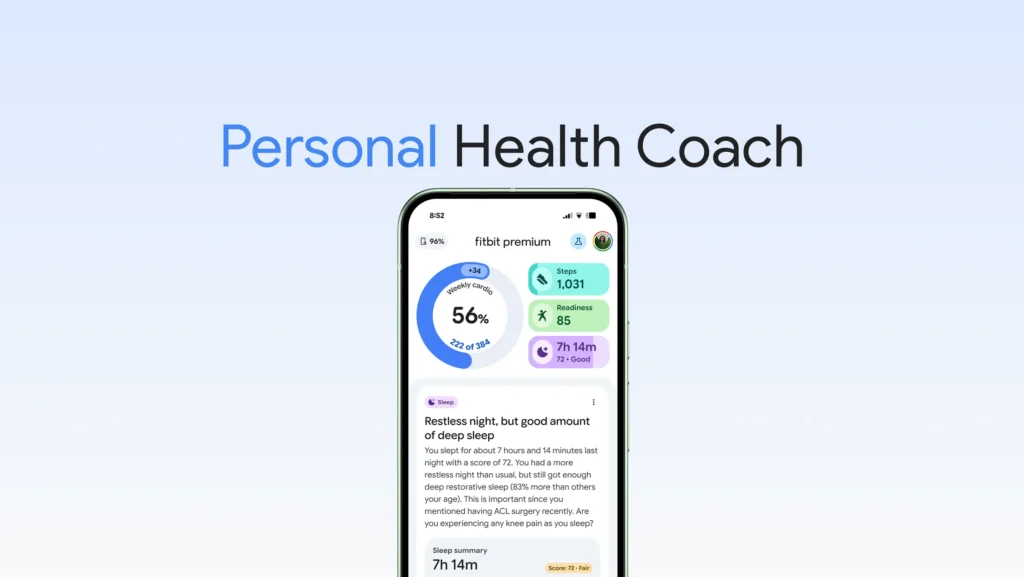
Fitbit reaches a new milestone in its transformation. Starting next month, select users will be able to link their medical records to the app, allowing its Gemini-powered coach access to information such as lab results, prescribed medications, and consultation history.
In addition, Google also announces an enhancement in sleep tracking, with a 15% increase in the accuracy of sleep phase detection.
The goal is clear: Fitbit aims to go beyond just being an activity or sleep tracker. The brand seeks to become a broader health reading layer, capable of combining wrist data with actual clinical information to provide more contextualized advice.
Fitbit: Sleep Becomes More Accurately Interpreted
Even before the introduction of medical records, Fitbit is already enhancing one of its historical foundations: sleep. Google explains that its new model for sleep phases differentiates better between the time spent trying to fall asleep and the time actually spent sleeping. According to clinical validation cited by the company, this update improves performance by 15% compared to the previous version on compatible Pixel and Fitbit devices.

Fitbit is also preparing a new version of the Sleep Score, designed to be more actionable. Instead of mainly summarizing the night with an overall score, the app will highlight concrete elements, such as sleep onset time. The improved sleep tracking is already being rolled out, while the new Sleep Score experience will arrive in the coming weeks for users in the Public Preview program.
The Real Turning Point: Linking Medical Records to Fitbit
The most significant new feature will arrive next month for Public Preview users in the United States. They will be able to connect their medical records directly in the Fitbit app, consolidating their lab results, treatments, visit history, and other data from various healthcare providers in one place. For this, Google relies on partners like b.well and CLEAR, either by searching for their healthcare provider or verifying their identity with an ID and a selfie according to IAL2 standards.
Once these data are linked, the AI coach will be able to respond in a much more personalized manner. Google cites the example of cholesterol: instead of a generic response, the assistant could summarize important values, identify trends, and suggest options based on both medical records and wearable data. The company also pointed out that this information could later be shared securely with a physician or a loved one via a Smart Health Link or a QR code in the coming months.
Google Emphasizes Privacy
On such a sensitive subject, Google naturally emphasizes data protection. The company states that medical records are stored securely within Fitbit, remain under the user’s control, and are not used for advertising purposes.
This is a central point, as the entire value proposition relies on a delicate exchange: more personalization in return for access to much more intimate health data.
Glucose Also Comes into Play
At the same time, Public Preview users will also be able to connect a continuous glucose monitor through Health Connect. The idea is to enable the Fitbit coach to explain, based on personal data, how a meal or exercise session actually influences their blood glucose levels.
This further expands the product’s ambition: moving beyond merely tracking metrics to connecting daily behaviors with observable physiological effects.
A Strategy Beyond Just Product Updates
These announcements fit into a broader dynamic at Google. The company highlights a recent study published in Nature about predicting insulin resistance from smartwatch signals, while simultaneously collaborating with Included Health on conversational AI applied to virtual care.
This indicates that Fitbit is no longer viewed as just a wellness accessory but as a building block of a larger health ecosystem, blending research, prevention, and digital assistance.
Ultimately, Fitbit is moving towards a much more ambitious vision: to become an application that not only tracks your steps or sleep hours but begins to understand your health state in a more comprehensive way. The question remains whether users will be willing to unlock their medical vault to gain more relevance in their daily lives.



