

Vast Data and Nvidia Unveil CNode-X: A New Era of GPU Servers for AI Operations
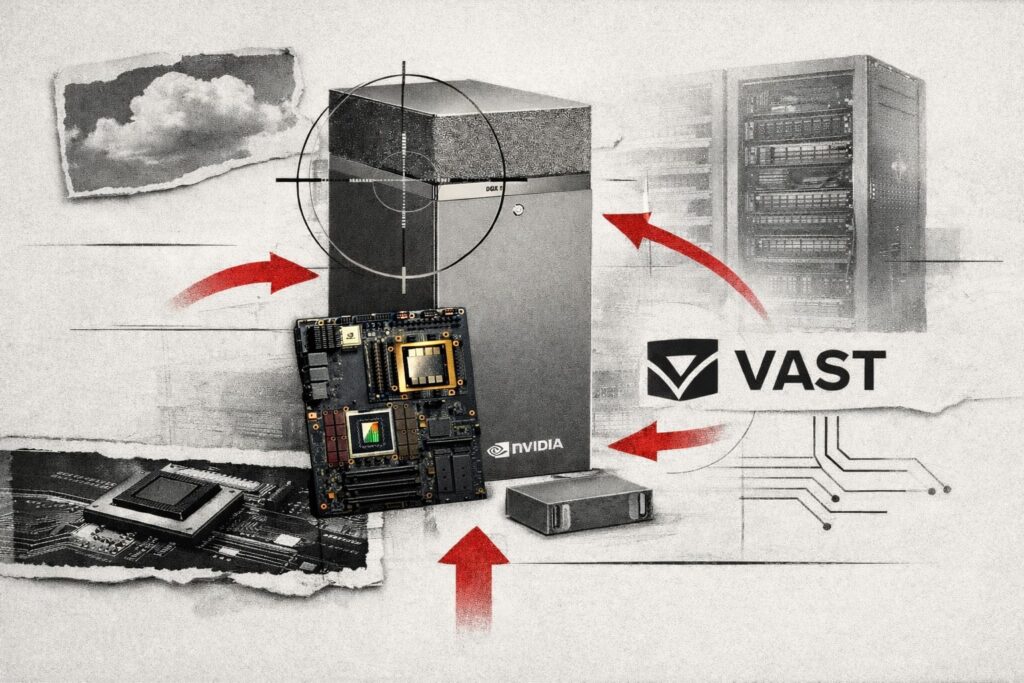
Vast Data and Nvidia have announced the launch of the CNode-X, a GPU server that runs the Vast AI Operating System. This platform integrates storage, vector databases, SQL analytics, and inference into a cohesive system, eliminating the need for separate stacks. For enterprises, this development aims to break down data silos that hinder the progression of AI projects from experimentation to production. Both Cisco and Supermicro will distribute the CNode-X.
According to Vast Data, a staggering 90% of enterprise data is housed in systems that were never designed to support real-time model feeding. Traditional architectures force teams to duplicate data across separate AI infrastructures, resulting in silos, version conflicts, and compliance risks. The CNode-X turns this paradigm on its head by running the Vast AI OS directly on GPU servers equipped with Nvidia’s RTX PRO 6000 Blackwell chips, performing computations where the data resides without prior movement.
The CNode-X incorporates several Nvidia libraries directly into Vast’s core services. The cuVS library speeds up vector search and clustering, reducing retrieval latency for production-ready RAG (retrieval-augmented generation) pipelines. The Sirius engine, which is based on Nvidia cuDF and is open source, enables GPU-accelerated SQL analytical query execution at the compute layer. Vast has reported preliminary benchmarks indicating a reduction of query time by up to 44% and a cost decrease of up to 80%. However, these results still require validation in real production environments.
Dase Architecture: Universal Data Access
The Vast DataBase leverages GPU execution while organizing data storage with pushdown and filtering mechanisms that minimize unnecessary I/O before queries reach the compute layer. This approach produces a database optimized for both storage and GPU, in contrast to methods that delegate acceleration to a single layer.
The platform is built on Vast Data’s Disaggregated Shared Everything (Dase) architecture. Each CNode-X node accesses all data through NVMe over Fabrics, eliminating inter-node coordination, sharding, and east-west traffic. The entire system operates as stateless containers managed by Kubernetes within the Vast AI OS, removing the need for assembling separate systems for storage, vector databases, analytics engines, and AI infrastructure.
RAG pipelines that previously required separate GPU clusters, standalone vector databases, and dedicated storage layers can now operate as a unified workflow, allowing all components to access the same data corpus simultaneously. Access policies seamlessly propagate from raw data to inference, with no additional security layer to manage.
Extended Inference and Multi-Agent Systems via Nvidia CMX
Vast has integrated Nvidia’s Context Memory Storage (CMX) platform alongside clusters featuring Nvidia BlueField-4 DPUs and the Spectrum-X network. This integration aims to accelerate access to shared KV caches and reduce the time-to-first-token for long-duration inference workloads and multi-agent systems. The Dase architecture also allows for off-band enterprise data services without compromising KV recovery times.
Additionally, Vast is deploying Nvidia NIM microservices on the CNode-X and releasing open-source DataEngine plans targeting three use cases: video intelligence, document RAG in enterprises, and genomic research. These plans streamline the industrialization process for teams prototyping on heterogeneous stacks. Vast intends to distribute the CNode-X servers through two OEM partners, Cisco and Supermicro, enabling enterprises to acquire GPU infrastructure from their familiar suppliers while benefiting from Vast’s software expertise, support, and operations.
Transforming AI Stacks in Enterprises
The Vast Data-Nvidia partnership emerges amidst a structural shift documented by major analytics firms for 2025-2026. This convergence trend stems from a market reality where the slower-than-expected industrialization of AI deployments is hindered by data quality and reliance on external platforms. Market players are addressing this by absorbing missing layers instead of merely interfacing them. According to Gartner’s ten strategic trends for 2026, platforms natively designed for AI and dedicated supercomputers are essential for successful industrialization. Deloitte predicts that nearly two-thirds of AI computing power consumed in 2026 will be for inference rather than training, placing performance demands precisely where Vast and Nvidia aim to optimize operations.
This layer consolidation strategy is manifesting across multiple market levels. On the enterprise platform front, Salesforce completed its acquisition of Informatica in November 2025 for $8 billion, enabling it to oversee governance and data quality essential for its Agentforce AI agents. In the hybrid middleware sector, IBM has integrated Watsonx.data into Think 2025 as a central access point between AI agents and document silos, following its acquisition of DataStax to enhance vector search capabilities. At the sovereign level, Mistral AI acquired the Paris-based startup Koyeb in February 2026 and invested $1.4 billion in data centers in Sweden, rigorously building its complete stack—models, inference, execution, and physical infrastructure—to reduce dependence on American hyperscalers while addressing localization demands from major European clients. Additionally, a joint venture involving MGX, Bpifrance, Mistral AI, and Vast for an AI campus in France underscores that this consolidation is also exploring public-private pathways nationally.
A Race for Control of a Strategic Resource
Microsoft has followed a similar trajectory at Ignite 2025, structuring its tech stack as a federated orchestration layer—Agent 365, Fabric IQ, Foundry IQ, and Copilot—where data, workflows, and agents share the same governance framework. Capgemini, in its TechnoVision 2026 report, describes this movement as a “race for control of strategic resources,” encompassing semiconductors, storage, and models, anticipating it will reshape the global digital landscape profoundly.
For CIOs, Forrester’s position is unequivocal: a quarter of AI spending may be postponed to 2027 due to lack of tangible returns, with one in four IT executives likely to be called upon to salvage projects initiated by business units without sufficient technical foundations. The CNode-X addresses this exact diagnostic—removing integration frictions that prevent AI projects from transitioning from experimentation to production—within an ecosystem whose evolving conditions remain dictated by its primary architects.



