

OVHcloud Unveils Quantum Platform: Europe’s First Quantum-as-a-Service Offering
In a significant milestone for Europe’s sovereign cloud initiative, OVHcloud has announced the launch of its Quantum Platform, the continent’s first Quantum-as-a-Service solution, granting immediate access to Pasqal’s quantum computer. This groundbreaking initiative aims to provide businesses the opportunity to experiment, enhance their skills, and prepare for impending technological disruptions.
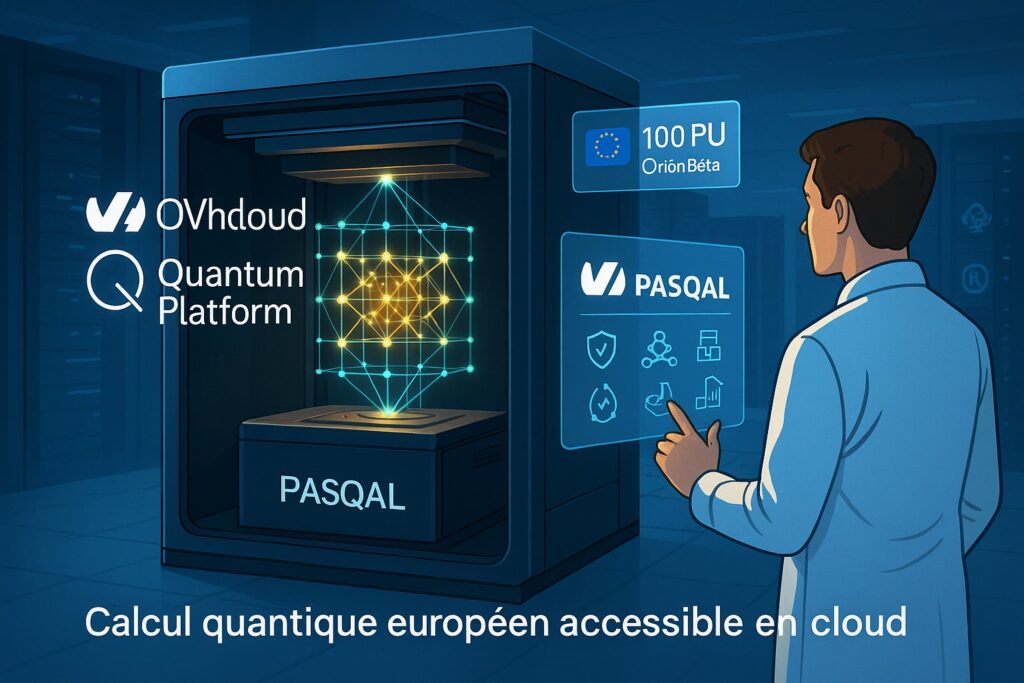
The Quantum Platform represents a pivotal move towards embedding quantum computing capabilities within the European sovereign cloud framework. During the Choose France event, OVHcloud officially rolled out this remote access infrastructure to quantum computers, designed to expand computational capabilities for organizations without the need for hefty investments in specialized hardware. The first quantum processing unit (QPU) integrated into this platform is Pasqal’s Orion Beta, a leading French quantum technology developed by Georges-Olivier Reymond and co-founded by Nobel Prize-winning physicist Alain Aspect. This neutral-atom-based processor offers 100 operational qubits available through OVHcloud’s cloud environment, ensuring a secure, shared platform that meets sovereignty requirements. By 2027, the Quantum Platform plans to accommodate eight additional QPUs, including seven European systems, paving the way for a gradual integration of the most advanced technologies.
The launch of the Quantum Platform extends OVHcloud’s strategy of democratizing access to emerging technologies by removing technical and financial barriers. This “as-a-service” model empowers businesses to test quantum algorithms under realistic conditions, refine complex use cases, and progressively incorporate these resources into their research and development workflows without reliance on non-European providers. The collaboration with Pasqal delivers a practical solution based on a technology recognized as one of the industry’s most promising. Neutral-atom qubits, trapped and manipulated using lasers in a vacuum, offer superior scalability compared to trapped ion or superconducting approaches. The Orion Beta QPU hosted by OVHcloud leverages this architecture, paving the way for industrial applications in optimization, molecular simulation, and hybrid artificial intelligence.
Europe’s Broadest Range of Quantum Simulation Tools
In addition to this inaugural hardware integration, OVHcloud is also enhancing its software ecosystem. The company currently supports nine quantum emulators on its infrastructure, providing the largest range of quantum simulation tools in Europe. Used by nearly a thousand clients, these emulators allow users to familiarize themselves with various quantum computing models (such as universal circuits, annealing, and boson sampling) and prepare developers for future advancements. The objective is to enable companies to develop their quantum maturity at their own pace, without waiting for the arrival of a universal quantum computer. This gradual approach serves as a strategic lever for anticipating changes, particularly in sectors with critical computation or post-quantum cybersecurity needs.
Headquartered in Massy, Pasqal stands out as a technological leader in quantum computing in Europe. Their technology is based on controlling clouds of neutral atoms using optical tweezers—laser beams that can position, move, and manipulate individual atoms within three-dimensional arrays. This patented and industrially mastered approach enables unprecedented qubit density with high coherence ratios and moderate energy consumption. In June 2024, Pasqal achieved a symbolic milestone by surpassing the threshold of 1,000 trapped atoms within a single QPU. Their roadmap targets 10,000 qubits by 2026, featuring fault-tolerant architecture capable of competing with projections from American and Chinese industry giants.
A Strategic Move toward Post-Quantum Readiness
Pasqal is already collaborating with numerous industrial partners—including EDF, BASF, BMW, and Thales—on practical applications ranging from materials simulation to energy optimization. The company has also established a strategic integration with NVIDIA around the cuQuantum platform, facilitating interaction between classical high-performance computing and quantum computation. By incorporating its machines into OVHcloud’s offerings, Pasqal aims to achieve two key objectives: bolstering European technological sovereignty and accelerating the industrialization of useful quantum computing. As Loïc Henriet, CEO of Pasqal, aptly stated, this ensures that quantum computing—from hardware to cloud—can be developed, deployed, and operated entirely within Europe.
An underlying goal of this new offering is to prepare for the technological disruption heralded by quantum advancements. While most applications remain experimental, certain algorithms—such as Shor’s algorithm for factorization—pose a future threat to traditional cryptographic protocols. For many companies, proactively investing in testing, benchmarking, and strategies for migrating to quantum-resistant algorithms has become essential. The ability to conduct this work within a European cloud framework, free from extraterritorial legal exposure, is a distinct advantage.
Additionally, the most sensitive sectors, such as defense, energy, research, and finance, can begin exploring the hybridization of classical and quantum computing resources. The combination of emulators, accessible physical machines, and integrated development tools serves as a launchpad for future use cases in production environments. With this infrastructure in place, OVHcloud positions Europe not as a follower, but as a proactive player in the imminent transition to a post-silicon digital landscape.



