

NotebookLM becomes smarter: Google finally automates source organization
Google is continuously enhancing its research assistant powered by Gemini. With a new update, NotebookLM introduces a long-awaited feature: automatic source categorization, designed to simplify the management of complex projects.
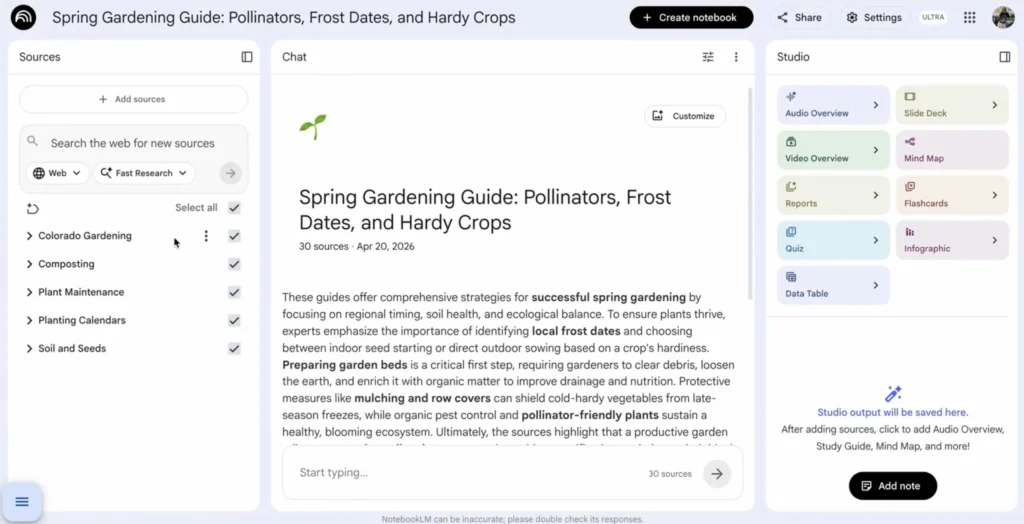
NotebookLM: Automatic organization from 5 sources
Until now, NotebookLM excelled in analysis but struggled with organization. Once a notebook contained more than a few documents, navigation quickly became cumbersome.
With this update, everything changes:
- Starting with 5 sources, the AI automatically analyzes their content
- It groups related documents together
- Then assigns contextual labels to each group
Even better, a single source can receive multiple labels if it covers different topics, providing a more accurate representation of complex research.
More sources, more problems? Not anymore:
Rolling out now, NotebookLM can auto-label & categorize sources (when you have 5+), so you can spend less time scrolling and more time thinking/learning/philosophizing, etc.
Rename, reorganize, & personalize (emojis!) to your ❤️’s content. pic.twitter.com/WiY58zkQJU
— NotebookLM (@NotebookLM) April 24, 2026
Google does not lock the system. Users can rename labels, reorganize them, add emojis, or even completely adjust the categorization. The AI provides suggestions, but the user decides—this balance has become essential in augmented productivity tools.
Streamlined Sharing for Teams
Another discreet yet useful improvement: sharing. Until now, collaborators had to be added one by one. Now, you can paste a complete list of emails, and NotebookLM will automatically identify the recipients.
This is a significant time-saver for teams, students, or collaborative projects.
Another NotebookLM papercut: ✅
Sharing notebooks with multiple people at once just got a whole lot easier. No more adding emails one by one—just copy and paste your list, tap send, and prepare for the world to witness your masterpiece. pic.twitter.com/RyjXtHcqtW
— NotebookLM (@NotebookLM) April 23, 2026
Increasing Integration with Gemini
This evolution is part of a larger trend: NotebookLM is becoming a central building block of the Gemini ecosystem. Notebooks are now integrated within Gemini Notebooks, access is expanded to more users, and Google is already exploring additional enhancements, particularly regarding the organization of generated outputs.
Google Transforms NotebookLM into a True Research OS
With this update, Google addresses a major weak point. NotebookLM is no longer just an intelligent analysis tool; it is beginning to evolve into a genuine knowledge management system.
The direction is clear: less friction, less manual organization, and more automatically generated structure. It’s a subtle yet strategic evolution. In a world where sources are proliferating—articles, PDFs, notes, videos—the value lies not only in understanding but also in the ability to intelligently organize information.
And in this arena, Google is significantly sharpening its advantage.



