

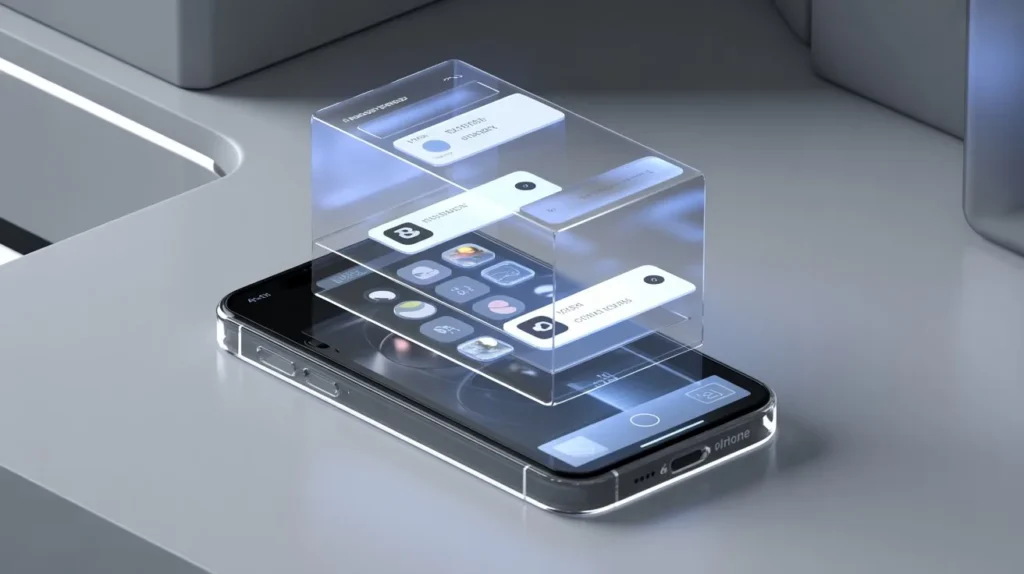
Apple is reportedly working on a holographic iPhone with a 3D spatial display
What if the iPhone of the future didn’t just display content in 2D? According to a new leak from X, Apple is working on a “Spatial iPhone” capable of projecting a true holographic effect without glasses.
This idea might sound like science fiction, but it aligns surprisingly well with Apple’s current trajectory.
Is a Holographic Screen Developed with Samsung?
The rumor comes from a well-known leaker known as “Schrödinger,” who claims that Apple is developing a new screen called MH1, or Mobile Holographic 1. The panel would be produced by Samsung and would rely on a combination of advanced AMOLED, eye tracking, and optical structures capable of directing light with high precision.
The principle discussed involves diffractive beam steering: microstructures embedded in the screen would direct light beams differently based on the user’s eye position. The theoretical outcome: a 3D depth effect visible to the naked eye, without the need for a headset or glasses.
According to the leak, users could even tilt the iPhone to “look around” an object displayed on the screen, showcasing a dynamic pseudo-holographic rendering.
Samsung is reportedly moving its 3D Plate tech to mobile with the MH1 (H1) display. Forget 2D; we’re talking glasses-free holographic depth & spatial AI avatars floating above the glass. More info will be shared on Schrödinger Intel soon… pic.twitter.com/mUysO0Wbv5
— Schrödinger (@phonefuturist) May 6, 2026
A Technology More Credible Than It Appears
On paper, this immediately brings to mind the 3D screens of the Nintendo 3DS. However, Apple aims to avoid the historical drawbacks of those screens: loss of sharpness, limited viewing angles, and visual fatigue.
The leak states that the screen will maintain a traditional 4K resolution for standard uses, while the holographic layer would only activate for compatible content.
Furthermore, Apple is not starting from scratch. The company has been filing patents for holographic interfaces and glasses-free 3D screens for nearly two decades. As early as 2008, the company explored spatial rendering technologies for mobile devices. More recently, iOS 26 introduced “Spatial Scenes,” a 3D parallax system applied to photos on compatible iPhones.
In other words, the concept of a “Spatial iPhone” is not entirely isolated in R&D labs.
Apple is Gradually Pushing Towards Spatial Computing
Since the launch of the Apple Vision Pro, Apple has consistently emphasized a single ambition: making spatial computing the next major interface after smartphones.
John Ternus, Apple’s hardware chief, recently described spatial computing as an “inevitability”. And it is likely in this context that the current rumor holds significance.
Rather than immediately replacing the iPhone with a headset, Apple appears to be looking to gradually incorporate spatial elements into its existing products. This approach aligns with its usual strategy: to evolve usage through seamless steps rather than through abrupt changes.
2030: A Credible Yet Distant Horizon
The leak mentions a preliminary research phase with a potential goal around 2030. This means there are still numerous unknowns: production costs, energy consumption, software compatibility, and actual user relevance. The tech industry has a history filled with “revolutionary” screens that never made it beyond the prototype stage.
However, this time, several factors make the idea more credible than before: advancements in OLED technology, miniaturization of optical systems, experience gained with the Vision Pro, and the potential involvement of Samsung in the panels.
Apple seems set on transforming the smartphone screen into a more immersive, contextual, and lively window. The question remains whether users will actually want a holographic iPhone… or if this vision will remain simply a glimpse into the future.



