

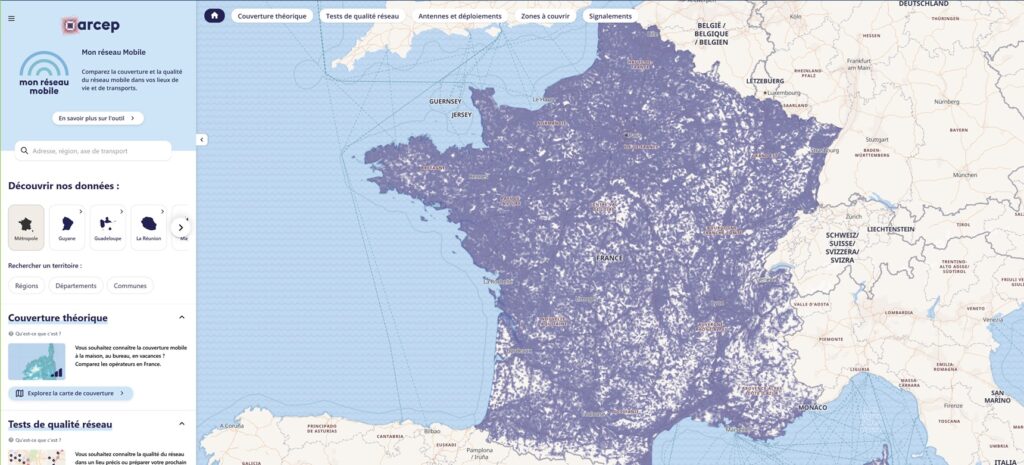
ARCEP’s 2025 Report Highlights the Mobile Service Quality Landscape in France
The French telecommunications authority ARCEP’s annual 2025 campaign on mobile service quality reveals that Orange continues to lead in most performance indicators, while also highlighting significant disparities between urban and rural areas. Although overall performance among operators has improved, the digital divide remains a pressing issue, particularly in mobile internet access and service continuity during travel.
As digital usage intensifies and diversifies, the enhancement of mobile service quality remains a critical focus for telecom providers in France. Every year, ARCEP conducts extensive field measurements to objectively assess the performance of mobile networks across the country. The 2025 results offer a snapshot of the market dynamics, showcasing the competitive standings in voice, SMS, mobile internet, and transport coverage, while pinpointing areas requiring improvement.
Competitive dynamics are now focused on the ability to provide a consistent user experience nationwide, as notable gaps persist between urban centers and rural areas. Businesses, government agencies, and individuals prioritize the reliability and continuity of mobile services, especially amidst the ongoing digital transformation and the rise of collaborative tools.
Orange Retains Leadership in Voice and SMS Services
In the realm of voice and SMS, Orange maintains its national leadership, recording that 91% of calls exhibit perfect quality with 95% free from interruptions. Bouygues Telecom and SFR follow closely, both at 88% and 87%, while Free Mobile lags with an 84% success rate. In densely populated regions, Bouygues Telecom matches Orange’s performance at the forefront, but in rural areas, Orange stands out with 83% of calls rated as perfect, well ahead of SFR (79%), Bouygues Telecom (77%), and Free Mobile (76%).
SMS performance shows a tighter competition, with all operators delivering over 93% of messages in less than ten seconds, reflecting the maturity of their infrastructures but also the ongoing service inequality outside major urban centers.
A new feature for 2025 includes assessing call quality via a second VoIP platform, which measures performance through instant messaging apps. Success rates are lower compared to traditional calls, with Orange (82%) and Free Mobile (80%) leading, followed by Bouygues Telecom and SFR at 77%. This underscores the dependency of these services on network quality and device compatibility.
Evolving Mobile Internet Quality Metrics
Mobile internet quality is now analyzed through various download speed thresholds—including 3, 8, and 30 Mbit/s—reflecting the growing diversity of usage, from browsing to streaming and collaborative tools. Orange excels overall, particularly in rural and mid-tier areas, while Bouygues Telecom shines in denser regions for less demanding thresholds. Upload speeds, crucial for data transmission and artificial intelligence growth, see Orange far ahead in urban areas with 34 Mbit/s and in rural regions with 14 Mbit/s, as competitors remain below 12 Mbit/s in rural settings.
This approach, embraced by ARCEP within a “sustainable digital” framework, aims not just to prioritize maximum speed but to ensure experiences tailored to actual user needs. Despite advancements, coverage and performance in sparsely populated areas continue to demand regulatory attention, as operators strive to bridge the digital divide.
User Experience: Smooth Navigation in Urban Areas, Struggles in Rural Regions
Web browsing and video streaming experience smoothness in densely populated and mid-tier areas, with over 93% of pages loading in under five seconds on networks like Orange and Bouygues Telecom. In rural settings, Orange leads at 79%, followed by SFR (75%), Free Mobile (72%), and Bouygues Telecom (71%). While urban areas enjoy near-constant video streaming flow, disparities widen in less covered regions, highlighting the need for sustained investment beyond major cities.
This scenario exemplifies the challenge of delivering uniform service quality nationwide, despite the widespread implementation of 4G and gradual rollout of 5G. The ability of operators to ensure service continuity is becoming a key differentiator as collaborative applications, video conferences, and real-time tools grow more prevalent.
Transportation: Room for Improvement in Rail Services
Mobile performance on roadways and in urban areas remains robust, with Orange achieving 95% of calls maintained for two minutes, closely followed by Bouygues Telecom and SFR at 94%, and Free Mobile at 92%. However, significant disparities are observed in the rail sector. On high-speed trains (TGV), Orange retains 74% of calls, followed by Free Mobile (61%), Bouygues Telecom (58%), and SFR (56%). In regional trains, the hierarchy stays the same, but Orange’s success rate drops to 63%. For web browsing, Orange leads with 70% of pages loading quickly on TGVs, ahead of Free Mobile and SFR (63%) and Bouygues Telecom (61%).
Public transport in the Île-de-France region (RER, Transilien, metro) sees improved continuity, with Orange and Bouygues Telecom achieving over 85% for quickly loaded pages. In the metro, all four operators are close to high performance standards. However, long-distance rail network service experiences a shortfall, raising concerns about onboard coverage and the need for tailored deployment strategies for the railway sector.
The ARCEP 2025 report confirms the ongoing enhancement of mobile network quality in France while emphasizing the extent of geographical disparities. Orange solidifies its position as a benchmark, although competitors are advancing in specific segments and continue investing in infrastructure. The rise of mobile usage, collaborative work, and artificial intelligence development presents fresh challenges in capacity, latency, and reliability. Future efforts will need to focus on bridging service gaps, adapting networks for new usage patterns, and supporting territorial transitions under a regulatory framework that prioritizes quality of experience over mere technical performance metrics.



